

Received a littering Fixed Penalty Notice? Check the offence, issuing authority, amount and deadline. This guide mainly explains England’s process; Wales, Scotland and Northern Ireland have different rules and penalty levels.
Paid service: This page links to JustAnswer, a paid question-and-answer service. Check its current price, any trial, recurring subscription, renewal and cancellation terms before paying. Advice does not replace your responsibility to meet appeal or court deadlines and cannot guarantee an outcome. MoneyNerd may receive a referral fee.
In this article, we’ll provide clear and simple information on:
- What exactly a littering fine is.
- If you are required to pay these fines.
- How you can make an appeal against a littering fine.
- Tips to avoid getting fined for littering.
- What may happen if you choose not to pay the fine.
We understand that getting a littering fine can be worrying. You may be unsure about the rules, worried about the cost, or confused about the next steps. But you can rest easy now. Our aim is to give you helpful advice and show you options you may not know you have. Let’s walk through this together.
Paid legal information from JustAnswer
JustAnswer is a paid third-party question-and-answer service providing general information. Its standard service does not create a solicitor-client relationship. Membership can renew automatically with recurring charges until cancelled. Check the initial price, renewal price and cancellation terms before signing up. Buying this service does not guarantee a successful challenge. See JustAnswer’s membership and cancellation information.
You can use the official challenge process without buying a paid service. If you choose to use JustAnswer, visit JustAnswer to read its service and payment terms.
Commercial link to JustAnswer. MoneyNerd may receive a referral fee. No successful outcome is guaranteed.
Is dropping litter illegal in the UK?
Littering is an offence. In England, the main provisions are sections 87 and 88 of the Environmental Protection Act 1990. Check the relevant rules elsewhere in the UK rather than assuming England’s penalties apply everywhere.
Litter creates cleaning costs and can harm people, animals and the environment. Enforcement is intended to change behaviour and address offences proportionately.
One way of tackling the problem is by issuing people with a littering fine.
Environmental Impact of littering UK
The effects of littering on the environment UK are consequential.
Public anti-litter campaigns encourage people to use appropriate bins or take their rubbish home.
Discarded packaging, sharp objects and cigarette waste can injure wildlife or contaminate habitats.
Friends of the Earth and the Marine Conservation Society have all voiced their concerns for a long time on how dumping litter impacts the environment, wildlife and marine ecosystems.
What is a littering fine?
UK littering penalties are severe with fines being issued to a person who is alleged to have dropped litter in a public space.
Environmental fixed penalties can cover several different offences. The notice should identify which one is alleged. Examples include:
- Dropping empty wrappers and cartons
- Dropping food waste or chewing gum
- Dog-fouling offences under the applicable local rules, which are distinct from ordinary littering
- Graffiti, which follows separate legislation
- Fly-posting, which also follows separate rules
In England, section 87 of the Environmental Protection Act 1990 concerns throwing down, dropping or otherwise depositing and leaving litter in a place covered by the provision. Private land can be included, but exceptions such as lawful authority or the landowner’s consent can apply.
The location, circumstances and whether litter was left matter. See the government’s enforcement guidance for how authorities should assess an allegation.
Throwing rubbish into bodies of water like rivers, streams, or lakes is also included.
The perpetrator may be given a fine by the police or by the local authorities. However, private citizens may also choose to pursue legal action.
The offence is brought before the magistrates’ court, which has the authority to impose a fine of up to £2,500.
An authority should consider the evidence and its enforcement policy before deciding whether to issue a fixed penalty or prosecute.
It is possible to issue a fixed penalty notice for the offence of littering under Section 88 of the Environmental Protection Act (EPA).
Local authorities have the authority to choose the amount of the fine that will be imposed within their area.
In England, the default statutory littering fixed penalty is £100 where the authority has not specified an amount. Local amounts and discounts can differ within the legal limits.
The offender has fourteen days to make the payment. The failure to pay may result in legal action being taken.
Fixed Penalty Notice for littering
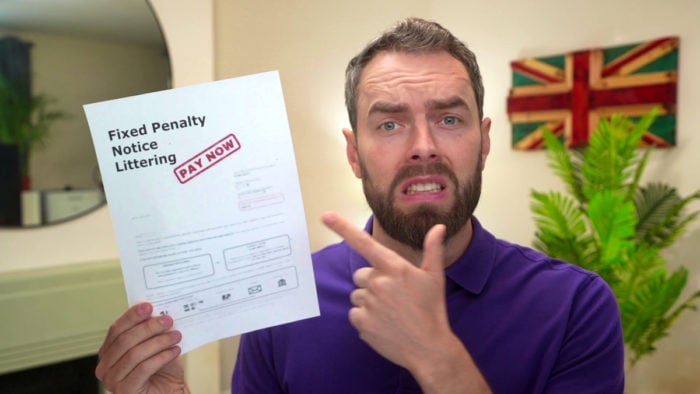
The correct term for a littering fine is a Fixed Penalty Notice (FPN).
You can be issued a Fixed Penalty Notice for littering as well as other offences, such as speeding and other driving offences.
People can be given “on-the-spot fines UK”, or the FPN for littering could be sent to your home address.
Payment is usually required within 14 days, but follow the deadline and any discount terms printed on the notice.
Littering best practices
There are many anti-littering campaigns around the country from cleaning beaches, rivers, parks, towns and rural areas.
Schools and communities are all encouraged to take part in cleaning areas all over the UK.
Waste bins are strategically placed to help you dispose of litter correctly. Recycle sites allow you to dispose of various types of waste safely.
Signs are erected in popular areas that encourage you to take litter home with you.
All of these strategies are in place to protect the environment and wildlife.
Are Fixed Penalty Notices serious?
A Fixed Penalty Notice can become serious if you ignore it.
Who can issue a fixed penalty notice for littering?
You might be wondering who enforces littering laws UK?
Fixed Penalty Notice littering fines are predominantly issued by local councils and national parks, but they can be issued by police officers and community support police officers as well.
Several different types of fines can be issued by the council or a police officer.
You can read about them and find information relevant to your fine on my police and council fines hub.
Check the right challenge process
A Fixed Penalty Notice does not normally use the council parking tribunal process. The notice explains how to dispute the allegation, which may require a court hearing. If convicted, the penalty and costs can be higher than the fixed penalty. Check the process and deadlines before deciding what to do.
General information. The procedure depends on the notice and jurisdiction. Check the issuer’s instructions.
Do I have to give my details to litter enforcement officers?
An authorised officer who is proposing to issue a littering FPN can require your name and address under the relevant power. Ask to see identification if you are unsure who is dealing with you.
Refusing to provide a name and address when lawfully required, or giving false or inaccurate details, can be a separate offence. This is not a general obligation to provide every item of personal information requested.
Give accurate details. If a genuine error appears on the notice, contact the issuing authority promptly and keep a record of your response.
If you persistently refuse to give your details to a council worker, the police might be called and there is a possibility that you will be arrested.
What happens if there are the wrong details on fixed penalty notice for littering?
An error does not automatically cancel the allegation. Check whether it affects identification or another material issue, and ask the issuer to investigate.
If you have received an FPN through the post with the wrong details and you haven’t committed the crime, you should get in touch with your local council straight away.
However, if you did drop litter and have a fixed penalty notice with the wrong details, you should also endeavour to get this straightened out too.
Your FPN for littering should outline how to get in touch.
An authority’s clerical error is not itself proof that you gave false information. Explain any mistake accurately and provide evidence where possible.
Keep copies of the notice and your correspondence. Do not assume that raising an error suspends the payment or court-response deadline.
How much can you be charged for littering?
From 1 September 2026, a principal litter authority in England can set a littering FPN between £65 and £750. This increased the previous £500 maximum. Check the 2026 regulations and the issuer’s published amount.
The amount you’re fined might be determined by the type of littering offence you’re alleged to have committed and the location of the alleged littering.
England’s statutory default is £100 if no local amount has been specified. Different amounts and rules apply elsewhere in the UK.
If prosecuted and convicted of the ordinary littering offence in England, the court can impose a fine of up to £2,500, with possible costs and a surcharge. This is different from the fixed-penalty amount.
Legal information through JustAnswer
JustAnswer is a paid third-party question-and-answer service providing general information. Its standard service does not create a solicitor-client relationship. Membership can renew automatically with recurring charges until cancelled. Check the initial price, renewal price and cancellation terms before signing up. Buying this service does not guarantee a successful challenge. See JustAnswer’s membership and cancellation information.
Historical JustAnswer review image. The displayed rating and review total are not live. Reviews do not predict your case outcome. Membership fees and renewal terms apply.
Can I pick up my litter to avoid a littering fine?
The offence concerns depositing and leaving litter. Government guidance says enforcement should normally require evidence of an intention to drop and leave it, and authorities should consider accidental littering and a prompt response when it is pointed out.
Picking litter up after an offence has been committed does not guarantee cancellation. If it was accidental or you immediately retrieved it, explain the facts and provide evidence rather than assuming either that a fine is inevitable or that it cannot be issued.
Are littering fines legally enforceable?
A littering FPN offers an opportunity to discharge liability for the alleged offence by paying it. It is not itself a court conviction.
In fact, these “fines” are really a conditional offer for you to pay to avoid prosecution in court. If you fail to pay within the 14-day deadline, you may be summoned to court.
What happens if you don’t pay a litter fine?
If you do not pay, the authority may prosecute the underlying littering allegation. Respond to any court documents by their deadline; prosecution is not automatic simply because the payment period has passed.
If the court decides you’re guilty of littering, you can be asked to pay a much bigger fine of up to £2,500.
Although littering fines of this magnitude are reserved for unique cases, you’re still likely to be made to pay more if the case escalates to court.
If you do not pay the fine after it has gone through the courts, the courts can:
- Take the money directly from your wages or benefits.
- Send bailiffs to your address
- Use the applicable court-fine enforcement procedures; a default can have further consequences and should be addressed promptly.
I suggest you try not to let things get this far because it could prove expensive.
Can I avoid paying a littering fine?
The foolproof way to avoid having to pay a littering fine is to not litter in the first place.
If you believe the notice is wrong, act promptly and keep evidence. A request for review may resolve an error, but there is no guaranteed cancellation route.
Some issuing authorities will consider representations or review a notice. Check the process and contact details on your FPN.
This is not the same statutory tribunal appeal process used for council parking PCNs. A complaint or request for review does not automatically extend a payment deadline.
If the matter is prosecuted, the authority must prove the offence. You can defend the allegation and raise any applicable defence. Get advice before choosing to contest it in court.
How do I appeal a Fixed Penalty Notice for littering?
Check whether the issuing authority will review the FPN. Send your reasons and supporting evidence using its stated process, and ask whether the deadline will be held while it considers them.
If a review is unavailable or unsuccessful, disputing liability may require defending a prosecution. Follow any court papers rather than treating the case as an informal appeal.
The usual payment period is 14 days. Read the notice and any written response from the authority to confirm the applicable deadline.
If you do not pay, the authority may decide to prosecute. Non-payment of a littering FPN is not itself the littering offence; the underlying allegation is what the prosecution must prove.
If proceedings are issued, follow the instructions about entering a plea and attending any required hearing.
A guilty finding is a conviction. For the ordinary littering offence in England, the fine can be up to £2,500, with possible costs and a surcharge. Disclosure rules are separate and should be checked where relevant.
What happens if I appeal a littering fine and lose?
If the authority rejects your representations, read its response carefully. Do not assume it automatically gives a new payment deadline or preserves a discount.
If the notice remains unpaid, prosecution may follow. Take advice about the evidence and possible consequences before deciding to defend the allegation.
At a prosecution hearing, the issue is whether the alleged offence is proved and whether a legal defence applies. It is not simply an appeal against the authority’s refusal to cancel the notice.
If convicted, the court determines the sentence under the applicable law. The total may exceed the FPN and include costs and a surcharge; it is not simply an automatic penalty for asking for a review.
Do I have to pay a fine for dropping a cigarette?
Discarding and leaving a cigarette butt can be littering. In England, the relevant littering FPN can be up to £750 under the current statutory limit, with the actual amount set by the authority.
A prosecution concerns the underlying littering offence, not merely failure to pay the FPN. A conviction can result in a court fine and associated costs.
Case study: Littering fine issued by mistake
I’ve included a message posted on a popular forum about a littering fine they received for dropping a cigarette and they don’t even smoke.

Source: Moneysavingexpert
Is dropping a cigarette butt down the drain classed as littering?
Yes. It doesn’t matter where cigarette butts are dropped, cigarette butts not disposed of correctly (in a bin or designated ashtray) are counted as litter.
It will be classed as such when it comes to issuing a Fixed Penalty Notice.
I should also point out that throwing a cigarette out of a vehicle is also a littering offence.
What is the Environmental Protection Act (1990)?
The Environmental Protection Act (1990) is an Act of Parliament to state how the UK should tackle waste management and emissions.
It is the relevant act for littering fines together with UK waste management laws.
Where can I check local litter enforcement information?
Check the issuing authority’s published enforcement policy, fixed-penalty amounts, discount rules and review process.
Enforcement activity varies between authorities. An undated national statistic is not a reliable guide to how your particular notice will be handled.
In England, authorities must consider the statutory litter-enforcement guidance when exercising the relevant powers. They should use enforcement proportionately and consistently.
Penalty limits can change. Use the current legislation and the authority’s published charges, rather than old reports referring to a £150 maximum.
Keep the original notice and any evidence of the incident, payment or correspondence so you can explain your position clearly.
Before using a paid legal information service
JustAnswer is a paid third-party question-and-answer service providing general information. Its standard service does not create a solicitor-client relationship. Membership can renew automatically with recurring charges until cancelled. Check the initial price, renewal price and cancellation terms before signing up. Buying this service does not guarantee a successful challenge. See JustAnswer’s membership and cancellation information.
A paid service is optional. Gather your notice and evidence, check the deadline and decide whether you need professional advice about your circumstances.
Commercial link to JustAnswer. MoneyNerd may receive a referral fee. Check all charges and cancellation terms before signing up.