







Deed and Notice of Debt Assignment: What Is the Difference?








MoneyNerd introduces enquiries to The Debt Advice Service and may receive a referral fee. For free, independent guidance and help finding a debt adviser, visit MoneyHelper.
This information and enquiry service is not a full financial assessment or a guarantee of suitability or debt write-off. Debt solutions are not suitable for everyone. Fees may apply, and your credit record and assets may be affected. Get advice on your circumstances before choosing a solution.
MoneyNerd introduces enquiries to The Debt Advice Service and may receive a referral fee. For free, independent guidance and help finding a debt adviser, visit MoneyHelper.
This information and enquiry service is not a full financial assessment or a guarantee of suitability or debt write-off. Debt solutions are not suitable for everyone. Fees may apply, and your credit record and assets may be affected. Get advice on your circumstances before choosing a solution.
Received a notice saying your debt has been assigned? Check who now owns the account and verify any new payment instructions.
This guide explains the main distinction between a transfer document and the notice sent to the debtor, focusing on England and Wales. Other UK jurisdictions have different assignment rules.
In this article, we’ll explain:
- What a ‘deed of assignment’ is
- What it means for your debts
- Different types of assignment
- Why companies sell their debts
- Ways to handle your debt situation
A sale does not create an extra debt or remove every complaint and defence. Ask for advice if the account or assignment is disputed.
Deed of Assignment of Debt – the basics
Being in debt is confusing enough as it is. And it can get even more complicated when you get a letter through the door from a company you may never have heard of demanding (often in quite a strongly-worded way) that you make your payments to them instead.
What’s going on, you might ask yourself?
At the end of the day, the creditor will want the money that you owe back.
A creditor may transfer an account for commercial reasons. Assignment is not limited to cases where it lacks resources to collect arrears.
What is a Deed of Assignment of Debt?
A deed of assignment is a formal document that can transfer rights between the original creditor and the new owner. It is different from a notice of assignment, which tells the debtor about the transfer.
A valid assignment can change the party entitled to receive payment. Verify the transfer and recipient before changing payment details.
You may receive a notice without a copy of the entire commercial transfer document. The evidence a creditor must provide depends on the issue and any proceedings; the absence of a deed in your letter does not automatically cancel the debt.
Understand your debt options
MoneyNerd can introduce you to The Debt Advice Service for free debt advice. MoneyNerd does not provide debt advice or recommend debt solutions.
The Debt Advice Service can explain your options, including their benefits, costs and risks. Options available depend on your circumstances. There’s no obligation to take a debt solution.
MoneyNerd does not provide debt advice or recommend debt solutions. The Debt Advice Service is a trading style of Pacific Financial Solutions Limited. If you request an introduction, we’ll share your details with their team so they can contact you.
Some debt solutions have fees and may negatively affect your credit rating. MoneyNerd is a commercial introducer and may receive a fee if you go ahead with a debt solution through The Debt Advice Service.
For free, impartial money guidance and help finding free debt advice, visit MoneyHelper.
What does it mean?
A deed of assignment of debt is used to transfer or sell the right to recover a debt.
A deed is not universally required. Section 136 of the Law of Property Act 1925 sets conditions for a legal assignment, including an absolute written assignment by the assignor and express written notice to the debtor.
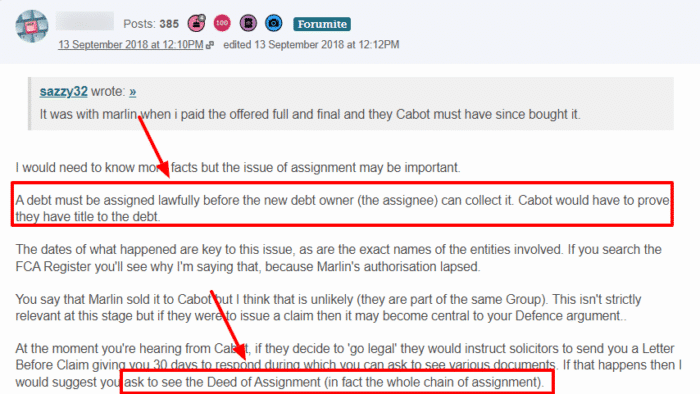
The assignor transfers the rights; the assignee receives them. Do not reverse these roles when checking the paperwork.
Section 136 does not impose a general seven-day deadline for notice. Failure to meet its conditions does not automatically mean the underlying debt is void; an equitable assignment or other issue may need legal assessment.
Is there more than one type of assignment?
Confusingly, there are actually two different sorts of assignment that a creditor can make. These are Legal and Equitable.
A legal assignment meeting section 136 and an equitable assignment are different. The notice, documentation and correct parties to proceedings can affect how the rights are enforced.
1. Legal Assignment
A legal assignee can generally sue in its own name for the assigned right, subject to the debtor’s available defences and the applicable rules.
Basically it means that you make payments to this company instead of the original creditor, and they can send you letters and make calls to your home.
2. Equitable
An equitable assignment may transfer a beneficial interest without meeting every condition for a section 136 legal assignment.
An equitable assignee is not automatically unable to enforce. Court procedure may require the original creditor to be joined or other steps to be taken; get legal advice on an actual claim.
Take the first step towards tackling your debt
Every day, our partner, The Debt Advice Service, helps people understand their options for dealing with debt. Their debt advice is free, with no obligation to proceed.
MoneyNerd introduces you to The Debt Advice Service. We do not provide debt advice or recommend debt solutions.

Natasha
Very helpful and informative thank you

If you submit the enquiry form, MoneyNerd will share your details with The Debt Advice Service so they can contact you.
Some debt solutions have fees and may negatively affect your credit rating. MoneyNerd may receive a fee if you go ahead with a debt solution through The Debt Advice Service.
The Debt Advice Service is a trading style of Pacific Financial Solutions Limited.
For free, impartial help and access to not-for-profit debt advice, visit MoneyHelper.
Why do companies sell their debts?
An assignment transfers rights relating to the existing balance. It does not create another layer of money owed merely because ownership changes.
Many debts can be assigned, subject to the law and agreement. Check any relevant restrictions rather than assuming every contract contains the same clause.
Fresh debtor consent is not universally required for an assignment, but that does not remove the need to comply with the relevant legal conditions.
You can still dispute an incorrect balance, challenge the claimed assignment or complain about relevant conduct. Mental health issues are not the only possible grounds for a complaint; explain any support needs separately.
» TAKE ACTION NOW: Fill out the short debt form
What are the next steps?
So that’s the basics about a Deed of Assignment of Debt. But what does this mean for you?
Check whether the company owns the debt or is merely collecting for the existing creditor.
If the account is reported to credit reference agencies, the entries must accurately reflect the transfer. A sale should not restart an existing default date or misleadingly show two separate debts.
Compare the notice with previous correspondence and ask the original creditor to confirm the new owner through verified contact details.
For regulated consumer-credit debts, firms must consider appropriate forbearance. Where a repayment arrangement is used as forbearance and you meet its terms, interest and charges must be reduced, waived or cancelled as needed so the balance does not grow during the arrangement.
Keep copies of the evidence, raise a genuine dispute promptly and respond to any court papers within their deadlines. An ordinary collector has no bailiff powers merely because it owns the account.