







DCBL Debt Letters: Collection, Enforcement and Your Options








MoneyNerd introduces enquiries to The Debt Advice Service and may receive a referral fee. For free, independent guidance and help finding a debt adviser, visit MoneyHelper.
This information and enquiry service is not a full financial assessment or a guarantee of suitability or debt write-off. Debt solutions are not suitable for everyone. Fees may apply, and your credit record and assets may be affected. Get advice on your circumstances before choosing a solution.
MoneyNerd introduces enquiries to The Debt Advice Service and may receive a referral fee. For free, independent guidance and help finding a debt adviser, visit MoneyHelper.
This information and enquiry service is not a full financial assessment or a guarantee of suitability or debt write-off. Debt solutions are not suitable for everyone. Fees may apply, and your credit record and assets may be affected. Get advice on your circumstances before choosing a solution.
Direct Collection Bailiffs Ltd (DCBL) carries out debt collection and enforcement work. The powers available depend on the role it is acting in and the legal stage of your case, not simply the word “bailiffs” in its name.
We understand your pain points. Being contacted by a bailiff company can be scary, but we’re here to help. We offer expert advice on:
- How to check if the debt is yours.
- What to do if you get a Notice of Enforcement.
- What happens if Direct Collection Bailiffs LTD claim a parking charge.
- How to protect your credit score.
- Possible ways to write off your debt.
Check the creditor, account reference and the type of document you have received. This guide focuses on England and Wales; other UK jurisdictions have different enforcement procedures.
In this article, we will explain everything you need to know about Direct Collection Bailiffs LTD. We’ll answer your questions and provide the solutions you need to feel more confident. Remember, you’re not alone in this struggle.
Let’s face your fears together.
Do I have to pay them?
If DCBL is enforcing a judgment or other lawful authority, check the notice, balance and available court options promptly. Payment, an agreed arrangement, a stay or a successful challenge may affect enforcement. Do not assume the only option is immediate payment or that an ordinary collection letter authorises seizure.
Before enforcement, DCBL may send collection reminders about an unpaid account. A reminder is not automatically a formal Letter of Claim, and neither is a court judgment. Identify the document and follow its applicable response deadline.
Liability arises from the agreement or law, not only when a collector answers a proof request. Verify an unfamiliar demand and raise any genuine dispute. A proof request does not itself cancel the debt or suspend court or enforcement deadlines.
If you cannot afford payment in full, provide an income-and-expenditure budget and propose affordable instalments. The company does not have to accept every offer. Ask for written confirmation of any agreement and whether enforcement is paused; merely making an offer does not stop action or fees.
Sending a prove the debt letter
Ask for evidence relevant to the account: the creditor, balance, basis of liability and authority to collect. A private parking charge does not normally depend on a handwritten contract. A formal Letter of Claim under the England and Wales Debt Claims Protocol normally gives an individual 30 days to respond; use its Reply Form and request necessary documents. See prove it letter template.
For a relevant regulated consumer-credit dispute, FCA rules require investigation and a pause in recovery on valid or potentially valid grounds. Those rules do not apply identically to every parking or enforcement matter. If court papers arrive, file the required response in time; a previous proof request is not a court defence.
From my experience, too many people skip the verification of debt in the UK. Not asking for proof might mean that you pay for a debt that you didn’t have to!
Understand your debt options
MoneyNerd can introduce you to The Debt Advice Service for free debt advice. MoneyNerd does not provide debt advice or recommend debt solutions.
The Debt Advice Service can explain your options, including their benefits, costs and risks. Options available depend on your circumstances. There’s no obligation to take a debt solution.
MoneyNerd does not provide debt advice or recommend debt solutions. The Debt Advice Service is a trading style of Pacific Financial Solutions Limited. If you request an introduction, we’ll share your details with their team so they can contact you.
Some debt solutions have fees and may negatively affect your credit rating. MoneyNerd is a commercial introducer and may receive a fee if you go ahead with a debt solution through The Debt Advice Service.
For free, impartial money guidance and help finding free debt advice, visit MoneyHelper.
Can I ignore it?
You should never ignore a letter from Direct Collection bailiffs Ltd. You might read some advice online telling you it’s okay to ignore their letters, but there is better and less risky action you can take.
The risks of ignoring debt letters outweigh any possible benefits.
Distinguish an ordinary debt reminder, formal Letter of Claim, court claim and Notice of Enforcement. They have different legal effects and deadlines.
» TAKE ACTION NOW: Fill out the short debt form
Parking charge
DCBL collects unpaid private Parking Charge Notices for parking operators. These are contractual claims, not council Penalty Charge Notices or criminal fines.
In its ordinary collection role, DCBL can request payment but cannot seize goods. The creditor or its legal representative may bring a claim. Any later enforcement of a judgment requires the appropriate legal authority.
The company name alone does not establish whether a parking demand is valid. Check the operator, location, date, vehicle and stated basis of liability.
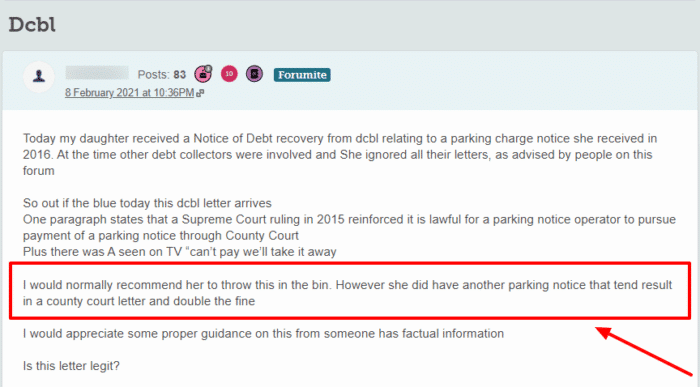
Throwing debt collector letters in the bin in this type of situation is not a good idea, as ignoring them might make your things much worse.
Request relevant evidence and consider any available appeal or defence, rather than assuming a request guarantees cancellation. Do not identify someone as the driver inaccurately or miss court deadlines while awaiting a reply.
Can I get a debt solution?
If you are struggling to pay your debts – or know that you wont’ be able to afford to pay much to Direct Collection Bailiffs – you might benefit from a debt solution.
There are several different debt solutions available in the UK, so I recommend speaking to a debt charity as soon as possible. Their advisors will be able to look at your finances in detail, help you work out which debt solution will work best for you, and offer you financial advice for debt.
Take the first step towards tackling your debt
Every day, our partner, The Debt Advice Service, helps people understand their options for dealing with debt. Their debt advice is free, with no obligation to proceed.
MoneyNerd introduces you to The Debt Advice Service. We do not provide debt advice or recommend debt solutions.

Natasha
Very helpful and informative thank you

If you submit the enquiry form, MoneyNerd will share your details with The Debt Advice Service so they can contact you.
Some debt solutions have fees and may negatively affect your credit rating. MoneyNerd may receive a fee if you go ahead with a debt solution through The Debt Advice Service.
The Debt Advice Service is a trading style of Pacific Financial Solutions Limited.
For free, impartial help and access to not-for-profit debt advice, visit MoneyHelper.
I have linked a few charities that offer these advisory services for free below.
Debt Management Plan (DMP)
A Debt Management Plan can organise affordable payments towards suitable unsecured debts, but is informal and does not automatically stop interest, court action or bailiff enforcement. Priority debts need separate attention.
Because it is informal, it is not legally binding so you are not tied into a DMP for a minimum number of payments.
Individual Voluntary Arrangement (IVA)
An IVA is a formal insolvency arrangement managed by an insolvency practitioner. Your proposal sets out payments, any assets involved and fees. Once approved, it binds the creditors and debts covered by it and restricts recovery action; it is not a blanket ban on necessary correspondence.
Many IVAs involve payments for five or six years, but the agreed term varies. Qualifying unpaid debt is normally released only on successful completion. An IVA affects your credit record, may involve assets or home equity, and can fail if its terms are not met.
IVA suitability depends on your debts, affordable contributions or available assets, fees and creditor approval. There is no universal rule that you must owe several thousand pounds to more than one creditor. Get independent debt advice and compare other options before agreeing to an IVA.
Trust Deed
IVAs are not available in Scotland. A Scottish money adviser can compare a protected trust deed, the Debt Arrangement Scheme, sequestration and informal arrangements; a trust deed is not compulsory.
A protected trust deed is a Scottish insolvency arrangement, usually lasting at least four years of contributions. It can discharge qualifying unpaid debt on successful completion, but fees apply and your home or other assets may be at risk. Covered creditors cannot pursue payment outside it, but can still send required documents.
Debt Relief Order (DRO)
In England and Wales, a DRO may suit an eligible non-homeowner with low surplus income, limited assets and qualifying debts within the £50,000 limit. Detailed income, asset, vehicle and residence rules apply. An approved debt adviser checks eligibility and submits the application to the Insolvency Service.
During the usual 12-month DRO period, recovery of listed qualifying debts is restricted and you generally do not pay those debts. Ongoing bills and excluded debts still need attention. Creditors may send statements and other permitted correspondence.
A DRO normally lasts 12 months. If it remains in force, the qualifying debts listed in it are normally discharged at the end. You must report relevant changes and continue paying ongoing bills and excluded debts, such as court fines and student loans.
Bankruptcy
If you have debts but no realistic possibility of ever paying them off, you may need to declare bankruptcy.
Bankruptcy has an unfair stigma attached to it as it may be your only way of getting a financial fresh start. That said, it is a serious financial situation that should not be taken lightly.
Sequestration
Sequestration is the Scottish version of bankruptcy.
Scotland’s Minimal Asset Process is a form of bankruptcy for people meeting specific debt, income and asset conditions. It has consequences for credit and finances and should be assessed with an approved money adviser. See Minimal Asset Process guide.
How do I complain?
Complain about inaccurate information, unreasonable conduct, charges or support needs through DCBL’s complaints procedure. The appropriate external route depends on whether it was collecting a debt or carrying out enforcement. See FCA handbook information.
FCA consumer-credit rules apply only to relevant regulated activity. They are not the general framework for every private parking charge or bailiff act.
Make your first complaint to DCBL so that they have the chance to sort out the issue themselves. You will need to follow the DCBL customer complaints process.
If you feel that they have not taken your complaint seriously enough or have not addressed your issue properly, you can escalate matters.
DCBL’s current complaints procedure directs eligible High Court enforcement complaints to the Enforcement Conduct Board. Other collection or parking complaints can have different routes. A complaint about conduct does not replace a parking appeal, defence, set-aside application or request to stay enforcement.
An ordinary collector must not claim bailiff powers. An enforcement agent must act within the actual authority, entry and goods rules. The table below explains the distinction.
| Bailiffs may | Important limits |
|---|---|
| Visit under a valid enforcement power | Normally at least 14 clear days’ notice is required before taking control of goods; courts can shorten notice. An eligible debt-advice request can extend it to 28 clear days. |
| Take non-exempt goods belonging to the debtor | They cannot take ordinary essential household items or someone else’s property. Some jointly owned goods may be affected. |
| Take a vehicle where legally permitted | Ownership, finance, disability and other exemptions must be checked. ANPR does not remove those limits. |
| Enter through a door when lawful | For ordinary civil debts they usually cannot force first entry to a home. A CCJ by itself is not a power to break in. |
| Enter into a controlled goods agreement | Ask for a clear inventory and terms; breaking an agreement can have serious consequences. |
| Sell goods under the enforcement rules | Notice and sale requirements apply. Get advice if you dispute ownership, exemption, entry or fees. |
England and Wales only. Tools and equipment needed personally for work, study or education have a combined exemption limit of £1,350. The rules differ elsewhere in the UK.
Direct Collection Bailiffs Ltd Contact Details
| Website: | https://dcbltd.com/ |
| Phone number for complaints | 0203 434 0432. |
| Email address for complaints: | [email protected] |
| London regional office | Solar House, 915 High Road, North Finchley, London, N12 8QJ. Telephone: 0203 298 0201. |
| North West regional office | Direct House, Greenwood Drive, Manor Park, Runcorn, Cheshire, WA7 1UG. Telephone: 01606 608 4222. |
| Midlands regional office | Colmore Plaza, 20 Colmore Circus, Queensway, Birmingham, B4 6AT. Telephone: 0121 514 3115. |
| Scotland regional office | 8 Deer Park, Fairways Business Park, Livingston, EH54 8GA. Telephone: 0141 413 8387. Office location does not make England and Wales bailiff powers apply in Scotland. |
| Wales regional office | Sophia House, 28 Cathedral Road, Cardiff, CF11 9LJ. Telephone: 0292 235 0831. Check the official contact page for the correct team for your case. |
The Breathing Space Scheme
In England and Wales, an eligible debt adviser can assess whether the statutory Breathing Space scheme is suitable. Merely asking DCBL for time is not the same as entering the scheme. See related guidance.
A standard Breathing Space normally lasts up to 60 days and restricts most enforcement, contact, interest and charges on qualifying debts. It is not a debt write-off or a general payment holiday; ongoing liabilities and conditions remain.
The scheme has two routes, with eligibility and evidence requirements:
- Standard Breathing Space: an authorised debt adviser must assess eligibility and suitability; it is not automatically available to everyone with debt.
Mental health crisis Breathing Space: for eligible people receiving qualifying crisis treatment, with the required evidence. Protection normally continues for the treatment period plus 30 days.
References






