












Hiding money can undermine a divorce settlement and lead to serious consequences. This guide explains financial disclosure and lawful ways to address concerns about assets in England and Wales.
So, you're not alone.
In this article, we’ll explore:
- The need to declare assets in a divorce
- How you can protect your money during a divorce
- The penalties for hiding assets in a divorce
We’ve got a team with firsthand experience of divorce; they understand how tough it is to face these financial fears.
Get independent family-law advice about your circumstances, especially if assets may be moved or financial disclosure is incomplete.
How to save money on divorce fees
How to save money on divorce fees
Divorces are hard to handle, but the financial repercussions can make a bad situation feel even worse.
The solution? Understanding your next steps and exactly how much they’ll cost.
For only £5, JustAnswer offers a trial chat with an experienced divorce solicitor. They can help you navigate the process and save you from costly face-to-face lawyer fees.
Chat below to get started with JustAnswer

Do you have to declare assets in a divorce?
In England and Wales, both people must give full and frank financial disclosure when resolving financial claims. This includes assets, debts, income and relevant interests, whether held jointly or separately. Disclosure should come before a binding settlement and must be kept up to date during proceedings.
Both parties must declare the following:
- Joint assets
- Sole assets
Deliberate concealment may lead to adverse findings, costs orders or a settlement being reopened. False statements or breaches of court orders can have further consequences, but a fine or criminal penalty is not automatic.
The court’s response depends on the evidence and its legal powers. It does not simply award a fixed extra share whenever an asset is disputed.
What’s the penalty for hiding money in divorce proceedings?
Possible consequences depend on the conduct, statements made and orders breached. Obtain advice about disclosure duties and any suspected concealment.
A family court could:
- Reduce your share of the matrimonial pot
- Get you to pay your spouse’s legal costs
» TAKE ACTION NOW: Get legal support from JustAnswer
How can I protect my money during a divorce?
I recommend you seek advice from a family law solicitor if you’re worried your spouse will raid and empty joint accounts. A solicitor will help you with divorce financial planning and make the court aware of the situation.
Where the legal tests are met, a solicitor may seek an urgent injunction or another order to prevent disposal of assets. Such orders are not granted automatically.
Do you need a financial consent order?
If you reach a financial agreement, consider having it recorded in a court-approved consent order. A private agreement or the final divorce order alone may not dismiss financial claims.
A court-approved consent order can make an agreed financial settlement binding in England and Wales. It does not automatically cut every financial tie: a clean break requires the appropriate dismissal of claims, and maintenance or other obligations may continue.
Is a consent order mandatory in divorce proceedings?
A consent order is not a prerequisite for the divorce itself. It is one way to make an agreed financial settlement binding; if agreement is impossible, the court can decide a financial application.
Worried About Divorce Finances?

Divorce can be complicated, especially when it comes to navigating the cost. One small error could lead to serious consequences.
But, the support of a good solicitor can help you to understand your next steps.
For a £5 trial, JustAnswer’s online divorce solicitors can help you understand your rights and guide you towards the best financial solution for you.
In partnership with Just Answer.
Inheritance and divorce UK
Inheritance can be relevant to a later financial claim, but it is not automatically shared. The existing orders, timing, needs and circumstances matter.
If financial claims have not been properly dismissed, a later application may be possible. Delay, remarriage and the nature of the claim can affect the position; obtain advice.
Mediation services and divorce
Mediation can help where safe and suitable, but it is not appropriate for every situation. A mediation information and assessment meeting may be required before certain court applications unless an exemption applies. See related guidance.
Join thousands of others who got legal help for a £5 trial
Getting the support of a Solicitor can take a huge weight off your mind.

Reviews shown are for JustAnswer.
How long does it take to get a divorce consent order?
Processing times vary with the court, paperwork and any questions the judge raises. Do not rely on a fixed six-to-ten-week promise.
Could a judge reject a consent order?
The court reviews the proposed order and financial information. It may ask questions, request changes or decline to approve the proposal; fairness does not necessarily mean equal shares.
A financial consent order normally takes effect only after the final divorce order or decree absolute. Ask a family law solicitor about the timing and effect of each provision before completing payments, property transfers or pension arrangements.
Can I challenge a consent order?
Depending on the issue, the appropriate route may be an appeal, an application to set aside, variation of a variable provision or enforcement. Grounds and deadlines differ, so seek legal advice promptly. See related guidance.
How long does a financial consent order last?
The effect and duration depend on the provisions. Capital orders are generally final subject to limited challenge routes, while some maintenance provisions can be varied or end on specified events.
Child maintenance and divorce
A court order for child maintenance does not automatically expire after a year. Once it has been in force for a year, either parent can usually apply to the CMS if it has jurisdiction; an effective CMS calculation can replace the relevant court-maintenance provision. Different rules apply to some kinds of court maintenance.
The CMS uses statutory income and family-circumstance rules. Collection and enforcement depend on the arrangement and case; payment is not guaranteed. See related guidance.
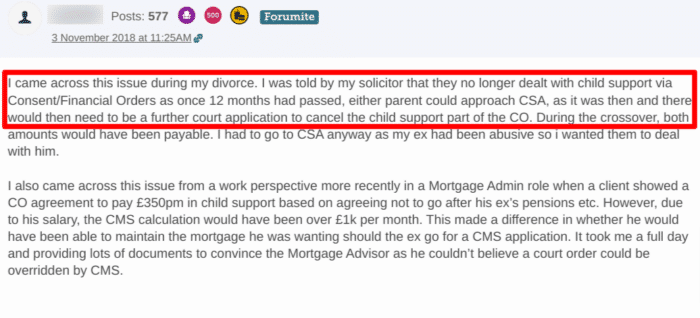
As you can see, this MoneySavingExpert forum user spoke to their solicitor and received confirmation that they could approach the CSA, the Child Support Agency (which was replaced by the CMS in 2012), for help with Child Maintenance.
Divorce Doesn’t Mean Financial Ruin

Legal advice can make all the difference when navigating the financial aspects of divorce, and affordable help is within reach.
Normally, the cheapest solicitors in the UK will put you back at least £130 per hour.
But, for a £5 trial, a divorce solicitor from JustAnswer can review your situation and provide personalised guidance. It’s a no-brainer!
Try it below.
In partnership with Just Answer.