Can Bailiffs Force Entry for Council Tax Debt?


MoneyNerd introduces enquiries to The Debt Advice Service and may receive a referral fee. For free, independent guidance and help finding a debt adviser, visit MoneyHelper.
This information and enquiry service is not a full financial assessment or a guarantee of suitability or debt write-off. Debt solutions are not suitable for everyone. Fees may apply, and your credit record and assets may be affected. Get advice on your circumstances before choosing a solution.
MoneyNerd introduces enquiries to The Debt Advice Service and may receive a referral fee. For free, independent guidance and help finding a debt adviser, visit MoneyHelper.
This information and enquiry service is not a full financial assessment or a guarantee of suitability or debt write-off. Debt solutions are not suitable for everyone. Fees may apply, and your credit record and assets may be affected. Get advice on your circumstances before choosing a solution.
For council tax enforcement in England and Wales, a liability order does not authorise forced initial entry into your home. This guide explains entry rules, fees and how to get help.
In this friendly guide, we will explain:
- What happens when you can’t pay your council tax.
- How to deal with council tax debt.
- What bailiffs can and can’t do.
- How to keep safe if bailiffs come to your home.
- And where to find more help if you need it.
We know it’s tough when you can’t pay your bills. But remember, you are not alone. There are ways to solve your problems and people who want to help.
Let’s get started and find some answers to your worries about council tax debt.
Can They Force Their Way into My Home?
» TAKE ACTION NOW: Fill out the short debt form
What Can They Take for Arrears?
There are strict rules on what bailiffs can’t remove from your property. These items include:
- Goods owned solely by someone else cannot be taken for your debt. Jointly owned goods can be affected, with protection for the other owner’s share; provide evidence and obtain prompt advice if ownership is disputed.
- Pets or service animals
- Vehicles, tools, or equipment that you need for your job or to study up to £1,350
- A vehicle displaying a valid Blue Badge because it is used to transport a disabled person, and goods needed to care for a disabled or seriously ill person.
- Anything permanently fitted to your home – kitchen units, etc.
Bailiffs also can’t take things that you need to live. These items can be anything that you use for your ‘basic domestic needs.’ They can take some of these things, but must leave you with:
- A table with enough chairs for everyone in your home
- Beds and bedding for everyone in your home
- A phone or mobile phone
- Any medicine or medical equipment that you need to care for someone
- A washing machine
- A cooker or microwave, and a fridge.
If you think that a bailiff has taken something that they shouldn’t, you need to complain immediately. I go through the complaints process below.
You can also contact a debt charity for some advice. I have listed several charities that offer free advice at the bottom of this page.
Understand your debt options
MoneyNerd can introduce you to The Debt Advice Service for free debt advice. MoneyNerd does not provide debt advice or recommend debt solutions.
The Debt Advice Service can explain your options, including their benefits, costs and risks. Options available depend on your circumstances. There’s no obligation to take a debt solution.
MoneyNerd does not provide debt advice or recommend debt solutions. The Debt Advice Service is a trading style of Pacific Financial Solutions Limited. If you request an introduction, we’ll share your details with their team so they can contact you.
Some debt solutions have fees and may negatively affect your credit rating. MoneyNerd is a commercial introducer and may receive a fee if you go ahead with a debt solution through The Debt Advice Service.
For free, impartial money guidance and help finding free debt advice, visit MoneyHelper.
Will They Charge Me Fees?
Yes, a bailiff will charge fees. This will be added to the total value of your debt.
For relevant non-High Court enforcement under the rules effective from 1 May 2026, the compliance fee is £79, the enforcement fee is £247, and the sale or disposal fee is £116. The latter two stages each add 7.5% of the debt above £1,900. Earlier enforcement action has transitional protection. These are not the fee rules for court-employed County Court bailiffs.
The percentage fee is calculated on the portion of the debt above the relevant threshold, not on the entire debt. It is a fee, not interest.
For example, a £2,500 debt reaching the non-High Court enforcement stage under the current rules incurs the following stage fees, excluding any later sale or permitted additional costs:
- £79 compliance fee.
- £247 enforcement fee.
- £45 percentage fee: 7.5% of £600, the part of £2,500 above £1,900.
Total stage fees: £371, in addition to the £2,500 debt. This example assumes only compliance and enforcement have begun under the current non-High Court rules.
Can They Enter Without My Permission Through an Open Door?
Take the first step towards tackling your debt
Every day, our partner, The Debt Advice Service, helps people understand their options for dealing with debt. Their debt advice is free, with no obligation to proceed.
MoneyNerd introduces you to The Debt Advice Service. We do not provide debt advice or recommend debt solutions.

Natasha
Very helpful and informative thank you

If you submit the enquiry form, MoneyNerd will share your details with The Debt Advice Service so they can contact you.
Some debt solutions have fees and may negatively affect your credit rating. MoneyNerd may receive a fee if you go ahead with a debt solution through The Debt Advice Service.
The Debt Advice Service is a trading style of Pacific Financial Solutions Limited.
For free, impartial help and access to not-for-profit debt advice, visit MoneyHelper.
What if I am a Vulnerable Person?
If you have received a Notice of Enforcement but think that you or whoever owes the debt is vulnerable, you should get some advice from a debt charity as soon as possible.
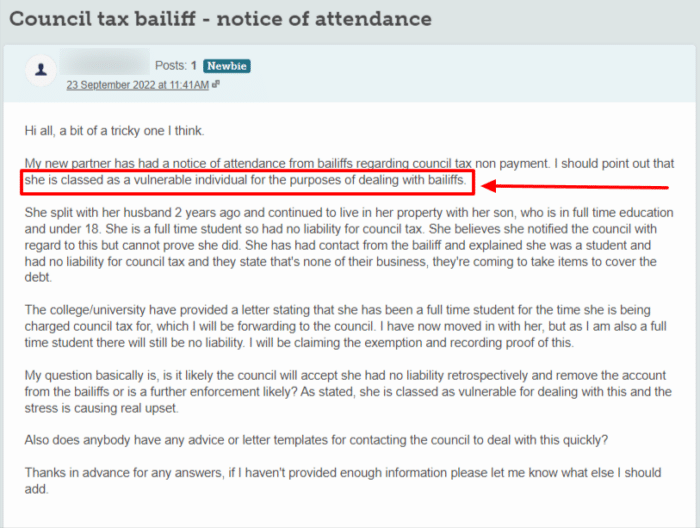
Circumstances that may make someone vulnerable include:
- Are disabled in any way or extremely ill
- Suffer from any kind of mental illness
- Have children or are pregnant
- Age-related difficulties that affect the person’s ability to deal with enforcement; there is no automatic over-65 exemption.
- Are dealing with a stressful situation such as the death of a loved one or unemployment
- Don’t speak English very well
Vulnerability depends on the person’s circumstances and how enforcement affects them. Tell the enforcement company and creditor about your needs, provide relevant evidence if available, and ask for suitable adjustments. A diagnosis or membership of a particular group does not automatically cancel the debt, stop all visits or remove all fees.
Ask for a hold and suitable adjustments. Separately, under the rules effective from 1 May 2026 a qualifying debt advice provider can request that the notice period be extended to at least 28 clear days before the original deadline, except for excluded business debt. If notice is defective, get advice rather than assuming enforcement has stopped.
If you fall into any of the above categories, you need to either tell the bailiffs yourself or get a relative or carer to do it for you. You can then contact them by phone or by post. I have a free letter template that you can use to explain your situation.
When you speak to the bailiffs, you need to:
- Tell them that you’re vulnerable
- Explain why you would find dealing with bailiffs more difficult than other people in the same situation
- Ask for visits to be paused or another suitable adjustment, explaining the effect a visit would have; obtain written confirmation of what is agreed.
- Tell them if a letter or a visit could make your situation worse – this could be the case if you have a mental health problem or a heart condition, for example.
Make a note of what you agree with the bailiffs about future contact. This will make it easier to argue with them if they don’t stick to this new agreement, or if you need to make a complaint.
What Happens If I don’t have any Goods that They can Take?
How do I Complain?
You can complain about threats, unlawful charges, taking protected goods or failure to consider vulnerability. The FCA is not the general regulator of bailiff enforcement. See related guidance.
Complain to the enforcement company and the creditor, identifying the conduct or charge you dispute. For a County Court bailiff employed by HMCTS, complain to the court. A complaint does not itself suspend enforcement or extend a court deadline. In a council tax case, also complain to the council.
The Financial Ombudsman Service is not a general appeal body for bailiff enforcement and does not fine bailiffs. The correct escalation route depends on the agent and creditor: it may involve an eligible enforcement complaints scheme, a council ombudsman complaint or an application to court. Obtain advice on the route and any deadline. See related guidance.
CIVEA means the Civil Enforcement Association. Check the current complaints arrangements for the firm and any applicable independent scheme; membership and eligibility matter. Court complaints about certification are a separate process and can carry costs risks. See related guidance, related guidance, related guidance.
References