Tell a Bailiff That You Are Vulnerable – Letter Template


MoneyNerd introduces enquiries to The Debt Advice Service and may receive a referral fee. For free, independent guidance and help finding a debt adviser, visit MoneyHelper.
This information and enquiry service is not a full financial assessment or a guarantee of suitability or debt write-off. Debt solutions are not suitable for everyone. Fees may apply, and your credit record and assets may be affected. Get advice on your circumstances before choosing a solution.
MoneyNerd introduces enquiries to The Debt Advice Service and may receive a referral fee. For free, independent guidance and help finding a debt adviser, visit MoneyHelper.
This information and enquiry service is not a full financial assessment or a guarantee of suitability or debt write-off. Debt solutions are not suitable for everyone. Fees may apply, and your credit record and assets may be affected. Get advice on your circumstances before choosing a solution.
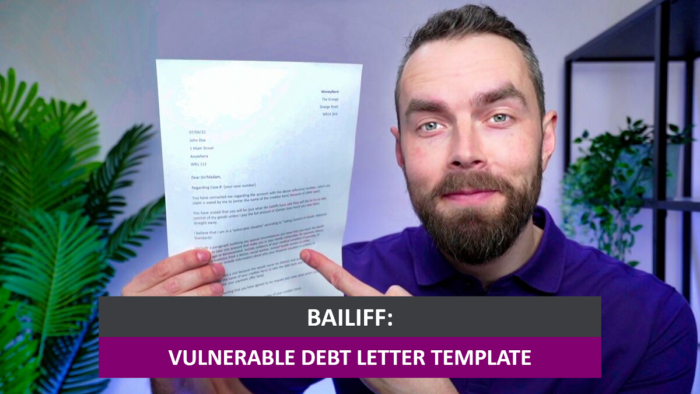
Use this letter template to tell an enforcement company and creditor about circumstances that make you vulnerable. This guide concerns taking control of goods in England and Wales.
Debt problems can be hard, but you don’t have to face them alone. We will help you write a letter to tell the bailiff about your situation.
In this article, you’ll find:
- A clear guide to bailiff rules for vulnerable persons.
- Ways to show you are vulnerable to a bailiff.
- What comes next after you tell a bailiff you are vulnerable.
- Actions to take if a bailiff does not believe you are vulnerable.
- Tips for legally writing off debt.
We have also included a free letter template. It is easy to use and will help you tell a bailiff about your situation.
Ready to take control of your money worries? Let’s dive in!
Downloadable Resource
The download links below take you to a Google document template where you can make a copy or save in any document format you like. Note, you may have to login to your Google account.
Download – Single (for one person)
Download – Joint (for couples)
What are the rules for bailiffs and vulnerable people?
Vulnerability depends on the person’s circumstances and how enforcement affects them. Tell the enforcement company and creditor about your needs, provide relevant evidence if available, and ask for suitable adjustments. A diagnosis or membership of a particular group does not automatically cancel the debt, stop all visits or remove all fees. Relevant protections include:
- Agents must not enter, re-enter, remain in premises or take control of goods where the only people present are children under 16 or vulnerable people, including a combination of them. This is different from a blanket ban on visiting anyone who lives alone.
- Consider appropriate adjustments and whether the creditor should take control of the case.
- Observe the applicable requirement to allow an adequate opportunity to obtain assistance and advice before removing controlled goods.
Under regulation 12 of the Taking Control of Goods (Fees) Regulations 2014, enforcement-stage fees and related disbursements are not recoverable from a vulnerable debtor unless they have been given an adequate opportunity to obtain assistance and advice before controlled goods are removed. This is a conditional protection, not a blanket fee exemption.
How the introduction works
The Debt Advice Service can discuss your circumstances and explain available options, including their benefits, costs and risks.
Options depend on your circumstances. You decide whether to proceed.
Advertisement. MoneyNerd introduces enquiries; we do not give debt advice or recommend solutions. The Debt Advice Service, a trading style of Pacific Financial Solutions Limited, offers free debt advice with no obligation. Complete the enquiry form to share your details and request a call.
Some debt solutions have fees and may negatively affect your credit rating. MoneyNerd may receive a fee if you go ahead with a debt solution through The Debt Advice Service. For free, impartial guidance and help finding free debt advice, visit MoneyHelper.
What is classed as vulnerable to bailiffs?
Pregnancy, disability, serious illness, bereavement, single-parent responsibilities, unemployment, age or language difficulties can contribute to vulnerability. Each situation should be assessed individually rather than treated as an automatic exemption.
You might be able to claim that you are vulnerable temporarily. Examples would include a recent death in the family that has affected you, a traumatic experience, a victim of a crime or recently becoming unemployed.
How to prove you are vulnerable to bailiffs?
Explain your circumstances and the support or adjustments you need. Relevant evidence, such as a medical letter or evidence of a recent change in circumstances, can help; discuss what evidence is reasonable and available rather than assuming one particular document is mandatory.
About The Debt Advice Service
Use the enquiry form to request a call about your circumstances and available options. You decide whether to proceed.

Advertisement. MoneyNerd introduces enquiries; we do not give debt advice or recommend solutions. The Debt Advice Service, a trading style of Pacific Financial Solutions Limited, offers free debt advice with no obligation. Complete the enquiry form to share your details and request a call.
Some debt solutions have fees and may negatively affect your credit rating. MoneyNerd may receive a fee if you go ahead with a debt solution through The Debt Advice Service. For free, impartial guidance and help finding free debt advice, visit MoneyHelper.
What happens after you have been declared vulnerable?
The Ministry of Justice’s national standards say creditors should be prepared to take control of a case where necessary when vulnerability is identified. They do not require every case involving a vulnerable person to be returned automatically.
Ask for written confirmation of any hold, adjustment or return to the creditor. Keep dealing with court deadlines and seek free debt advice; sending a vulnerability letter does not itself suspend enforcement.
What if they don’t believe me?
If a bailiff does not accept that you are a vulnerable person, you should write a second letter of complaint. It is also wise to speak with Citizens Advice who may speak with the bailiff on your behalf and get them to agree.