







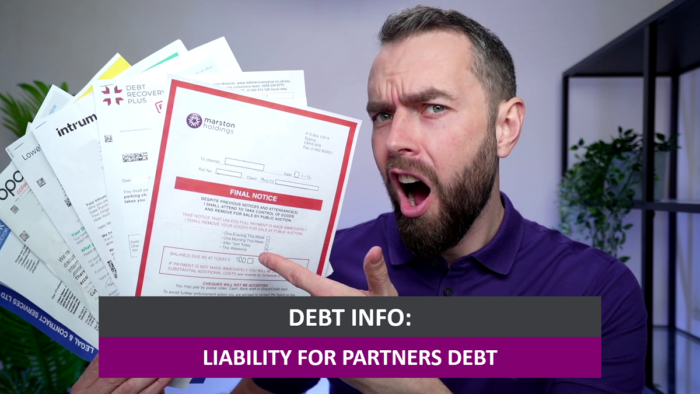
Am I liable for my partner’s debts? Joint and individual liability








MoneyNerd introduces enquiries to The Debt Advice Service and may receive a referral fee. For free, independent guidance and help finding a debt adviser, visit MoneyHelper.
This information and enquiry service is not a full financial assessment or a guarantee of suitability or debt write-off. Debt solutions are not suitable for everyone. Fees may apply, and your credit record and assets may be affected. Get advice on your circumstances before choosing a solution.
MoneyNerd introduces enquiries to The Debt Advice Service and may receive a referral fee. For free, independent guidance and help finding a debt adviser, visit MoneyHelper.
This information and enquiry service is not a full financial assessment or a guarantee of suitability or debt write-off. Debt solutions are not suitable for everyone. Fees may apply, and your credit record and assets may be affected. Get advice on your circumstances before choosing a solution.
You do not normally become liable for someone’s individual borrowing simply because you live together, marry or enter a civil partnership. Liability can arise from a joint agreement, guarantee or the legal rules for a particular household bill.
What if we have a joint loan or overdraft?
Joint borrowing is commonly subject to joint and several liability. This means the lender can seek the whole outstanding amount from either borrower, not just half each. It does not matter who spent the money. The lender cannot recover more than the total due.
You can apply for a joint product from the outset where a provider offers one. There is no general rule that one partner must first borrow alone and later add a co-signer. Approval depends on the lender’s checks on the applicants and affordability.
Are credit cards joint debts?
UK credit cards are generally held by one main account holder. An additional cardholder is not normally liable to the card company for repayment, while the main holder is responsible for spending on the account. This differs from a joint loan or overdraft. Check the agreement. See MoneyHelper’s joint-debt guide.
Understand your debt options
MoneyNerd can introduce you to The Debt Advice Service for free debt advice. MoneyNerd does not provide debt advice or recommend debt solutions.
The Debt Advice Service can explain your options, including their benefits, costs and risks. Options available depend on your circumstances. There’s no obligation to take a debt solution.
MoneyNerd does not provide debt advice or recommend debt solutions. The Debt Advice Service is a trading style of Pacific Financial Solutions Limited. If you request an introduction, we’ll share your details with their team so they can contact you.
Some debt solutions have fees and may negatively affect your credit rating. MoneyNerd is a commercial introducer and may receive a fee if you go ahead with a debt solution through The Debt Advice Service.
For free, impartial money guidance and help finding free debt advice, visit MoneyHelper.
What about guarantees and household bills?
If you guarantee a partner’s borrowing, you can become liable under the guarantee even if the loan itself is only in their name. Understand its scope before signing.
Some liabilities arise under rules rather than a joint credit agreement. For example, spouses or partners living together can be jointly liable for council tax, depending on the circumstances. Joint tenancy, mortgage and utility arrangements also need to be checked individually. Merely having a separate bank account does not remove these obligations.
» TAKE ACTION NOW: Fill out the short debt form
Will their credit history affect mine?
Marriage and sharing an address do not by themselves merge credit reports. Joint credit can create a financial association, allowing a lender to consider the linked person’s credit history when assessing an application. You still have separate reports and scores; there is no single co-score.
Check the financial associations on your reports and dispute errors. If the shared financial commitments have ended, ask the credit-reference agencies about a financial disassociation. It does not cancel a joint debt that remains owed.
What happens after separation?
A separation or private agreement about who pays does not normally release either borrower from the lender’s joint agreement. Ask the provider how to stop further joint borrowing and what is required to close or change the account.
Take the first step towards tackling your debt
Every day, our partner, The Debt Advice Service, helps people understand their options for dealing with debt. Their debt advice is free, with no obligation to proceed.
MoneyNerd introduces you to The Debt Advice Service. We do not provide debt advice or recommend debt solutions.

Natasha
Very helpful and informative thank you

If you submit the enquiry form, MoneyNerd will share your details with The Debt Advice Service so they can contact you.
Some debt solutions have fees and may negatively affect your credit rating. MoneyNerd may receive a fee if you go ahead with a debt solution through The Debt Advice Service.
The Debt Advice Service is a trading style of Pacific Financial Solutions Limited.
For free, impartial help and access to not-for-profit debt advice, visit MoneyHelper.
A court settlement or contribution claim between former partners depends on the facts and applicable law. Do not assume you can always force an equal split or that an arrangement between you binds the lender. Get legal advice where liability or the division of assets is disputed. See MoneyHelper’s separation guidance.
How can I help without taking on more risk?
You can help prepare a budget, organise letters and find free debt advice. You are not obliged to borrow, act as guarantor, surrender insurance or use savings to cover someone else’s individual debts. Consider your own essential costs and financial security first.
A debt adviser can compare suitable options. A DMP is informal; an IVA is a formal insolvency arrangement with fees and consequences; consolidation can increase the overall cost or put a home at risk. Debt Relief Orders in England and Wales currently cover up to £50,000 of qualifying debt, subject to the other eligibility conditions.
What if the borrowing involved pressure or fraud?
If you were coerced, your signature was forged, or your partner controls access to money, tell a free debt adviser and the lender’s specialist support team. Do not assume an apparent joint debt can never be challenged. Help is available for financial abuse.







Worried you're being wrongly chased for debt?
Chat to a professional online lawyer about your case
Grab a £5, week-long trial to get the best advice on your case.
That’s £50 of legal advice for £5!