






Clean-break consent orders: templates, costs and legal checks








This guide explains clean-break consent orders in England and Wales and the limits of using a template.
In this article, we’ll help you understand:
- How a clean break consent order can safeguard your finances.
- Why a template may need professional drafting or review.
- The ways to ensure a fair division of assets during a divorce.
- How to decide if a clean break consent order is the right choice for you.
- Steps on how to get a clean break consent order.
Court and legal costs depend on the work involved. A historic divorce-cost average is not a quotation for drafting a consent order.
A financial agreement needs suitable legal wording and court approval; a downloaded template alone does not settle claims.
How to save money on divorce fees
How to save money on divorce fees
Divorces are hard to handle, but the financial repercussions can make a bad situation feel even worse.
The solution? Understanding your next steps and exactly how much they’ll cost.
For only £5, JustAnswer offers a trial chat with an experienced divorce solicitor. They can help you navigate the process and save you from costly face-to-face lawyer fees.
Chat below to get started with JustAnswer

How To Get a Clean Break Consent Order
Consent orders are legal documents that formalise the financial agreement you’ve made with your partner.
This can include things like dividing assets like property, savings, investments, pensions and arranging maintenance payments and child support.
It confirms your agreement and makes it legally binding, which is crucial since a court can’t enforce it later if anything goes wrong until it is made legally binding.
I’ve covered the basic process of getting a consent order below.
- Disclose your financial details – Provide a financial statement that outlines your income, expenses, assets, and debts. You’ll also need your partner’s financial statement.
- Fill in form D81 – You’ll have to fill out details about your marriage, children, finances, etc.
- Reach an agreement on the divorce settlement – Either face to face or by using a mediation service, you and your partner must agree on the divorce settlement.
- Prepare a draft consent order with terms that fit your finances and agreement. Legal advice is strongly advisable, especially for property, pensions or ongoing obligations; using a solicitor is not a universal legal requirement.
- Apply for court approval with the required documents and the current fee. The consent financial-order fee in England and Wales is £62 as checked on 4 October 2026.
- The court cannot approve a divorce consent order before the conditional order, and it takes effect after the final order. It is usually better to resolve finances before finalising the divorce, especially where pensions are involved. Check the timing with an adviser.
Consider Using an Order Template
A person may apply without a solicitor, but agreement between spouses does not ensure a draft is legally complete or suitable.
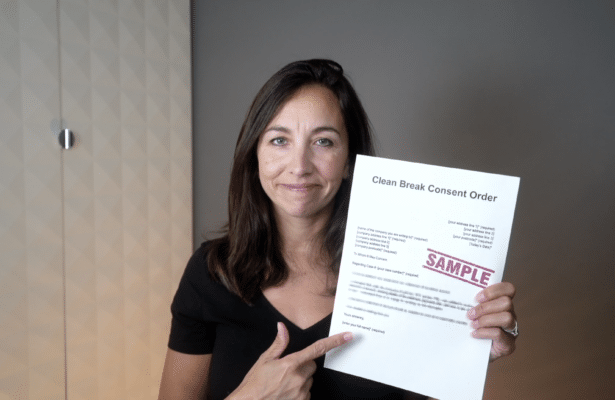
There is no universal clean-break template suitable for every case, and this article does not provide a downloadable order. See related guidance.
Online examples need careful checking against the relevant jurisdiction, current forms and your circumstances. Do not assume that editing names and figures is sufficient.
However, depending on the complexity of your assets and financial ties, a generic template may not suit your situation.
As a non-legal individual, you could overlook important details, so it might be advisable to at least pay for a single session with a solicitor to double-check your consent order before asking the court to approve it.
» TAKE ACTION NOW: Get legal support from JustAnswer
Is a Clean Break Option for You?
A clean break concerns ending specified financial claims between spouses. A consent order can instead include continuing obligations, so the two terms are not interchangeable.
Both parties must provide honest and complete financial disclosure. Hiding or transferring assets to frustrate claims can have serious consequences; it is not a legitimate way to protect money.
If you suspect non-disclosure, take independent legal advice about disclosure and the appropriate court process.
This is done by applying for a financial order. The court will schedule a series of hearings to learn about your and your partner’s finances.
The court will then make a fair decision about the division of these assets. The result is a legally binding financial order that you and your partner must adhere to.
Worried About Divorce Finances?

Divorce can be complicated, especially when it comes to navigating the cost. One small error could lead to serious consequences.
But, the support of a good solicitor can help you to understand your next steps.
For a £5 trial, JustAnswer’s online divorce solicitors can help you understand your rights and guide you towards the best financial solution for you.
In partnership with Just Answer.
References