DRO vs IVA: Eligibility, Costs and Consequences in England and Wales
By
Scott
Scott Nelson
Debt Expert
Scott founded MoneyNerd after his own experience with debt. He runs the website and oversees its general information about debt and other money matters.
Scott does not provide personal debt advice or recommend debt solutions through MoneyNerd. If you make a debt enquiry, MoneyNerd may introduce you to The Debt Advice Service, which provides any personal debt advice.
Janine contributed articles and videos to MoneyNerd about everyday money, household costs, debt topics and parking matters. She has a background in broadcasting, including work with BBC Radio 5 Live and Bauer radio stations.
MoneyNerd does not provide debt advice or recommend debt solutions. We can introduce you to The Debt Advice Service, a trading style of Pacific Financial Solutions Limited. Their debt advice is free, and there is no obligation to proceed.
If you request an introduction, we’ll share your details with The Debt Advice Service so they can contact you.
Some debt solutions have fees and may negatively affect your credit rating. MoneyNerd is a commercial introducer and may receive a fee if you go ahead with a debt solution through The Debt Advice Service.
For free, impartial money guidance and help finding free debt advice, visit MoneyHelper.
MoneyNerd introduces enquiries to The Debt Advice Service and may receive a referral fee. For free, independent guidance and help finding a debt adviser, visit MoneyHelper.
This information and enquiry service is not a full financial assessment or a guarantee of suitability or debt write-off. Debt solutions are not suitable for everyone. Fees may apply, and your credit record and assets may be affected. Get advice on your circumstances before choosing a solution.
MoneyNerd introduces enquiries to The Debt Advice Service and may receive a referral fee. For free, independent guidance and help finding a debt adviser, visit MoneyHelper.
This information and enquiry service is not a full financial assessment or a guarantee of suitability or debt write-off. Debt solutions are not suitable for everyone. Fees may apply, and your credit record and assets may be affected. Get advice on your circumstances before choosing a solution.
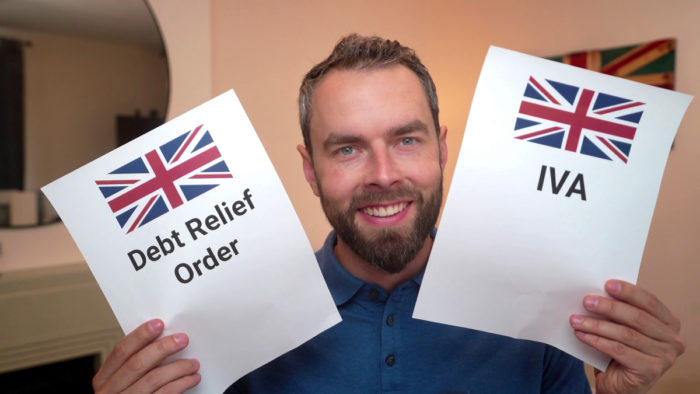
A Debt Relief Order (DRO) and an Individual Voluntary Arrangement (IVA) are different insolvency options. This comparison covers England and Wales. Eligibility, costs, assets and what you can realistically afford all matter; neither option is automatically better.
In this guide, we’ll help you understand:
How an IVA works and how to apply for it
The process of a DRO and how to get one
The debts that you can include in an IVA or a DRO
The effects of choosing a DRO or an IVA
Which debt solution is better for you: DRO or IVA
A free, independent debt adviser can compare these options with the alternatives. MoneyNerd provides general information and introductions; a personal recommendation requires an assessment of your circumstances.
Explore your debt options
Some formal debt solutions can write off eligible debts, but suitability depends on where you live, your debts, income and assets. Fees, restrictions and effects on your credit record may apply. Free, impartial debt advice is available from MoneyHelper. The enquiry form introduces you to our commercial partner; submitting it does not confirm that you qualify for any solution.
How does an Individual Voluntary Arrangement Work?
An IVA is a formal arrangement with creditors, supervised by a licensed insolvency practitioner. You make the payments and other contributions specified in the agreed proposal. On successful completion, the remaining debts covered by its release terms are written off. Debts outside the arrangement remain payable.
For arrangements following the 2025 IVA Protocol, the normal payment term is 60 months, or 72 months where the protocol’s home-equity criteria apply. Older, bespoke and Northern Ireland arrangements can have different terms. An extension may also be needed if the agreed conditions allow it.
Payments should reflect an affordable budget, but an IVA is a binding commitment. If your circumstances change, contact the supervisor promptly. A reduction, payment break or variation may be possible; failure can leave you liable for debts and further recovery action.
Creditors bound by an approved IVA must follow its terms, including the agreed treatment of interest and charges. Continue paying ongoing household costs and debts outside the arrangement.
Your monthly IVA payments are determined by the disposable income you make every month. You must provide proof of your household income and expenses when applying for an IVA.
Owning a home or car does not automatically make an IVA suitable, and an IVA is not blanket protection for assets. The proposal must explain how your assets and any home equity will be treated. Secured lenders’ rights are not removed without their agreement.
Approval generally requires at least 75% by value of the creditors who respond to the decision to vote in favour, with an additional rule concerning objections by unconnected creditors. Creditors may seek changes before approving the proposal.
Please note that your creditors are under no obligation to accept your proposal when it comes to Individual Voluntary Arrangements. Thus, there’s a chance that you may have to seek some other way to manage your debt.
An IVA normally stays on your credit file for at least six years from approval and can remain longer if it has not finished. Completion does not guarantee access to affordable credit.
Your name is also placed on the Insolvency Register and it stays there throughout the duration of your IVA. Your name will get removed within three months after your IVA finishes.
The Individual Insolvency Register is public. An IVA is therefore not completely confidential, even if your employer or landlord is not routinely notified.
As a debtor, you need to be aware of how an IVA affects your life before you apply for one.
How does a DRO Work?
A DRO is made by the official receiver following an application through an approved intermediary. It is not an agreement requiring creditors to vote in favour. During the usual 12-month period, payments towards listed qualifying debts are suspended and creditors are restricted from recovering those debts.
At the end of the DRO period, you are normally released from the listed qualifying debts if the order has not been revoked. Some liabilities, including debts arising from fraud, can survive. You must report relevant changes in income or assets throughout the period, rather than waiting for a final review.
While this may seem like a much more attractive solution than an IVA or a debt management plan, the truth of the matter is that a DRO has very strict eligibility criteria.
The main England and Wales limits are £50,000 in debts counted for DRO eligibility, £2,000 in counted assets and £75 a month in spare income after reasonable household expenses. A separate £4,000 vehicle limit and other asset exclusions apply. You cannot own your home. An approved intermediary must check the detailed valuation rules, residence connection and other eligibility conditions.
Applying for a DRO in England and Wales is free. The £90 application fee was abolished on 6 April 2024. You must apply through an approved intermediary rather than submitting an application yourself.
Tell the intermediary about all belongings and financial interests. They will decide what counts towards the asset limit and whether an exclusion applies; do not assume that every item used for work or study is exempt.
A DRO may be an alternative to bankruptcy for someone who meets its conditions. Neither procedure automatically clears every kind of debt, and both have restrictions and credit consequences.
You normally stop paying the qualifying debts listed in the DRO, but must continue paying ongoing rent, bills and excluded debts. Obtain advice about rent arrears or hire purchase before changing payments, because your home or goods can still be at risk.
An increase in income or assets can lead the Insolvency Service to review and potentially revoke the DRO. Report changes promptly and ask your intermediary how they affect your case.
Creditors can object on specified grounds, but their consent is not needed for a DRO. The official receiver decides the application; you do not normally attend court.
Please note that just like an IVA, a DRO is also logged into your credit report and has an extremely negative impact on your credit score as a debtor.
It’s also important to note that while a Debt Relief Order only lasts a year, it stays in your credit file for six years.
Which Is Better?
There’s no one solution which is better than the other. It all depends on your financial situation and which debt solution works best for you.
If you own a home or exceed the DRO asset limits, another solution may be needed. That does not establish that an IVA is the best choice. Compare affordability, asset treatment, fees and the consequences of failure.
If you qualify for a free DRO, ask an independent adviser why an IVA would be recommended instead. Lack of assets alone does not settle the comparison: the type and amount of debt, income and expected changes also matter.
There is no universal statutory minimum monthly IVA payment. A proposal must be affordable and acceptable to creditors, with its fees and other terms fully explained.
A shorter process is not the only consideration. Check which debts would be covered, any employment or housing implications, and what happens if circumstances change.
As a debtor, you must look at all aspects of your finances, such as your monthly income, expenditure, debts, assets and credit record, to choose between debt solutions.
A DRO is aimed at people with limited assets and little spare income who cannot repay their debts. An IVA requires a workable proposal, which may involve regular contributions, a lump sum or both. It should not be used to promise affordable debt relief without a proper assessment.
An IVA’s benefits and obligations depend on the agreed proposal. Read the asset, payment, fee, windfall and failure provisions before agreeing.
A DRO normally lasts 12 months and deals with the qualifying debts listed in it, subject to its rules. Ongoing commitments and debts outside its protection remain your responsibility.
Only through a specific adviser known as an ‘authorised intermediary‘ can you apply for a DRO.
A government official known as the official receiver will decide whether or not to approve your DRO application.
A DRO is individual. Partners who both need one must each qualify and apply separately, but neither pays an application fee in England and Wales. A DRO for one borrower does not release another person from a joint debt.
To apply for an IVA, you must find an insolvency practitioner (IP) through the Insolvency Service website. Each IP will have their own fee schedule, so you must contact them to determine whether they are right for you.
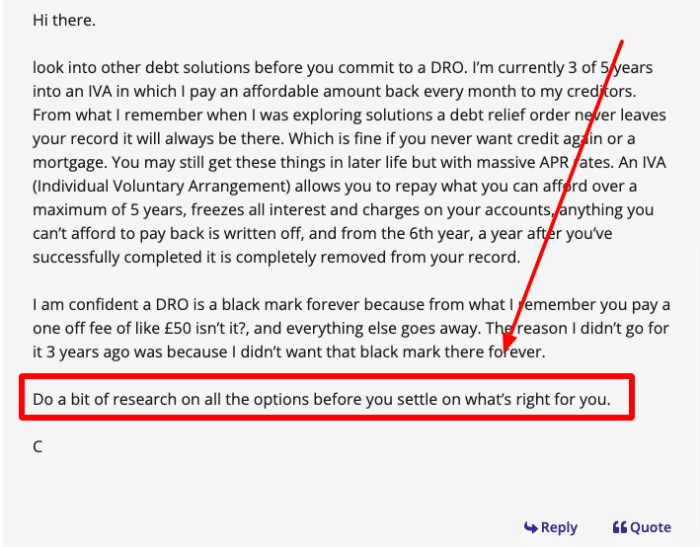
I must reiterate again how important it is to get independent, professional debt advice before agreeing to anything.
What are the consequences?
When you file a Debt Relief Order, it is recorded on the Insolvency Register, together with your personal information.
A DRO is also recorded on your credit file. The public register and credit file are separate records with different retention periods.
This will negatively influence your credit rating in the short term because it indicates to lenders that you have missed debts and had trouble repaying credit.
This can make opening new bank accounts difficult and have mortgage implications.
The DRO entry normally remains on your credit file for six years from approval. Check that linked defaults are recorded accurately; removal of the DRO does not itself guarantee a particular score or lending decision.
IVAs, like DROs, are recorded on the Public Insolvency Register and will thus have a credit score impact.
An IVA entry normally remains for at least six years from approval, and longer if the arrangement is still ongoing. Its effect depends on your wider credit history and a lender’s own assessment.
What Debts can be included in an IVA?
Common debts that may be included in an IVA are listed below. The practitioner must check your particular liabilities; criminal fines, most student loans and maintenance obligations are examples of debts that are generally excluded.
Catalogue debt
Personal loans
Credit card debt
Gas and electric (utility) arrears
Council tax arrears
Overdrafts
Payday loans
Store card debt
Income tax and national insurance arrears
Tax credit or benefit overpayments
Debts owed to family and/or friends
Any other outstanding bill for miscellaneous services
What Debts can be included in a DRO?
Qualifying DRO debts can include the following. The intermediary must check any exclusions and ensure all qualifying debts are properly listed:
Credit cards, overdrafts, personal loans and eligible catalogue or BNPL debts.
Rent, energy and other household bill arrears, although a DRO does not automatically protect a tenancy from possession action.
Council tax, income tax and qualifying benefit overpayments.
Debts to friends or family.
Liabilities under hire purchase require individual advice: the creditor’s ownership rights can remain, and keeping the goods depends on the agreement and DRO rules.
Did you like this article?
Show your support ❤️
We're glad you liked the article! As a small team, your support means everything to us. If you could rate us on Google, it would be amazing. Thank you!
Scott founded MoneyNerd after his own experience with debt. He runs the website and oversees its general information about debt and other money matters.
Scott does not provide personal debt advice or recommend debt solutions through MoneyNerd. If you make a debt enquiry, MoneyNerd may introduce you to The Debt Advice Service, which provides any personal debt advice.
Janine contributed articles and videos to MoneyNerd about everyday money, household costs, debt topics and parking matters. She has a background in broadcasting, including work with BBC Radio 5 Live and Bauer radio stations.
MoneyNerd does not provide debt advice or recommend debt solutions. We can introduce you to The Debt Advice Service, a trading style of Pacific Financial Solutions Limited. Their debt advice is free, and there is no obligation to proceed.
If you request an introduction, we’ll share your details with The Debt Advice Service so they can contact you.
Some debt solutions have fees and may negatively affect your credit rating. MoneyNerd is a commercial introducer and may receive a fee if you go ahead with a debt solution through The Debt Advice Service.
For free, impartial money guidance and help finding free debt advice, visit MoneyHelper.