







Gamification vs. Education: The Role of Simulators in Financial Literacy










For free & impartial money advice you can visit MoneyHelper. We work with The Debt Advice Service who provide information about your options. This isn’t a full fact-find, some debt solutions may not be suitable in all circumstances, ongoing fees might apply & your credit rating may be affected.
A lack of financial literacy has long been an issue in education. But the method of addressing that gap has evolved – from textbook problems and classroom theory to apps, stock trading simulators and gamified programs that focus on the practical experience. That’s in part because we’ve come to realize that financial education is not simply about consuming information. It’s about developing some kind of experiential learning, and that involves experimentation.
This is important for retail traders and personal investors. Experiences with leverage, volatility, and risk in a simulator are very different from reading about it in a textbook or article. This type of experience is valuable. But the financial education landscape has also seen a range of tools that increasingly blend learning with behaviors and experiences that are more about engagement than learning, and the difference is important if you are looking to build financial skills and understanding over the long term.
This piece looks at the role of simulators and gamification in the financial literacy debate, what they add to the debate, and where it’s important to be aware of the limitations.
The Role of Trading Simulators in Financial Education
Practicing trading using a demo trading simulator provided by a broker or as a separate application to trade with fake money is one of the most commonly recommended ways to get into trading. The idea is simple: you can practice trading with real markets, real (streamed) prices, and real orders, while avoiding the risk of losing real money. For a novice trader, it overcomes one of the major obstacles, the fear of making costly trading mistakes while learning the ropes.
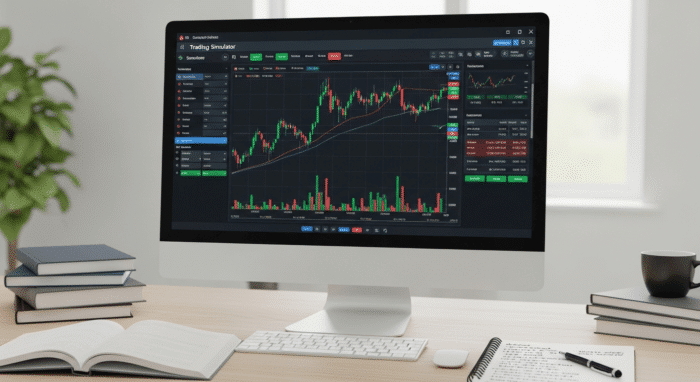
The benefits are clear. You can experiment with position movements, familiarize yourself with the trading platform controls, and learn to understand trading jargon in action. These are common offerings of most major brokers, and separate apps have brought the concept to other areas of personal finance, allowing users to play with budgeting or portfolios or to explore options in a “safe” environment.
But there’s a flip side to simulation as well. Market conditions in demos are generally better than reality. Slippage (the gap between the expected and actual price) is less prevalent. The lack of liquidity and rejections of orders that occur under live market conditions are rarely simulated. This is not too much of a problem for someone who is new to the game to learn how to navigate and basic concepts. For someone looking to gain a deeper understanding of the nature of real markets under stress, the differences between the two become more significant.
Varied Simulation Tools on the Market
The world of simulation is not a homogeneous one. There’s a wide range of tools in terms of how they model the market and what they’re used for.
Demo accounts offered by brokers are generally the most realistic, with real-time (or near real-time) data feeds and the same trade execution systems as live trading. The stock market games used in schools and universities commonly use delayed and/or very abstracted data and mechanics. This is helpful for introducing the concepts, but less so for developing trading skills. Standalone simulation software is intermediate in terms of realism. Investment games go even further in abstracting the mechanics, adding elements of gamification (such as rewards and leaderboards) to even more stylized models of securities.
They all have their place. The key thing to remember is to be aware of the type of tool you’re using so that you can have realistic expectations of the value of the information you’re learning from it.
What Simulators Teach Well and Where They Fall Short
There are some learning gains from the use of simulators if one has the right expectations. A trainee can become familiar with financial concepts in a hands-on way – spreads, margin, order types – and learn how to navigate through the system without risking his or her money. Seeing how different classes of securities respond to the release of economic data or other news, in real time but with no skin in the game, is a valuable market experience. For some learners, merely decreasing their fear of stepping into a complex system has value in and of itself.
What is not obvious is what simulators don’t do. The psychological aspect of trading with real money – the stress, the fear of losing money, seeing your position go against you with real consequences – is not a virtual experience. The evidence from behavioral finance has been clear that much of the sub-optimal investing by individuals can be accounted for by psychological and cognitive influences, and no simulator today accurately reproduces the psychological conditions of real trading. This is not to say anything negative about the tools, just a limitation of the medium. The factors that play a significant role in real-world financial decision-making are the ones that simulations eliminate.
Gamification in Finance – Opportunities and Challenges
Gamification isn’t new to finance, but it has become increasingly prevalent over the last few years. Personal budgets, investment platforms and financial education programs now typically include progress bars, badges, streaks, leaderboards and “gamified” learning programs. The psychology of it is nothing new – the variable reward schedule and the visual progress bar help keep users engaged, and engagement is the first step to learning.
There’s a good reason for this strategy, especially given the low levels of financial literacy in many countries. An OECD survey in 2023 across a range of countries revealed that less than half of adults (39%) had an acceptable level of financial literacy on standard measures. If gamification is one of the methods that can get more people to engage with financial content to begin with, that’s helpful. There are well-documented negative impacts of being passive when it comes to engagement with finance on retirement saving, debt reduction, and general economic decision-making.
Game Mechanics with an Educational Purpose
In classrooms, successful gamification has been demonstrated to have positive effects on learning. When financial principles are learned through experience with decision-making in a scenario-based environment rather than reading, students can more easily understand and use the information. Instant feedback – a central component of most games – allows for a greater understanding of cause-and-effect than delayed feedback or assessment.
The more successful gamified financial tools have some characteristics in common. They introduce abstract concepts in interactive contexts, rather than as abstract definitions. They are based on practice and experimentation with no actual risk. They have a clear sequence of learning to sustain motivation. And they can illustrate concepts such as compound interest or portfolio diversification. These are valuable teaching points. The fact that the game-like nature of the delivery system doesn’t mean that the educational value isn’t high – it’s provided by the content of the game, not the game interface itself.
When Gamification Works Against Learning
The issue is when the game features preempt the learning features. For example, leaderboards that reward the most risk-prone virtual trading strategies can be a distraction, encouraging and rewarding risk-taking that has nothing to do with valid financial analysis. If the key criteria for success is a virtual scorecard, rather than actual learning, the educational message is obscured by the competitive dynamics.
Then there’s misguided faith. Behavioral psychology identifies the ‘hot-cold empathy gap‘, demonstrating that success in a low-stakes, ‘cold’ simulator rarely translates to real-world trading because individuals drastically underestimate how actual financial stress will alter their decisions. This is important for financial training. A person who uses a gamified investment tool successfully may become overconfident in their own abilities and not know how they will react when managing real money and risks.
This doesn’t mean gamified platforms are a bad idea – it means that the way they’re presented is important. If financial platforms aim to use gamified experiences to prepare users for financial engagement, they should be up front about the limits of the gamified experience.
Financial Literacy as a Broader Practice

Let’s take the debate about the platforms aside for a moment. Trading simulations and games target a fairly limited aspect of financial literacy. Understanding how to use a trading platform or to create a portfolio in simulation is only one dimension of this. Knowing how the inflation rate erodes the value of a dollar over time, how different tax treatments apply to different types of accounts, how the structure of debt compounds over multiple years, or how to scrutinize the terms of a financial product – these are not the kinds of skills simulation apps teach.
A more holistic financial literacy deals in skills that span the spectrum. These skills include having a basic understanding of some of the key economic principles relevant to personal finance; knowing how different investment vehicles work and what risks are involved; being able to interpret basic financial statements and product disclosures; understanding some of the biases (such as confirmation bias and loss aversion) that can skew financial decision-making; and knowing when to seek out expert financial advice (as opposed to relying solely on technological products). Simulation does some of this, but not all.
Simulators and gamified apps are just one of many inputs. They can be an onramp, especially for those who learn more effectively in interactive presentations than in more conventional modes of instruction. But they shouldn’t be used as the key to holistic financial education. Most robust financial literacy comes from a range of sources – formal instruction, reliable information, experience, and occasional professional advice where the complexity and stakes are high enough.
What This Means For Retail Traders and Newbies
For novice investors or anyone who wants to start learning about the markets or personal finance, the simulator debate comes down to calibration. These simulators are helpful for the purpose they are intended for: a relatively risk-free environment to learn about the markets and other financial concepts. They’re no substitute for how you might think, feel, or react to having real money on the line, and that’s not what they’re meant to be.
There’s more and better technology available for financial education in 2026 than ever before. That’s a great thing for those seeking to gain knowledge and skills without having to pay much (if anything) upfront. Here are a few questions to ask of any of these:
- Is it using real-time or ‘lagged’ data, and does this matter for the learning goals?
- Does the tool separate entertainment elements from educational material?
- Does it discuss the risks and downsides of investing or focus more on the upside?
- Does the content originate with or is it reviewed by a financial professional?
- Is learning achieved through using the platform or simply familiarity with the platform?
There are no clear-cut or definitive answers to these questions, but they help to understand which tools prioritize learning and which prioritize time spent on the platform. They’re not necessarily the same, and this is a type of financial literacy.
Disclaimer
This is a marketing communication and should not be taken as investment advice or research.
This is not a recommendation to buy or sell, nor a solicitation to buy or sell. It should not be considered financial advice, investment advice, or a solicitation to take any particular investment action. Losses are possible with leveraged products. Historical performance (backtesting or otherwise) is no guarantee of future performance. The availability of financial products, risks, and regulatory protections differ in each jurisdiction. If you are thinking of making such decisions, please seek out a regulated and appropriately qualified financial adviser.