












Giving away money or property before divorce can be scrutinised if it affects a spouse’s financial claim. This guide concerns England and Wales; the law differs elsewhere in the UK.
In this article, you’ll learn:
- Why you need to tell about all your money and things in a divorce.
- Which assets and financial interests must be disclosed
- How to keep your money safe in a divorce.
- What the rules say about giving money to family before a divorce.
- What happens if you hide money in a divorce.
Get independent legal advice before making a significant gift or transfer when separation or divorce is contemplated.
The purpose, timing, value and recipient of a transfer matter. There is no universal safe amount or a rule that every gift is unlawful.
How to save money on divorce fees
How to save money on divorce fees
Divorces are hard to handle, but the financial repercussions can make a bad situation feel even worse.
The solution? Understanding your next steps and exactly how much they’ll cost.
For only £5, JustAnswer offers a trial chat with an experienced divorce solicitor. They can help you navigate the process and save you from costly face-to-face lawyer fees.
Chat below to get started with JustAnswer

Is money I give away before divorce considered by the court?
A court can consider gifts and transfers when deciding financial claims. Section 37 of the Matrimonial Causes Act 1973 also provides powers to prevent or set aside certain transactions intended to defeat a claim.
The available remedy depends on the statutory requirements, the evidence and the recipient’s position. It is not an automatic recalculation of an informal “pot”.
The three-year period in section 37 relates to a rebuttable presumption of intention in specified circumstances. It is not a blanket time limit after which older transfers become immune from scrutiny.
Note: A court has the power to do this because it is laid out in the Matrimonial Causes Act 1973 – section 37.
Is it illegal to gift money before a divorce?
In England and Wales, both people must give full and frank financial disclosure when resolving financial claims. This includes assets, debts, income and relevant interests, whether held jointly or separately. Disclosure should come before a binding settlement and must be kept up to date during proceedings. See related guidance.
An ordinary gift or reasonable living expenditure is not automatically an attempt to defeat a claim. Significant transfers, especially at undervalue or without proper disclosure, require careful advice.
The negative impact of doing this could result in:
- Reopening settlements later on
- Legal implications for the party who gifts money before divorce
The court applies the relevant statutory factors and legal powers to the circumstances. It does not have unlimited discretion to undo every transfer. See related guidance.
A court has the power to examine transactions with third parties. This includes family members if the court believes one party is attempting to reduce the amount in a matrimonial pot.
Not only is not fully disclosing assets or hiding money in a divorce seen as a way not to pay a spouse a fair share, but manipulating financial assets can also have an impact on child support agreements and, therefore, potentially cause harm to children who are involved.
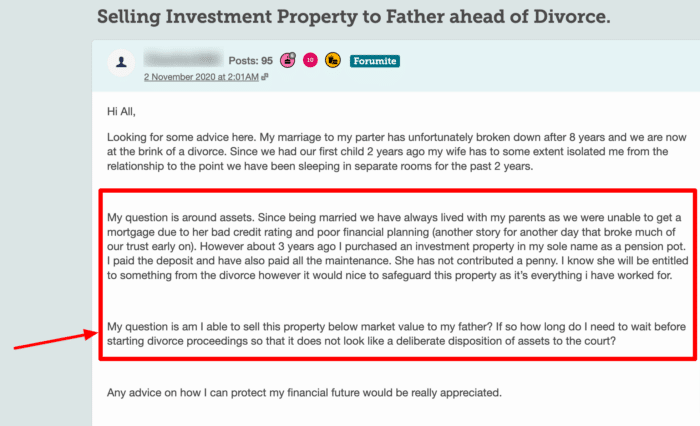
Here, you can see this forum user on MoneySavingExpert is looking for advice on whether he can sell a property to his father at below-market value to prevent his wife from receiving part of its value in their divorce.
What is the penalty for hiding assets in a divorce?
False disclosure or breach of a court order can have serious consequences, including contempt proceedings where the legal requirements are met. A criminal offence or imprisonment is not an automatic result of every disputed gift.
The court may draw adverse inferences, make costs orders or consider other remedies available under the law.
Examples being:
- A family court may reduce your share of the matrimonial pot
- A court could rule you pay your spouse’s legal costs
Worried About Divorce Finances?

Divorce can be complicated, especially when it comes to navigating the cost. One small error could lead to serious consequences.
But, the support of a good solicitor can help you to understand your next steps.
For a £5 trial, JustAnswer’s online divorce solicitors can help you understand your rights and guide you towards the best financial solution for you.
In partnership with Just Answer.
When is it okay to gift money before divorce?
Section 37 addresses transactions intended to defeat financial-relief claims. It contains specific conditions and protections for some recipients; it is not general permission to dispose of assets without disclosure. See related guidance.
For the recipient protection in section 37, the relevant questions include whether:
- The recipient acted in good faith in relation to the transaction
- The transaction was for valuable consideration, other than marriage See related guidance.
- The recipient had no notice of an intention to defeat the applicant’s financial-relief claim
These conditions concern the recipient and transaction, not simply the transferring spouse’s claimed good faith. Whether a disposition can be set aside also depends on the statutory tests; the court is not restricted to transactions that leave the available assets unchanged.
A court may restrain a proposed disposal where the legal test is met. Seek urgent advice if there is a real risk of assets being moved.
» TAKE ACTION NOW: Get legal support from JustAnswer
How are assets divided in England and Wales?
There is no automatic equal division of every asset. The court considers the statutory factors, including resources and needs, with the welfare of minor children as a first consideration. See related guidance.
In short, all divorces are decided on their own merits. However, courts have the power to use their discretion so that financial settlements in a divorce are fair to both parties, as well as considering any children involved.
Equality can be a useful fairness check, but it does not replace an assessment of needs and the other relevant factors. See related guidance.
Join thousands of others who got legal help for a £5 trial
Getting the support of a Solicitor can take a huge weight off your mind.

Reviews shown are for JustAnswer.
Can I spend my savings before divorce?
Reasonable living costs and legitimate expenditure differ from deliberate dissipation. Keep records, disclose material transactions and seek advice before significant spending or gifts.
The purpose and effect of spending can be examined, but a penalty is not automatic whenever savings are used.
Can I empty bank accounts before divorce?
Banks may restrict a disputed joint account, and a court can restrain or set aside certain transactions where the legal tests are met. Emptying an account does not remove disclosure duties or guarantee that the money is excluded from a settlement.
Divorce Doesn’t Mean Financial Ruin

Legal advice can make all the difference when navigating the financial aspects of divorce, and affordable help is within reach.
Normally, the cheapest solicitors in the UK will put you back at least £130 per hour.
But, for a £5 trial, a divorce solicitor from JustAnswer can review your situation and provide personalised guidance. It’s a no-brainer!
Try it below.
In partnership with Just Answer.