






How Far Back Can DWP Recover Benefit Overpayments?








MoneyNerd introduces enquiries to The Debt Advice Service and may receive a referral fee. For free, independent guidance and help finding a debt adviser, visit MoneyHelper.
This information and enquiry service is not a full financial assessment or a guarantee of suitability or debt write-off. Debt solutions are not suitable for everyone. Fees may apply, and your credit record and assets may be affected. Get advice on your circumstances before choosing a solution.
MoneyNerd introduces enquiries to The Debt Advice Service and may receive a referral fee. For free, independent guidance and help finding a debt adviser, visit MoneyHelper.
This information and enquiry service is not a full financial assessment or a guarantee of suitability or debt write-off. Debt solutions are not suitable for everyone. Fees may apply, and your credit record and assets may be affected. Get advice on your circumstances before choosing a solution.
DWP can recover some benefit overpayments that are more than six years old. In England and Wales, the time limit for starting court proceedings is different from recovery through benefits or wages. An old overpayment is not automatically written off.
This guide explains the main distinctions. Scotland and Northern Ireland have different rules and administration, so obtain advice for the relevant jurisdiction.
In this article, we’ll explain:
- What the DWP is and what we mean by ‘DWP debt’.
- How the DWP can claim overpayments, and how far back they can do this.
- Who DWP Debt Management are and what they do.
- How you can pay back DWP overpayments.
- If the DWP can take money from your wages.
If you receive a demand, ask for the decision, calculation and recovery history. A welfare-rights or debt adviser can help check liability, challenge deadlines and what you can afford.
Can DWP claim overpayments?
Yes, the Department for Work and Pensions can ask you to pay back your DWP overpayments.
Overpayments can result from an unreported change, incorrect information, a processing problem or official error. Receiving a demand does not by itself mean that you acted dishonestly.
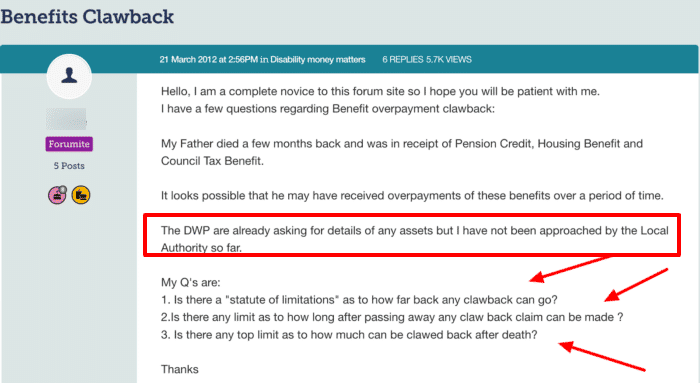
Source: https://forums.moneysavingexpert.com/discussion/3863397/benefits-clawback
Whether an overpayment is legally recoverable depends on the benefit and how it arose. Universal Credit and new-style JSA or ESA overpayments can be recoverable even when DWP made the mistake. Some official-error overpayments of legacy benefits, including Pension Credit, are not recoverable. Ask for the legal basis if you disagree.
You can usually request mandatory reconsideration within one month of the decision date. Late requests may be considered in some circumstances. Follow the decision letter and obtain advice promptly; a repayment negotiation is different from challenging the decision.
How far back can they claim overpayments?
There is no general rule limiting DWP recovery to overpayments made in the last six years. The DWP recovery guide distinguishes civil court action from deductions that do not require a court judgment.
For court action in England and Wales, the six-year period normally runs from the final recovery decision, subject to matters such as later voluntary payments or written acknowledgments. The date the benefit was originally paid is not necessarily the starting point.
Even where an English or Welsh court claim would be statute-barred, recovery through benefits or an eligible Direct Earnings Attachment may still be possible. Do not ignore a court claim: seek advice and raise any limitation defence within the response deadline.
» TAKE ACTION NOW: Fill out the short debt form
How far back can they claim pension credit overpayments?
Pension Credit does not have a separate automatic six-year write-off rule. First establish whether the overpayment is recoverable, then consider the recovery method and applicable time limits. See National Debtline’s legacy-benefit guide.
A correction to Pension Credit entitlement can also affect linked support, but any council-tax reduction decision must be checked under the relevant council scheme. It does not follow that every overpayment means council tax was deliberately avoided.
Understand your debt options
MoneyNerd can introduce you to The Debt Advice Service for free debt advice. MoneyNerd does not provide debt advice or recommend debt solutions.
The Debt Advice Service can explain your options, including their benefits, costs and risks. Options available depend on your circumstances. There’s no obligation to take a debt solution.
MoneyNerd does not provide debt advice or recommend debt solutions. The Debt Advice Service is a trading style of Pacific Financial Solutions Limited. If you request an introduction, we’ll share your details with their team so they can contact you.
Some debt solutions have fees and may negatively affect your credit rating. MoneyNerd is a commercial introducer and may receive a fee if you go ahead with a debt solution through The Debt Advice Service.
For free, impartial money guidance and help finding free debt advice, visit MoneyHelper.
How about overpayment claims after death?
DWP may recover a valid benefit overpayment from the deceased person’s estate. Payments made after death have separate recovery rules and should not simply be treated as money available for beneficiaries.
Notify DWP of the death and keep records of payments and correspondence. If money arrived after death, ask the bank and DWP how it should be handled.
DWP may request bank statements and other information to establish the deceased’s entitlement. There is no universal 12-year investigation limit described by this process.
If you are administering the estate, establish the outstanding debts before distributing it. DWP’s estate-recovery guidance explains the information it may request and the decision process.
The time needed depends on the case. Ask for updates and obtain probate advice where necessary, especially before a distribution while a possible claim remains unresolved.
An executor does not automatically inherit the deceased’s debts. However, distributing an estate without properly dealing with creditors can create personal liability. Whether that applies depends on the circumstances and the steps taken.
Can DWP take money from your wages?
Yes, the DWP may look to recover overpayments by taking money directly from your employment income. This is called a Direct Earnings Attachment (DEA).
The DWP requests your employer to deduct an amount from your salary and send it to them instead. The amount goes towards repaying benefit debt.
A DEA can be used for qualifying debts DWP is responsible for collecting. For example:
- Recoverable DWP benefit overpayments may be collected through this route where its requirements are met.
- Tax-credit debts transferred to DWP can also be recovered under the applicable rules.
- Child Benefit and debts administered by other bodies have their own processes; do not assume every government overpayment is covered by the same DWP procedure.
DWP does not need a CCJ before using a valid DEA. Notice, deduction rates and protected-earnings rules apply. Check the notice and contact DWP promptly if the amount is wrong or unaffordable.
Engaging early may allow an affordable repayment arrangement. Ask DWP to review an existing deduction if it causes hardship; stopping payments without agreement does not guarantee the deduction will end.
Take the first step towards tackling your debt
Every day, our partner, The Debt Advice Service, helps people understand their options for dealing with debt. Their debt advice is free, with no obligation to proceed.
MoneyNerd introduces you to The Debt Advice Service. We do not provide debt advice or recommend debt solutions.

Natasha
Very helpful and informative thank you
If you submit the enquiry form, MoneyNerd will share your details with The Debt Advice Service so they can contact you.
Some debt solutions have fees and may negatively affect your credit rating. MoneyNerd may receive a fee if you go ahead with a debt solution through The Debt Advice Service.
The Debt Advice Service is a trading style of Pacific Financial Solutions Limited.
For free, impartial help and access to not-for-profit debt advice, visit MoneyHelper.
How do you pay them back?
DWP can ask for repayment, including repayment in full. If you cannot afford the requested amount, contact Debt Management and provide details of your income, essential expenditure and any health or support needs.
Ask for an affordable instalment arrangement or a lower deduction rather than agreeing to payments that leave you unable to cover essentials.
You can pay a valid overpayment in full if affordable, or discuss an arrangement. Use the verified payment details in DWP’s official correspondence or its repayment guidance.
For Universal Credit and new-style benefit overpayments, see National Debtline’s guidance on challenging recovery and requesting help with deductions.
Affordability and hardship should be considered when deciding how recovery proceeds. Keep evidence of your budget and explain any effect on you or your dependants.
Recovery routes can include:
- Deductions from ongoing benefit payments, subject to the applicable rules.
- A Direct Earnings Attachment to eligible wages.
- Civil court action where legally available.
- New Direct Deduction Orders for qualifying bank accounts, subject to statutory conditions, affordability assessments, notice and review or appeal safeguards.
Can DWP waive an overpayment?
The age of a debt does not automatically entitle you to a write-off. DWP may exceptionally waive recovery, taking account of compelling circumstances such as serious welfare consequences and prolonged hardship. You can ask for a written decision and provide supporting evidence; a waiver is not guaranteed.
If a waiver is not appropriate, ask about reduced or temporarily suspended recovery. Separately, DWP announced a gradual rollout of new enforcement powers from October 2026. Its Code of Practice restricts when bank deductions and, as a last resort, an application to court for driving disqualification can be used. These are not automatic consequences of an ordinary overpayment or being unable to pay.