







How Long Can a Creditor Pursue an Old Debt?








MoneyNerd introduces enquiries to The Debt Advice Service and may receive a referral fee. For free, independent guidance and help finding a debt adviser, visit MoneyHelper.
This information and enquiry service is not a full financial assessment or a guarantee of suitability or debt write-off. Debt solutions are not suitable for everyone. Fees may apply, and your credit record and assets may be affected. Get advice on your circumstances before choosing a solution.

MoneyNerd introduces enquiries to The Debt Advice Service and may receive a referral fee. For free, independent guidance and help finding a debt adviser, visit MoneyHelper.
This information and enquiry service is not a full financial assessment or a guarantee of suitability or debt write-off. Debt solutions are not suitable for everyone. Fees may apply, and your credit record and assets may be affected. Get advice on your circumstances before choosing a solution.
The time a creditor has to act depends on the debt, jurisdiction and recovery method. Six years is not a universal deadline for all UK debt collection.
Here’s what we’ll cover:
- Understanding ‘Statute Barred’ in detail and why it’s important.
- The six-year rule for chasing debts and exceptions to this rule.
- What to do if you think your debt is ‘Statute Barred’.
- How long you can be chased for debt after a County Court Judgement (CCJ).
We know it’s stressful to have outstanding debts. Every month, over 170,000 people visit our website for guidance on such issues.
Some of our team have also been there. We understand your worries and are here to share our knowledge on how to manage debts.
Let’s dive in!
How Long Can You Be Chased?
In England and Wales, many simple-contract claims, including ordinary credit-card and personal-loan debts, have a six-year limitation period.
When the relevant court claim is outside its limitation period, it may be statute-barred.
That does not automatically cancel the debt or prohibit every kind of recovery. The cause of action, any payments or valid acknowledgment, and earlier proceedings must be checked.
Statute Barred in Detail
The Limitation Act 1980 sets the ordinary simple-contract court limit in England and Wales. It is a legal defence, rather than a loophole that applies merely because an account is old.
Time normally starts when the creditor becomes entitled to sue for the relevant amount. Depending on the agreement, a required default notice may affect that date.
A credit-file default date is not necessarily the same legal starting point. Use the agreement, notices and payment history to establish the timeline.
Why is this important?
A properly raised limitation defence can defeat a late ordinary claim. Some public debts have recovery powers that do not depend on an ordinary civil judgment.
The underlying debt generally remains in England and Wales. Scotland has different prescription rules, often five years for ordinary debts if the conditions are satisfied; Northern Ireland has its own limitation law.
» TAKE ACTION NOW: Fill out the short debt form
Does every debt have a six-year limit?
No. Mortgage capital, tax debts, benefit overpayments, council tax and judgments can require different analysis.
For an ordinary simple-contract claim, check all of the following:
- The date the relevant cause of action arose and the applicable limitation period.
- Any payment or qualifying written, signed acknowledgment before that period expired.
- Whether the creditor started proceedings within time or obtained a judgment.
Payment or valid acknowledgment before expiry can restart the period. A creditor’s letter does not itself restart it. Once an ordinary claim is already statute-barred under the Act, later payment or acknowledgment does not revive it.
For example, an account opened six years ago is not necessarily statute-barred: the legal right to sue may have arisen later, or a later payment may have restarted the period.
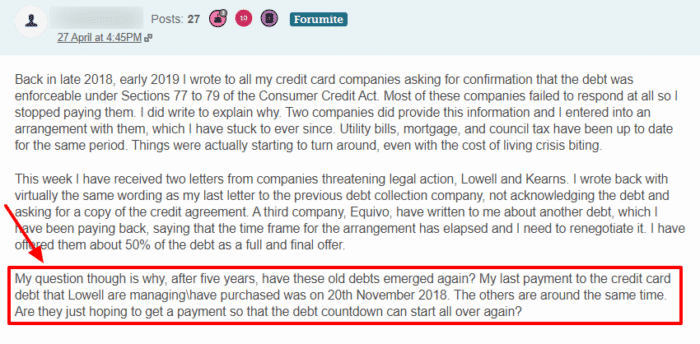
If the creditor disputes your dates, ask for the evidence relied on and have an adviser check it.
Before responding to a disputed old debt:
- Gather the agreement, notices, payment records and any court papers.
- Ask a debt adviser to assess limitation before making a payment or admitting liability in writing.
- Do not assume a request for information has a particular legal effect regardless of its wording.
- A verbal conversation is not itself the written, signed acknowledgment required by the Limitation Act, but keep an accurate record of what was said.
- Respond to court documents on time; an information request or complaint does not replace a defence.
Understand your debt options
MoneyNerd can introduce you to The Debt Advice Service for free debt advice. MoneyNerd does not provide debt advice or recommend debt solutions.
The Debt Advice Service can explain your options, including their benefits, costs and risks. Options available depend on your circumstances. There’s no obligation to take a debt solution.
MoneyNerd does not provide debt advice or recommend debt solutions. The Debt Advice Service is a trading style of Pacific Financial Solutions Limited. If you request an introduction, we’ll share your details with their team so they can contact you.
Some debt solutions have fees and may negatively affect your credit rating. MoneyNerd is a commercial introducer and may receive a fee if you go ahead with a debt solution through The Debt Advice Service.
For free, impartial money guidance and help finding free debt advice, visit MoneyHelper.
I Think My Debt Is Statute Barred, What Next?
If you believe your debt is Statute Barred, you should try to get confirmation of this.
A free debt adviser can help review the evidence. You can ask the creditor for relevant records using appropriately worded correspondence.
Advice should address the particular debt and dates. A general online checklist cannot guarantee that a limitation defence succeeds.
If the adviser confirms that an appropriate limitation argument applies, you can send a tailored statute-barred reply and retain a copy.
Sending a Statute Barred Letter
As mentioned earlier, if you receive requests for payment and possible legal threats from creditors and your debt is Statute Barred, it is time to make your creditors aware.
Use a template for the correct jurisdiction and debt type, such as the letter linked in National Debtline’s guide.
Send the letter to all applicable creditors and keep a record of the letter sent, possibly even record the delivery.
For debts covered by FCA rules, state clearly that you will not pay because the debt is statute-barred. The rules restrict continuing payment demands; they do not ban every administrative response.
What If They Continue to Request Payment?
Keep copies and use the appropriate complaint route:
- Complain to the lender or collector first, explaining the dates and the conduct you dispute.
- If eligible and unresolved, refer the complaint to the Financial Ombudsman Service within the applicable deadline.
- Threats or harassment may justify other action, but a further letter is not automatically a criminal offence.
Take the first step towards tackling your debt
Every day, our partner, The Debt Advice Service, helps people understand their options for dealing with debt. Their debt advice is free, with no obligation to proceed.
MoneyNerd introduces you to The Debt Advice Service. We do not provide debt advice or recommend debt solutions.

Natasha
Very helpful and informative thank you

If you submit the enquiry form, MoneyNerd will share your details with The Debt Advice Service so they can contact you.
Some debt solutions have fees and may negatively affect your credit rating. MoneyNerd may receive a fee if you go ahead with a debt solution through The Debt Advice Service.
The Debt Advice Service is a trading style of Pacific Financial Solutions Limited.
For free, impartial help and access to not-for-profit debt advice, visit MoneyHelper.
What Will the Financial Ombudsman Decide?
The Ombudsman can decide eligible complaints about a financial business and require appropriate remedial action or compensation where justified.
It does not impose regulatory fines or prosecute criminal harassment. See its complaint process; the FCA separately receives reports about misconduct.
How Long Can You Be Chased for Debt After a CCJ?
If there is already a CCJ, do not treat the original debt’s limitation period as permission to ignore the judgment.
The judgment does not automatically expire after six years. Some enforcement methods then require the court’s permission, and further restrictions depend on the method.
Removing a CCJ from a credit file or public register is different from ending the judgment debt.
If you believe judgment was wrongly entered, obtain prompt advice about the appropriate application rather than simply writing that the original debt was old.
An adviser can check the judgment, payment history, proposed enforcement and any grounds to vary, suspend or set it aside.