






How Much Can I Borrow on a Lifetime Mortgage?








MoneyNerd introduces enquiries to Age Partnership and may receive a referral fee. MoneyNerd does not provide equity release advice. Equity release reduces the value of your estate and can affect means-tested benefits. With a lifetime mortgage, unpaid interest compounds and increases the amount owed. Fees and early repayment charges may apply.
Ask a regulated adviser to explain suitability, costs and alternatives. For free, impartial guidance, visit MoneyHelper.

MoneyNerd introduces enquiries to Age Partnership and may receive a referral fee. MoneyNerd does not provide equity release advice. Equity release reduces the value of your estate and can affect means-tested benefits. With a lifetime mortgage, unpaid interest compounds and increases the amount owed. Fees and early repayment charges may apply.
Ask a regulated adviser to explain suitability, costs and alternatives. For free, impartial guidance, visit MoneyHelper.
Wondering how much money you can borrow on a lifetime mortgage? This guide is here to help.
In this guide, we’ll cover:
- How a lifetime mortgage works
- The risks and rewards of getting a lifetime mortgage
- The amount you might have to pay back
- What might happen if you move house or pass away
- Ways to make sure you get a fair deal
We know that thinking about money can be hard – you might be worried about the costs or unsure if a lifetime mortgage is right for you. But you’re not alone; we understand your concerns, and we’re ready to walk you through the process.
What amount can I borrow?
Borrowing depends on the youngest applicant’s age, property, product and lender criteria. A calculator gives only an estimate; there is no universal 20–60% range.
Do not assume an applicant aged 55 can always release 27%. Ask for an individual assessment using current criteria. See related guidance.
The current market value of your property plays a significant role in determining the amount you can borrow on a lifetime mortgage. Lenders typically assess the value of your property through a professional surveyor appointed by them. The higher the market value of your property, the more you may be able to borrow.
» TAKE ACTION NOW: Find out how much equity you could release
How much do you pay back?
Rolled-up interest compounds, but the balance does not necessarily double within ten years. Request projections using the actual rate, fees and repayment choices. See related guidance.
Here is one person’s experience and warning:
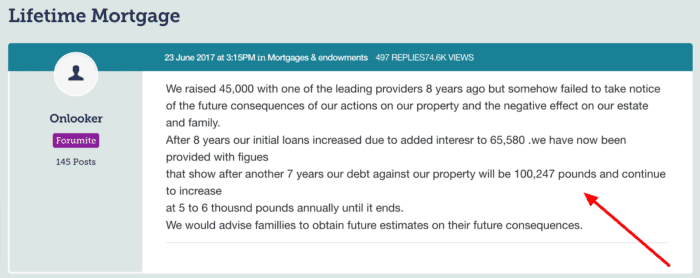
Source: https://forums.moneysavingexpert.com/discussion/5668790/lifetime-mortgage
What happens if you die soon after taking it out?
If you die soon after taking out a lifetime mortgage, the interest won’t significantly accumulate, meaning the debt won’t have grown as much.
Repayment following the final borrower’s death is normally a contractual end event rather than voluntary early repayment. Check the specific terms, any surviving borrower and the lender’s settlement requirements; do not assume a charge solely because death occurs early.
If no other homeowner is named on the lifetime mortgage, the lender can ask executors of your will to sell the property and pay off the debt. However, they may also offer estate beneficiaries to repay the debt with cash and keep the property.
Consider the costs and risks of equity release
Equity release is a long-term financial decision. A lifetime mortgage is a loan secured against your home. If interest is added to the loan, the debt can grow substantially and reduce the inheritance you leave.
Consider the fees, effect on means-tested benefits, early repayment charges and future care needs. Alternatives may include downsizing, using other assets or a retirement interest-only mortgage where affordable.
Use the button below to start an enquiry with Age Partnership. An estimate does not confirm eligibility or suitability. Get specialist financial and independent legal advice before proceeding.
In partnership with Age Partnership, which advises on lifetime mortgages. MoneyNerd introduces enquiries and may receive a referral fee. Equity release can reduce your estate and affect means-tested benefits and future care funding. Fees may apply and interest added to a lifetime mortgage increases the amount owed. Specialist financial and independent legal advice are required before proceeding.
What if you end up owing more than the home is worth?
For a plan meeting the relevant Equity Release Council standards, the right to remain depends on keeping the property as your main residence and meeting the contract terms. A no-negative-equity guarantee limits repayment to the net sale proceeds when its conditions are met; it does not stop the balance growing or make the product risk-free.
The guarantee normally relates to net sale proceeds after permitted sale costs and is subject to conditions; it does not stop the balance growing above property value.
Types of lifetime mortgages
There are some lifetime mortgage products with subtle but notable differences. Two of the most common are:
- Interest-payment lifetime mortgages may permit voluntary payments or require them for an agreed period. Paying interest can reduce debt growth. See related guidance.
- Enhanced lifetime mortgages allow homeowners to access a bigger loan if they have an estimated reduced lifespan.
- A drawdown lifetime mortgage, where smaller loan amounts are taken at a time.
- A flexible lifetime mortgage allows for a combination of lump sum payments and drawdowns.
- Home reversion is a separate equity-release type, not a lifetime mortgage: it involves selling part or all of the home.
Health conditions can have an impact on enhanced lifetime mortgages. Enhanced lifetime mortgages consider specific health and lifestyle factors to potentially offer a higher borrowing amount or a lower interest rate.
Lenders offering enhanced lifetime mortgages consider various health conditions, such as high blood pressure, diabetes, cancer, heart conditions, and more. The severity of the condition and its potential impact on life expectancy is considered.
The presence of certain health conditions may allow you to access a more significant percentage of your property’s value or borrow more money than with a standard lifetime mortgage. This is because lenders assess that the reduced life expectancy associated with certain health conditions decreases the time for interest to compound.
Some lifetime mortgage providers may also provide lower interest rates for borrowers with specific health conditions. This can result in reduced overall costs over the course of the loan.
It’s important to note that not all lenders offer enhanced lifetime mortgages or consider the same set of health conditions. Therefore, in my experience, seeking advice from an independent financial adviser is recommended.
Can you transfer it if you move?
Equity release companies that are a member of the Equity Release Council will allow you to transfer your lifetime mortgage to the new property if you move. This is a portable lifetime mortgage. However, the new property must be deemed “suitable”.
The new property must meet the provider’s criteria. A cheaper property is not automatically excluded, but partial repayment or charges may apply.
If you’re downsizing to a less valuable home, you may need to pay off a percentage of your lifetime mortgage to transfer it. This could trigger early repayment costs unless your agreement includes a downsizing clause.
An Age Partnership customer’s experience
Individual experiences vary. Equity release is a long-term decision, and specialist advice is needed to assess whether it is suitable for you. Compare the costs, risks and alternatives before proceeding.

Mrs Wareham
“I am more than pleased to have taken out Equity Release with Age Partnership.”
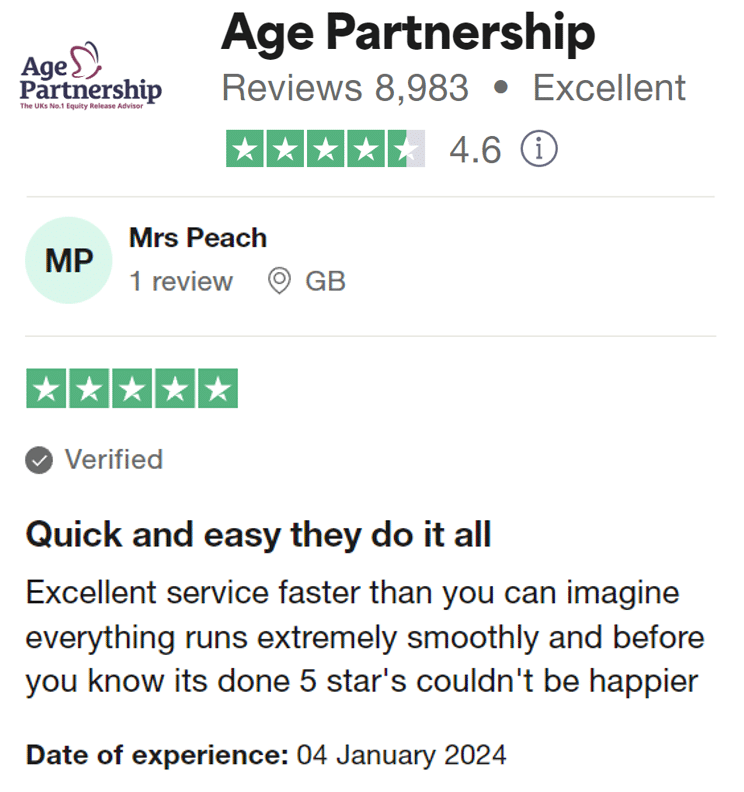
Reviews shown are for Age Partnership. Search powered by Age Partnership.
Can you sell a property with a debt?
Yes, you can sell a property with a lifetime mortgage, but the lifetime mortgage debt will need to be immediately repaid. You could repay this using some of the sale proceeds. You may want to get financial advice first.
Is it right for me?
Lifetime mortgage advice is mandatory as part of the application process. Only an equity release adviser can work with you to help you decide if this is the right option for you.
When seeking independent financial advice for a lifetime mortgage, choose an advisor who is reputable and registered with the Financial Conduct Authority (FCA). This ensures that they meet strict regulatory standards to protect consumers. To make a well-informed decision, it is recommended that you seek advice from multiple advisors. This approach will provide you with a comprehensive understanding of your options, helping you make the best choice for your individual needs.
You may wish to consider other options, such as selling and buying a smaller property or renting out part of your home.
Do banks offer them?
Lifetime mortgages are mostly offered by equity release companies and companies specialising in private pensions and insurance policies. Some high-street banks are partnered with equity release companies and can put you in touch with them.
Quick recap
The amount available must be assessed using current product criteria, age and property information; a generic percentage range is not a lending offer.
If you qualify for an enhanced lifetime mortgage due to poor health, you might be able to access a bigger loan than you otherwise would be able to.
Things to consider
Equity release includes lifetime mortgages and home reversion plans. A lifetime mortgage is a loan secured on your home; a home reversion plan sells part or all of the property. Equity release reduces what may be left in your estate and can affect means-tested benefits and future care funding. A lifetime mortgage is usually repaid when the last borrower dies or moves permanently into care, subject to the plan terms. Specialist financial and independent legal advice are needed. Any existing mortgage must normally be repaid from the proceeds or other funds. Age Partnership publishes an advice fee of £1,995 payable on completion; confirm the current fee in your personalised illustration. Lender and legal fees may also apply.