







Will I Lose My Home if I Go Bankrupt?








MoneyNerd introduces enquiries to The Debt Advice Service and may receive a referral fee. For free, independent guidance and help finding a debt adviser, visit MoneyHelper.
This information and enquiry service is not a full financial assessment or a guarantee of suitability or debt write-off. Debt solutions are not suitable for everyone. Fees may apply, and your credit record and assets may be affected. Get advice on your circumstances before choosing a solution.
MoneyNerd introduces enquiries to The Debt Advice Service and may receive a referral fee. For free, independent guidance and help finding a debt adviser, visit MoneyHelper.
This information and enquiry service is not a full financial assessment or a guarantee of suitability or debt write-off. Debt solutions are not suitable for everyone. Fees may apply, and your credit record and assets may be affected. Get advice on your circumstances before choosing a solution.
Are you worried about debts and thinking about going bankrupt? Are you wondering if you may lose your house?
You’re not alone in this. Every month, over 170,000 people come to our website, looking for guidance on how to handle debt.
This guide explains how bankruptcy can affect your home in England and Wales. Scotland and Northern Ireland have different procedures. Get debt advice before applying, especially if you own a property or have rent arrears.
- What it means to go bankrupt
- How it might affect your house
- The steps you can take to protect your home
- The rules about equity in your home
- How renting a home is affected by bankruptcy
Our team is here to help because we understand your struggles; some of us have been there too. Dealing with debt can be hard, but remember, there’s always a solution.
Ready to find out more about bankruptcy, and how it might affect your home? Let’s dive in.
Will it result in losing my home?
Bankruptcy can put a home you own at risk. Your trustee deals with your beneficial interest, usually your share of the equity after secured borrowing. A sale is one possible outcome, but a partner or another person may be able to buy that interest.
In short, some of the money in your home is used to pay:
- An official receiver’s fees and costs
- Your creditors
Explore your debt options
Some formal debt solutions can write off eligible debts, but suitability depends on where you live, your debts, income and assets. Fees, restrictions and effects on your credit record may apply. Free, impartial debt advice is available from MoneyHelper. The enquiry form introduces you to our commercial partner; submitting it does not confirm that you qualify for any solution.
Understand your debt options
MoneyNerd can introduce you to The Debt Advice Service for free debt advice. MoneyNerd does not provide debt advice or recommend debt solutions.
The Debt Advice Service can explain your options, including their benefits, costs and risks. Options available depend on your circumstances. There’s no obligation to take a debt solution.
MoneyNerd does not provide debt advice or recommend debt solutions. The Debt Advice Service is a trading style of Pacific Financial Solutions Limited. If you request an introduction, we’ll share your details with their team so they can contact you.
Some debt solutions have fees and may negatively affect your credit rating. MoneyNerd is a commercial introducer and may receive a fee if you go ahead with a debt solution through The Debt Advice Service.
For free, impartial money guidance and help finding free debt advice, visit MoneyHelper.
What if you’re the sole owner?
If you are the sole owner, the legal title and your beneficial interest normally transfer to the trustee. Secured borrowing, sale costs and the costs of bankruptcy affect how much is available for creditors.
However, if the property is jointly owned, an official receiver can only take your share and no more.
That said, it depends on the equity available. For example, an official receiver could:
- Sell your property, or
- Place a charging order on the property which means they receive the equity owed when you sell your property further down the line
Check out what happened to one person who posted this message on a popular forum:
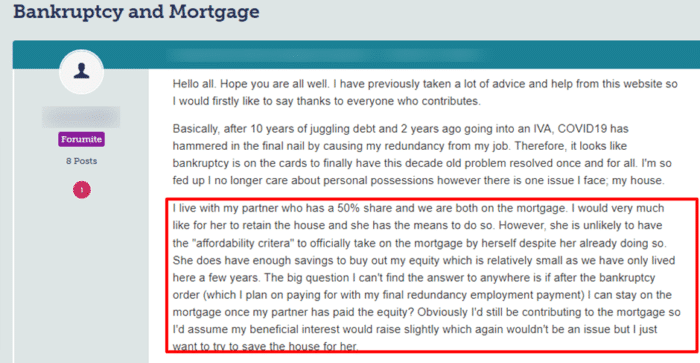
Source: Moneysavingexpert
Can someone else pay the equity to a receiver?
Yes. An official receiver could agree to someone else paying the equity if you’d like to keep your home when filing for bankruptcy.
Moreover, a family member or friend could be the one who bails you out.
What if there’s less than £1,000 equity?
Low or negative equity does not automatically put your home beyond the trustee’s reach. Its value and your share of the equity can change during the bankruptcy process.
Examples of a low-equity position include:
- There’s less than £1,000 equity in your home
- There’s negative equity in your home
The official receiver may review a low-equity family home later. Do not treat a review date as a guarantee that you can keep it; ask your trustee how your interest will be dealt with.
A family member or friend may be able to buy the trustee’s interest. The trustee must agree the value and terms.
Keep paying the mortgage and other secured commitments if you intend to retain the home. Bankruptcy does not remove the secured lender’s rights.
Take the first step towards tackling your debt
Every day our partners, The Debt Advice Service, help people find out whether they can lower their repayments and finally tackle or write off some of their debt.

Natasha
Very helpful and informative thank you

If you submit the enquiry form, MoneyNerd will share your details with The Debt Advice Service so they can contact you.
Some debt solutions have fees and may negatively affect your credit rating. MoneyNerd may receive a fee if you go ahead with a debt solution through The Debt Advice Service.
The Debt Advice Service is a trading style of Pacific Financial Solutions Limited.
For free, impartial help and access to not-for-profit debt advice, visit MoneyHelper.
What happens if there’s more than £1,000?
Where your beneficial interest exceeds £1,000, the trustee may consider a sale or a charging order. The practical outcome depends on the property, its ownership and your circumstances.
There is normally a three-year period for the trustee to take the required steps to deal with an interest in the family home. This is not a guaranteed three-year right to remain. Starting the relevant court action within that period can preserve the trustee’s interest even if the sale happens later.
What happens after your house is sold?
There is no general right to stay for 12 months after the home is sold. Where a partner or children live with you, a sale can often be postponed during the first year after the bankruptcy order. Get housing advice promptly if a sale or possession action is proposed.
If a mortgage lender repossesses and sells the property for less than the secured debt, the shortfall may be a debt covered by the bankruptcy. Tell your trustee and get advice before signing any new agreement accepting liability.
Do not assume that handing back the keys immediately ends the mortgage or your other housing costs.
What if I am renting from a private landlord?
If you’re living in a rented property and you declare bankruptcy, you should be allowed to remain in the house. However, you’d have to keep your rent payments up to date.
Rent arrears from before the bankruptcy are normally included, but this does not necessarily prevent your landlord from seeking possession. Keep paying ongoing rent and get housing advice if you receive a notice or court papers.
» TAKE ACTION NOW: Fill out the short debt form
Can you avoid eviction from a rented property?
If you have rent arrears, speak to a debt or housing adviser and your trustee before agreeing payments. They can explain how to protect your tenancy while complying with the bankruptcy rules.
An Income Payments Agreement (IPA) is a contribution towards the bankruptcy from affordable surplus income. It is not a rent-arrears repayment plan with your landlord.
An IPA or court-ordered Income Payments Order can last for up to three years. Reasonable living costs, including ongoing rent, are considered when calculating what you can afford.
A friend or relative may be able to help with rent arrears. Check the arrangement with your adviser and trustee, particularly if eviction is threatened.
What if your tenancy agreement includes a bankruptcy clause?
Ask a housing adviser to check any bankruptcy clause in your tenancy agreement. Its effect depends on the tenancy and the law that applies; it does not by itself give a landlord permission to evict you immediately.
Landlords must follow the applicable legal possession process. Get advice as soon as you receive a notice, rather than waiting for a court hearing.
Do private landlords check?
Yes. Private landlords are known to check whether a potential or current tenant has gone bankrupt. They can do this on the Insolvency (bankruptcy) Register.
Bankruptcy can make it harder to find a new tenancy, and a landlord may ask for a suitable guarantor. Any deposit must stay within the legal cap that applies to the tenancy.
What if you rent from a local authority?
Provided you keep up with your rent, you should be allowed to stay in a property you rent from the council. The same is true if you rent from a housing association.
However, much like renting from a private landlord, any rent arrears to the council are included in the bankruptcy.
A social landlord can still seek possession for rent arrears even where those arrears are included in the bankruptcy. Do not ignore possession notices or court papers.
How hard is it to rent another home?
A new private landlord may check the Insolvency Register before they’ll rent a property to you.
It can make finding a new place to live a lot more challenging.
A landlord may assess your finances or ask for a guarantor. For most private tenancies in England, the tenancy deposit is capped at five weeks’ rent if annual rent is below £50,000, or six weeks if it is £50,000 or more.
What’s the major benefit of declaring bankruptcy?
The major benefit of declaring bankruptcy is that it takes away the financial pressure you’re experiencing.
In England and Wales, discharge normally happens after 12 months and releases you from most bankruptcy debts. Some debts remain payable, and the trustee can continue dealing with assets or collecting agreed income contributions afterwards.
Quick Recap
Whether you get to keep your home when you file bankruptcy depends on whether you own the property. It also depends on whether there’s any equity in your home.
Low or negative equity may affect whether a sale is worthwhile, but it is not a promise that you can keep the property. Ask the trustee about your interest and the options for someone else to buy it.
Renters should keep paying ongoing rent and seek advice about arrears or possession action. Homeowners should understand both the trustee’s interest and the mortgage lender’s separate rights.
See the government guide to bankruptcy and your home, and get advice before choosing a debt solution.