





Council and Police Fines
Penalty Charge Notice

PCN 5 Minute Observation Rule – Know Your Rights!

Scott Nelson MoneyNerd Janine Marsh MoneyNerd
By
Scott
Scott Nelson MoneyNerd

Scott Nelson

Debt Expert

Scott founded MoneyNerd after his own experience with debt. He runs the website and oversees its general information about debt and other money matters. Scott does not provide personal debt advice or recommend debt solutions through MoneyNerd. If you make a debt enquiry, MoneyNerd may introduce you to The Debt Advice Service, which provides any personal debt advice.

Learn more about Scott
&
Janine
Janine Marsh MoneyNerd

Janine Marsh

Financial Expert

Janine contributed articles and videos to MoneyNerd about everyday money, household costs, debt topics and parking matters. She has a background in broadcasting, including work with BBC Radio 5 Live and Bauer radio stations.

Learn more about Janine
· May 25th, 2024
Paid legal information from JustAnswer

JustAnswer is a paid third-party service. Membership can renew automatically with recurring charges until cancelled. Check the initial price, renewal price and cancellation terms before signing up. Buying this service does not guarantee a successful challenge. Read membership and cancellation information.

pcn 5 minute observation rule

Receiving a Penalty Charge Notice (PCN) can be a headache, but you’re not alone. In fact, over 130,000 people visit our website each month to understand their fines and parking tickets, which is unsurprising, as Churchill Motor Insurance reports that in 2022, UK councils issued an average of 19,631 daily parking fines, a 12% increase from the previous year.1

In this article, we’ll help you with: 

  • Understanding what a PCN is and why you’ve received one. 
  • Figuring out if you must pay your PCN at once. 
  • Learning how to challenge the charge if you deem it unjust.  
  • Exploring cases where you might not need to pay.
  • Knowing the possible outcomes if you decide not to pay.

We know the process can be confusing, and getting a PCN can be frustrating. That’s why we’re here – to guide you through the details.

Let’s delve into the PCN 5 Minute Observation Rule and your rights.

JustAnswer is a paid third-party question-and-answer service providing general information. Its standard service does not create a solicitor-client relationship. Membership can renew automatically with recurring charges until cancelled. Check the initial price, renewal price and cancellation terms before signing up. Buying this service does not guarantee a successful challenge. See JustAnswer’s membership and cancellation information.

You can use the official challenge process without buying a paid service. If you choose to use JustAnswer, visit JustAnswer to read its service and payment terms.

Commercial link to JustAnswer. MoneyNerd may receive a referral fee. No successful outcome is guaranteed.

What Is the Penalty Charge Notice Observation Time?

I need to make it quite clear, exactly what the observation time is.

It is not the same as the 10-minute grace period you have to return to your vehicle once paid parking has expired.

Check out this message from one motorist who got a PCN even though they were parked for 4 to 5 minutes on private land.
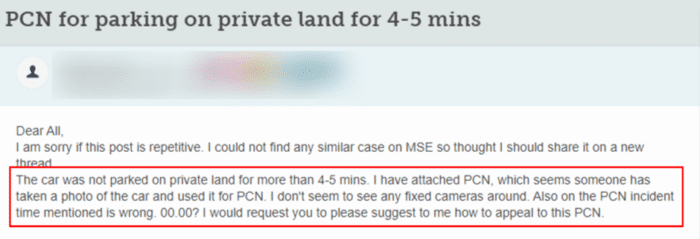
Source: Moneysavingexpert

The observation time, is a 5-minute period, during which you will have been witnessed committing an offence.

A good example here, is if you were unloading or loading cargo.

First, under the definition of a parked car, the ability to stop and unload or load cargo is allowed. 

Now, if either a traffic warden, or a traffic camera, were to see you start to unload/offload, there is generally provision for short-term parking in restricted areas to facilitate this.

However, if after the 5-minute observation period is up, you are not seen continuing to unload/offload. and are in fact simply just parked, this could trigger a penalty.

Put simply, the 5-minute observation period is a window for evaluating whether you are, or are not committing an offence that could result in a PCN being issued.

» TAKE ACTION NOW: Get legal support from JustAnswer

When Does it Apply?

In some situations, the 5-minute observation period is simply not workable.

You need to understand that you can’t treat the observation period as some kind of buffer in these situations.

Below, are some examples of scenarios when the observation period would be moot.

  • You did not display a disabled sticker when you parked in a disabled bay.
  • You were offloading or loading cargo in a zone that is designated as no stopping to unload/load.
  • You did not display a valid ticket when parked in a pay and display bay.
  • You parked in a permit-only holder bay, but did not display a valid permit.

In each of these scenarios, waiting and observing for 5-minutes does not change any of the facts of the offence.

And therefore, no observation period is applied to the reason for issuing a PCN.

Check the right challenge process

Check whether you need to make an informal challenge, formal representations or an independent tribunal appeal. Follow the route and deadline printed on your notice. London cases generally go to London Tribunals; relevant cases in England outside London and Wales go to the Traffic Penalty Tribunal. Other UK jurisdictions have different procedures.

Get started

General information. The procedure depends on the notice and jurisdiction. Check the issuer’s instructions.

Should You Pay the PCN?

If you receive a PCN from a local authority, you should not just ignore it.

You should either pay it or appeal against it.

When you do not deal with it, the council will continue to pursue you for the debt.

You have 28-days from the date the PCN was issued to pay it.

If you do not pay within this time period, you will be sent a court order, demanding that you make full payment within 14-days.

If you still don’t pay the PCN, further legal action may be taken against you.

Most local authorities will not let you pay the penalty charge in instalments.

But if you need some breathing space to get the cash together to pay, you can go through the informal appeal process outlined in the next section.

Can You Present an Appeal?

Every local authority has an informal appeal process in place, that can be used to challenge the penalty charge notice.

You need to either appeal online (if applicable) or appeal by post.

You will then receive a reply by post (or email) telling you what the outcome of your appeal was (success or failure).

You might also receive a letter asking you to provide more information or evidence.

If the informal appeal fails, you do have the option of going on to the formal representation stage of the appeal process.

The next stage is to escalate your appeal to an independent tribunal and their decision is final. To help you better understand the appeal process, here’s a quick table.

When Action
On receiving a council PCN Read the notice, keep it, gather evidence and note all payment and challenge deadlines.
Windscreen or handed-to-driver PCN An informal challenge may be available before the Notice to Owner. Early challenge can preserve a discount under the authority’s policy; 14 days is not a universal final appeal deadline.
Postal PCN or Notice to Owner Normally make formal representations within 28 days as stated on the notice. Do not assume there is an extra informal stage.
Representations rejected The Notice of Rejection explains how to appeal to the appropriate independent tribunal, normally within 28 days.
Appeal unsuccessful Pay by the deadline given in the decision or obtain advice on any available review. Further statutory charges can follow if you do neither.
Other ticket type Private parking charges and FPNs use different procedures; follow the actual notice.

Further guidance: Traffic Penalty Tribunal; Citizens Advice.

JustAnswer is a paid third-party question-and-answer service providing general information. Its standard service does not create a solicitor-client relationship. Membership can renew automatically with recurring charges until cancelled. Check the initial price, renewal price and cancellation terms before signing up. Buying this service does not guarantee a successful challenge. See JustAnswer’s membership and cancellation information.
Get started

Historical JustAnswer review image. The displayed rating and review total are not live. Reviews do not predict your case outcome. Membership fees and renewal terms apply.

Potential consequences of unpaid PCNs

You risk being given a County Court Judgement (CCJ) when you fail to pay a Penalty Charge Notice.

The issuer can ask the court to register the fine as a debt which can be enforced by bailiffs (enforcement officers).

A CCJ on your credit file will impact your ability to borrow money until it expires in 6 years.

Getting More Help and Advice

As I see it, deciding whether to simply pay a penalty charge notice, or to appeal it, depends on whether you believe you could win an appeal.

Even though there is no downside to losing the informal appeal process, if you are sure your appeal will fail, it might make sense just to pay the PCN and be done with it.

You can do some web research to try and find out what others have done in a similar situation to your own.

But make sure you double-check all the information you find online before deciding what to do.

JustAnswer is a paid third-party question-and-answer service providing general information. Its standard service does not create a solicitor-client relationship. Membership can renew automatically with recurring charges until cancelled. Check the initial price, renewal price and cancellation terms before signing up. Buying this service does not guarantee a successful challenge. See JustAnswer’s membership and cancellation information.

A paid service is optional. Gather your notice and evidence, check the deadline and decide whether you need professional advice about your circumstances.

Get started

Commercial link to JustAnswer. MoneyNerd may receive a referral fee. Check all charges and cancellation terms before signing up.

References

  1. SkyNews – Parking Tickets Statistics
Did you like this article?
Show your support ❤️
We're glad you liked the article! As a small team, your support means everything to us. If you could rate us on Google, it would be amazing. Thank you!
We are so sorry...

Is there something missing? We’re all ears and eager to improve. Send us a message and let us know how we can make our article more useful for you.

You can email us directly at [email protected] to share your feedback.

The authors
Scott Nelson MoneyNerd
Author
Scott founded MoneyNerd after his own experience with debt. He runs the website and oversees its general information about debt and other money matters. Scott does not provide personal debt advice or recommend debt solutions through MoneyNerd. If you make a debt enquiry, MoneyNerd may introduce you to The Debt Advice Service, which provides any personal debt advice.
Janine Marsh MoneyNerd
Appeals Expert
Janine contributed articles and videos to MoneyNerd about everyday money, household costs, debt topics and parking matters. She has a background in broadcasting, including work with BBC Radio 5 Live and Bauer radio stations.