PO Box 189 Huddersfield HD8 1DY: Check a Debt Letter


MoneyNerd introduces enquiries to The Debt Advice Service and may receive a referral fee. For free, independent guidance and help finding a debt adviser, visit MoneyHelper.
This information and enquiry service is not a full financial assessment or a guarantee of suitability or debt write-off. Debt solutions are not suitable for everyone. Fees may apply, and your credit record and assets may be affected. Get advice on your circumstances before choosing a solution.

MoneyNerd introduces enquiries to The Debt Advice Service and may receive a referral fee. For free, independent guidance and help finding a debt adviser, visit MoneyHelper.
This information and enquiry service is not a full financial assessment or a guarantee of suitability or debt write-off. Debt solutions are not suitable for everyone. Fees may apply, and your credit record and assets may be affected. Get advice on your circumstances before choosing a solution.
Quick answer
A return address such as PO Box 189, Huddersfield, HD8 1DY does not by itself identify or authenticate a sender. Check the company name and account reference inside the letter before responding or paying.
If it claims to be from Lowell, confirm the contact through Lowell’s official website. Its current published postal address is PO Box 13079, Harlow, CM20 9TE.
Four details to check on your letter
- Named sender: find the company name inside the letter, then look up its official contact details independently.
- Original creditor: check which account the letter concerns and whether you recognise it.
- Reference and balance: compare these with your own records. Ask for an explanation if something does not match.
- Type of letter and deadline: distinguish an ordinary collection letter from a Letter of Claim, court papers or an enforcement notice.
If the letter names Lowell, check Lowell’s official contact details.
Have You Had Letters From Them?
Collectors can send account letters, but excessive or misleading contact can be challenged. Keep the actual correspondence and avoid assuming the sender’s identity from the envelope alone.
Don’t ignore them!
I always recommend responding to debt collectors — even just to question the debt’s validity.
Ask for the creditor’s name, account reference, balance breakdown and evidence that you are liable. For regulated consumer credit debts, a firm must pause recovery while it investigates a dispute on valid or potentially valid grounds. A request for information does not itself cancel the debt or extend a court deadline.
For regulated consumer credit collection, FCA rules require firms to give due regard to reasonable requests about when, where and how they contact you. You can ask for letters or emails instead of calls and explain any health or accessibility needs. This is not an automatic ban on every call or required notice. Keep a record of unreasonable contact and complain if your request is not properly considered.
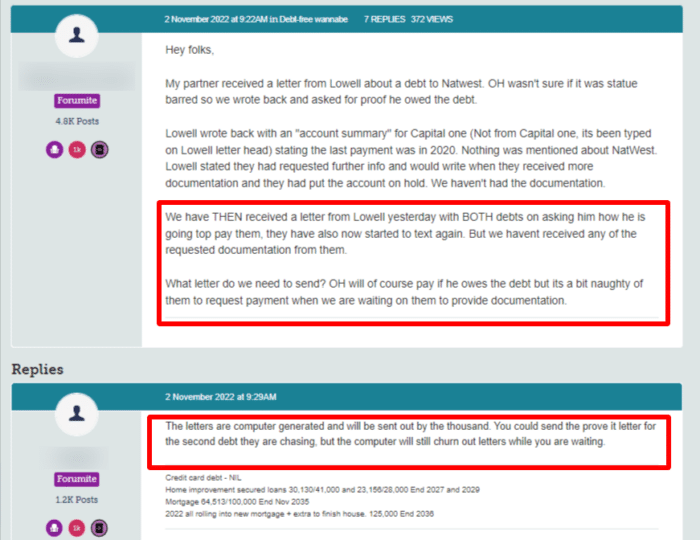
This person talks about statute-barred debts in their query. Understanding statute-barred debts can be tricky so I recommend that you speak to a debt charity to find out for certain if your debt is statute-barred.
For many unsecured debts in England and Wales, the usual limitation period is six years from the relevant cause of action, not simply the last phone call. A payment, qualifying written acknowledgement or court proceedings can affect the position. Scotland usually has a five-year prescription period for many ordinary debts, with different rules and exceptions. Court judgments, secured debts and some tax debts require separate advice. Get free debt advice before paying or acknowledging an old debt; do not ignore court papers.
A limitation defence and a debt being extinguished are different legal outcomes. The answer depends on the jurisdiction and kind of debt.
If a court claim arrives, obtain advice and respond in time even if you believe the debt is too old. A limitation argument is not necessarily considered automatically.
Court judgments, secured debts and some tax debts have different rules. A CCJ does not simply stop being enforceable when its credit-file entry disappears.
Why Would One of These Firms Be Contacting You?
If the letter is genuinely from Lowell, it may concern an account Lowell owns or is authorised to collect. Ask for the original creditor and evidence linking the account to you.
In the case of Lowell Financial, they may have bought the debt from the creditor, and aim to collect the money for themselves.
The amount a debt buyer paid for an account does not determine the amount legally owed.
Some examples of the kinds of debts these firms might be chasing are given below.
- Credit card debt.
- Personal loans, either secured or unsecured.
- Car finance or hire purchase.
- Unpaid utility bills or cellphone bills.
- Rent arrears to a private landlord.
- Catalogue debt.
Debt advice: Continue to the debt enquiry form
Advertisement. MoneyNerd is a commercial introducer, not a debt adviser. The Debt Advice Service, a trading style of Pacific Financial Solutions Limited, offers free debt advice with no obligation. If you request an introduction, your details are shared with them so they can contact you.
Some debt solutions have fees and may negatively affect your credit rating. MoneyNerd may receive a fee if you proceed with a debt solution through The Debt Advice Service. MoneyHelper offers free, impartial money guidance and help finding free debt advice.
Recognise the debt but struggling to pay?
MoneyNerd can introduce you to The Debt Advice Service for free debt advice. Complete the enquiry to ask their team to contact you about your options. There is no obligation to proceed.
This is an enquiry to The Debt Advice Service, not a message to the debt collector. If you request an introduction, MoneyNerd will share your details with their team so they can contact you.
MoneyNerd does not provide debt advice or recommend debt solutions. The Debt Advice Service is a trading style of Pacific Financial Solutions Limited. Some debt solutions have fees and may affect your credit record and assets. MoneyNerd is a commercial introducer and may receive a fee if you go ahead with a debt solution through The Debt Advice Service.
For free, impartial guidance and help finding a debt adviser, visit MoneyHelper.
Have You had a Claims Form Pack From the Local County Court?
A debt claim in England and Wales follows the applicable pre-court and court process. Do not treat every collection letter as a court claim.
- Letter of Claim: where the Debt Claims Protocol applies, a business normally gives an individual 30 days to reply. Use the Reply Form, request necessary documents and seek advice.
- Default notice: certain Consumer Credit Act agreements require a compliant default notice before specified enforcement steps. This is separate from a Letter of Claim; the order is not a universal two-stage sequence.
If a claim is issued, the claim form has its own deadline. A complaint or request for documents sent to the collector does not replace your court response.
Get advice promptly about admitting, defending or responding to the claim. Affordability matters if payment terms are being considered, but it does not by itself defeat a valid claim.
A CCJ normally remains on the register and credit file for six years. Paying it in full within one month can allow removal; paying later normally marks it satisfied. The debt does not automatically expire after six years.
Did the County Court Issue a County Court Judgment?
If you do not respond to a validly served claim in time, the claimant may request default judgment. This is not the same as every ignored letter automatically creating a CCJ.
Read the judgment and get advice about payment, variation or any grounds to set it aside. An unpaid judgment can lead to a separate enforcement application.
About The Debt Advice Service
Use the enquiry form to request a call about your circumstances and available options. You decide whether to proceed.

Advertisement. MoneyNerd introduces enquiries; we do not give debt advice or recommend solutions. The Debt Advice Service, a trading style of Pacific Financial Solutions Limited, offers free debt advice with no obligation. Complete the enquiry form to share your details and request a call.
Some debt solutions have fees and may negatively affect your credit rating. MoneyNerd may receive a fee if you go ahead with a debt solution through The Debt Advice Service. For free, impartial guidance and help finding free debt advice, visit MoneyHelper.
Could Bailiffs Visit?
Bailiffs are not sent automatically after a CCJ. An appropriate enforcement application and authority are needed. Under the rules applying from 1 May 2026, the usual Notice of Enforcement period is at least 14 clear days, with qualifications and possible court shortening.
Verify the enforcement agent, authority and balance before paying. Use the payment methods confirmed by the authorised service and obtain a receipt.
Enforcement agents can take control of eligible goods under the relevant authority, subject to entry rules and exemptions. Ordinary collectors cannot do this.
Enforcement fees are set by the applicable rules and stage, not simply an average charge for visiting. The current fees and transitional rules may matter.
| Stage | Fixed fee | Percentage fee on the amount above £1,900 |
|---|---|---|
| Compliance | £79 | None |
| Enforcement | £247 | 7.5% |
| Sale or disposal | £116 | 7.5% |
| Stage | Fixed fee | Percentage fee on the amount above £1,200 |
|---|---|---|
| Compliance | £79 | None |
| First enforcement | £200 | 7.5% |
| Second enforcement | £520 | None |
| Sale or disposal | £550 | 7.5% |
England and Wales: fee scale introduced on 1 May 2026. Earlier enforcement action is preserved by the transitional rules; check which scale applies to the particular case. Permitted disbursements and, in some High Court cases, a sum equivalent to VAT can be additional.
Second-stage fees are subject to statutory conditions. A first visit with no contact alone does not justify immediate escalation without another opportunity to pay or arrange repayment.
How Do I Complain About the Sender?
Complain to the verified firm about the specific conduct or account issue. Do not assume that a PO box identifies a particular solicitor or regulator.
Keep the complaint, evidence and response. A complaint does not extend a court or enforcement deadline.
Complain to the firm first and keep copies and call logs. For an eligible regulated financial complaint, you can normally approach the Financial Ombudsman Service after a final response or after eight weeks without one, usually within six months of the final response. The Ombudsman can require a remedy or compensation; it does not impose regulatory fines. Tax, council and other non-credit debts may have different complaint routes.
If the letter is from a solicitor, professional-conduct concerns may go to the relevant legal regulator. The Legal Ombudsman normally deals with complaints about your own legal service provider, not an opposing creditor’s solicitor.
References