ACT Credit Management: Debt Letters and Your Options


MoneyNerd introduces enquiries to The Debt Advice Service and may receive a referral fee. For free, independent guidance and help finding a debt adviser, visit MoneyHelper.
This information and enquiry service is not a full financial assessment or a guarantee of suitability or debt write-off. Debt solutions are not suitable for everyone. Fees may apply, and your credit record and assets may be affected. Get advice on your circumstances before choosing a solution.

MoneyNerd introduces enquiries to The Debt Advice Service and may receive a referral fee. For free, independent guidance and help finding a debt adviser, visit MoneyHelper.
This information and enquiry service is not a full financial assessment or a guarantee of suitability or debt write-off. Debt solutions are not suitable for everyone. Fees may apply, and your credit record and assets may be affected. Get advice on your circumstances before choosing a solution.
When a surprise letter comes from a debt collector, it can be a bit scary. You may wonder, why do I owe ACT Credit Management money? Should I pay it? Is this a real company?
A debt letter can be worrying. Keep the correspondence, check the creditor and balance, and note any response deadline. Free independent debt advice is available.
If dealing with debt is affecting your wellbeing, seek support and tell the firm about any communication or accessibility needs. A debt adviser can help you decide what to do next.
In this article, we’ll cover:
- What ACT Credit Management is and if it’s a real company.
- Who ACT Credit Management collects debts for.
- How ACT Credit Management may try to get money from you.
- What to do if you get a letter from ACT Credit Management.
- Options for handling your debt, such as a Debt Management Plan or Bankruptcy.
Remember, you’re not in this alone. We’re here to help you through it.
Have you received a letter?
A collection demand is not necessarily a formal Letter of Claim. Read the document carefully, check who the creditor is and respond by any stated deadline. If court papers arrive, follow the court’s deadline even while you are disputing the account or waiting for documents. See related guidance.
The size of a debt alone does not tell you whether proceedings will be issued. Check the documents and obtain advice promptly if legal action is proposed.
Keep a record of any conduct you consider misleading, threatening or excessive. A lawful warning of possible court action is different from pretending to have powers the firm does not possess. A complaint should identify the actual words, dates and evidence.
If you are struggling with several debts, an adviser can help you prioritise essentials and compare suitable options.
Request proof the easier way!
Keep copies of your correspondence and avoid admitting liability for a disputed or potentially time-barred debt before taking advice. A letter to the collector is not a court defence and does not extend a court deadline.
To make things easier, you can use our own letter template to ask for proof of the debt. This will save you time and ensure your request is made firmly.
If you dispute the debt, explain why and request an itemised balance and evidence of liability. For recovery covered by FCA consumer-credit rules, a valid or potentially valid dispute must be investigated and recovery paused. A generic proof request does not cancel a debt, override an existing judgment or extend a court deadline.
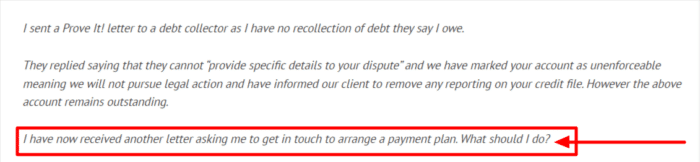
Do not treat the unanswered document request described in an online post as permission to ignore later correspondence. Read each letter and respond to any formal claim on time.
Understand your debt options
MoneyNerd can introduce you to The Debt Advice Service for free debt advice. MoneyNerd does not provide debt advice or recommend debt solutions.
The Debt Advice Service can explain your options, including their benefits, costs and risks. Options available depend on your circumstances. There’s no obligation to take a debt solution.
MoneyNerd does not provide debt advice or recommend debt solutions. The Debt Advice Service is a trading style of Pacific Financial Solutions Limited. If you request an introduction, we’ll share your details with their team so they can contact you.
Some debt solutions have fees and may negatively affect your credit rating. MoneyNerd is a commercial introducer and may receive a fee if you go ahead with a debt solution through The Debt Advice Service.
For free, impartial money guidance and help finding free debt advice, visit MoneyHelper.
Should you pay them?
Check the account and independently verify the payment destination first. If the debt is enforceable and affordable after essential costs and priority debts, consider payment or an agreed plan. Do not borrow further or miss essential bills simply to meet a collection demand.
Prepare a budget covering essential living costs and priority debts first. Propose only instalments you can afford, and obtain written acceptance and confirmation of any interest or action being paused. An offer alone does not guarantee agreement or stop a court claim.
An evidence request is useful where you genuinely dispute the account or balance:
- Explain what you dispute and ask for supporting documents.
- Continue to meet any court deadline while documents are being obtained.
- Tell the firm if it has contacted the wrong person and ask it to correct its records.
Could a time limit affect the debt?
For many unsecured contractual debts in England and Wales, the usual period for starting a court claim is six years from when the creditor could sue. A payment or qualifying signed written acknowledgment before expiry can restart it. A creditor’s letter alone does not restart it. Debt type, court action and jurisdiction matter; a limitation defence does not normally extinguish an England and Wales debt.
Many ordinary unsecured debts may become statute-barred after six years in England and Wales, or prescribed after five years in Scotland. The start date, debt type, payments, legally relevant acknowledgments and any court claim all matter. A creditor’s letter alone does not restart the period. Ask a debt adviser to check the facts before paying or admitting liability, and respond to any court papers on time.
Scotland has different prescription rules: certain debts are extinguished after five years without a relevant claim or acknowledgment, subject to the applicable rules. This is not the same as the England and Wales limitation defence. Ask an adviser to check the debt type, dates and any court action.
Keep in mind that not all debts become statute-barred!
A debt with an existing judgment, council tax liability order or enforcement warrant cannot be assessed using a simple six-years-since-last-payment rule. Tax debts also have special rules. A judgment does not disappear when its six-year credit-file entry ends, although later enforcement may require court permission.
If your debt is statute-barred, you can use my free letter template to write to ACT and explain the situation.
If you are unsure about the status of your debt, you can contact a debt charity for some advice. Their advisors will be able to look at the debt in question, determine its status, and advise you on your next steps.
Thousands have already tackled their debt
Every day, our partner, The Debt Advice Service, helps people understand their options for dealing with debt. Their debt advice is free, with no obligation to proceed.
MoneyNerd introduces you to The Debt Advice Service. We do not provide debt advice or recommend debt solutions.

Natasha
Very helpful and informative thank you

If you submit the enquiry form, MoneyNerd will share your details with The Debt Advice Service so they can contact you.
Some debt solutions have fees and may negatively affect your credit rating. MoneyNerd may receive a fee if you go ahead with a debt solution through The Debt Advice Service.
The Debt Advice Service is a trading style of Pacific Financial Solutions Limited.
For free, impartial help and access to not-for-profit debt advice, visit MoneyHelper.
How do they chase you?
ACT Credit Management will chase you for payment on a debt by calling, texting and emailing. But the most important communication you’ll receive from this is the ACT Credit Management debt letter.
We’ll come back to these letters shortly. But first…
» TAKE ACTION NOW: Fill out the short debt form
Online reviews
These are individual reviews reproduced from an earlier version of this article. They are not a current representative survey or verified findings about the firm. Your response should depend on your account and the evidence.
“Try to make an arrangement with clearing out my debt and they forced me to pay more than I could afford! The guy was absolutely horrible!”
- Dan P (Google review)
“I don’t understand why you guys are charging me so much! Maybe you are collecting my tuition from the college. Your harassing letters affect me badly! It was agreed at the beginning, but now it is forcibly asked for money! Obviously bullying people?”
- Sa Le (Google review)
What Happens If I Don’t Pay?
Non-payment can lead to further recovery action, depending on the account and circumstances.
- Your creditor will send you reminders and then demands that you pay any missed payments
- The account may default, subject to any applicable notice requirements.
- If you still don’t pay your debts, your creditor can choose to sell your debt to a debt collection agency or employ an agency to chase you for the missed payments. This is when you’ll most likely meet ACT Credit Debt Management.
- The creditor, or solicitors acting for it, may bring a court claim if entitled to do so. Only the court can issue a judgment. A claim form is not a CCJ: respond within its deadline, as judgment can be entered in default without a hearing.
An ordinary debt collector has no bailiff powers: it cannot force entry or seize your goods. You can decline a doorstep discussion and ask the visitor to leave. The creditor may still take lawful court action; authorised enforcement after judgment is a separate process. Collectors must protect your privacy and must not unfairly disclose a debt to relatives, neighbours or an employer. They can communicate with an authorised representative or make other legally permitted disclosures. Contact must be proportionate and must not amount to harassment.
How do I Make a Complaint?
If you think that ACT Credit Management has been unreasonable or behaved inappropriately, you can make a complaint. You can also make a complaint if you feel that they have broken any of the Financial Conduct Authority’s (FCA) guidelines.
Make your first complaint to ACT Credit Management so that they have the chance to sort out the issue themselves. If you feel that they have not taken your complaint seriously enough or have not addressed your issue properly, you can escalate matters.
Complain to the business first. If the activity falls within the Financial Ombudsman Service’s remit, you can normally escalate after a final response or eight weeks without one, usually within six months of the final response. The Ombudsman can require redress, such as compensation or correcting records; it does not fine firms or remove their authorisation.
Know Your Rights
To have an edge over the situation, it’s important that you know your rights and those of debt collectors. Here’s a quick table summarizing everything you need to know.
| Debt collectors may | Limits and protections |
|---|---|
| Contact you to seek payment | For regulated consumer credit, contact must be at reasonable times and respect reasonable requests about when, where and how you are contacted. |
| Ask to discuss the debt at a home visit | A collector has no bailiff powers, cannot force entry or take goods, and should leave when asked. |
| Explain possible court action | They must not mislead you about their powers or threaten action they cannot lawfully take. |
| Discuss an affordable repayment or settlement | Get agreed terms in writing and obtain free advice if you dispute the debt or cannot afford payments. |
| A creditor may seek a separate court enforcement order | A CCJ alone does not give a collector access to your bank account. A third-party debt order requires a separate court process. |
| A creditor may assign a debt | Check who owns it and who is authorised to collect; do not disclose payment details to an unverified caller. |
| Make proportionate follow-up contact | Harassment is prohibited. Requests about contact must be considered; necessary legal notices may still be sent. |
ACT Credit Management Contact Details
| Postal address and telephone | ACT Credit Management Ltd, Tara House, 46 Bath Street, Glasgow, G2 1HG. Telephone: 0203 1500 150. |
| Customer enquiries | Use the customer-enquiry email or live chat on ACT’s current official Contact Us page. See ACT customer contact page. |
| Website: | https://www.actcredit.com/ |
References