







Asset Link Capital: Checking a Debt and Your Options








MoneyNerd introduces enquiries to The Debt Advice Service and may receive a referral fee. For free, independent guidance and help finding a debt adviser, visit MoneyHelper.
This information and enquiry service is not a full financial assessment or a guarantee of suitability or debt write-off. Debt solutions are not suitable for everyone. Fees may apply, and your credit record and assets may be affected. Get advice on your circumstances before choosing a solution.
MoneyNerd introduces enquiries to The Debt Advice Service and may receive a referral fee. For free, independent guidance and help finding a debt adviser, visit MoneyHelper.
This information and enquiry service is not a full financial assessment or a guarantee of suitability or debt write-off. Debt solutions are not suitable for everyone. Fees may apply, and your credit record and assets may be affected. Get advice on your circumstances before choosing a solution.
This guide explains how to check an Asset Link Capital demand, identify the account owner and respond if you dispute the debt or cannot afford payment.
In this article, we’ll help you to:
- Understand who Asset Link Capital are.
- Find out why they are contacting you.
- Explore if you really need to pay them.
- Discover your rights and what to do if you can’t pay.
- Learn about debt solutions like Debt Management Plans and Bankruptcy.
Collection contact can be stressful. Keep the paperwork and seek free debt advice if you need help checking the account or choosing a response.
Our aim is to share useful information to assist you in dealing with Asset Link Capital Debt Collection. We can guide you on how to talk to them, how to settle your debt, and even how to write off some of it if possible.
Let’s dive in.
Should I pay Asset Link Capital?
Check that the demand is genuine, the balance is correct and you are legally liable. Affordability affects the available response, but inability to pay does not by itself cancel a valid debt.
Make sure that all the letters and documents you receive from them are accurate and have all the correct details on. Sometimes these letters are for the wrong person, or it might be a debt you don’t actually owe.
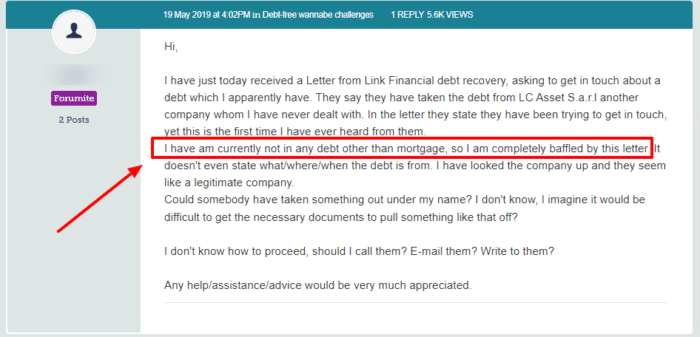
If you dispute the account, explain why and request relevant evidence. Adapt a template to the facts; sending it does not extend any court deadline. See related guidance.
Also, if it is a debt from a while ago, you may not actually have to pay it at all.
Many ordinary unsecured debts may become statute-barred after six years in England and Wales, or prescribed after five years in Scotland. The start date, debt type, payments, legally relevant acknowledgments and any court claim all matter. A creditor’s letter alone does not restart the period. Ask a debt adviser to check the facts before paying or admitting liability, and respond to any court papers on time.
For ordinary simple-contract debts in England and Wales, limitation generally restricts the court remedy rather than cancelling the balance. Scottish prescription can extinguish the obligation.
Keep in mind that not all debts become statute-barred!
Tax debts and judgments have different rules. A CCJ does not automatically expire after six years, although certain later enforcement steps require the court’s permission.
If the balance is valid and payment is affordable after essential costs and priority debts, use a verified payment route. Otherwise, discuss an affordable arrangement or other options with a debt adviser.
If you dispute the debt, explain why and ask for an itemised balance and evidence that you are liable. For recovery covered by FCA consumer-credit rules, a valid or potentially valid dispute must be investigated and recovery paused. A generic proof request does not cancel a debt, override an existing court order or extend a court deadline.
Why are they getting in touch?
Check the exact legal entity and account named on your letter. Different numbered Asset Link Capital companies and the firm administering an account should not be treated as interchangeable.
The current Asset Link Capital website identifies No.7, No.9 and No.10 as trading names of Link Financial Outsourcing Limited for loan administration.
Ask who owns the debt and who is administering it. An appointment to collect or administer an account does not by itself show that ownership has changed.
Debt portfolios may be sold at a discount, but purchase prices vary and do not determine your legal liability or guarantee a reduced settlement.
Understand your debt options
MoneyNerd can introduce you to The Debt Advice Service for free debt advice. MoneyNerd does not provide debt advice or recommend debt solutions.
The Debt Advice Service can explain your options, including their benefits, costs and risks. Options available depend on your circumstances. There’s no obligation to take a debt solution.
MoneyNerd does not provide debt advice or recommend debt solutions. The Debt Advice Service is a trading style of Pacific Financial Solutions Limited. If you request an introduction, we’ll share your details with their team so they can contact you.
Some debt solutions have fees and may negatively affect your credit rating. MoneyNerd is a commercial introducer and may receive a fee if you go ahead with a debt solution through The Debt Advice Service.
For free, impartial money guidance and help finding free debt advice, visit MoneyHelper.
What rights do they have?
There are some rights that debt collection agencies do have, but there are a lot of things that they’re not permitted to do. This is to try to make sure that there are fair debt collection practices at all times.
Link Financial Outsourcing Limited identifies itself as FCA authorised under reference 606817. FCA rules apply within their scope; the Credit Services Association is a trade body with a member code, not the financial regulator. See related guidance.
Debt collection agencies are famously persistent when it comes to sending letters and making phone calls. There is a fine line between persistence and harassment though, and if you feel like Asset Link Capital Limited is going a step too far, then you have every right to make a complaint about them.
Ask for a reasonable contact method and explain any vulnerability. The firm should consider your circumstances, but a preference or debt solution does not automatically prevent every necessary legal notice or communication.
An ordinary debt collector has no power to force entry or take goods. It may request a voluntary visit or payment, but you can refuse entry and ask it to leave. Bailiff enforcement requires separate lawful authority. Rules for an enforcement agent’s notice are different from an ordinary collector’s visit.
Know Your Rights
Knowing your rights and those of the debt collectors contacting/visiting your home is key to avoiding being taken advantage of. Debt collectors must abide by certain rules and can’t do anything they please when pursuing a debt.
Here’s a quick table summarizing what debt collectors can and can’t do.
| Debt collectors may | Limits and protections |
|---|---|
| Contact you to seek payment | For regulated consumer credit, contact must be at reasonable times and respect reasonable requests about when, where and how you are contacted. |
| Ask to discuss the debt at a home visit | A collector has no bailiff powers, cannot force entry or take goods, and should leave when asked. |
| Explain possible court action | They must not mislead you about their powers or threaten action they cannot lawfully take. |
| Discuss an affordable repayment or settlement | Get agreed terms in writing and obtain free advice if you dispute the debt or cannot afford payments. |
| A creditor may seek a separate court enforcement order | A CCJ alone does not give a collector access to your bank account. A third-party debt order requires a separate court process. |
| A creditor may assign a debt | Check who owns it and who is authorised to collect; do not disclose payment details to an unverified caller. |
| Make proportionate follow-up contact | Harassment is prohibited. Requests about contact must be considered; necessary legal notices may still be sent. |
What are your next steps if Asset Link Capital Debt Collection have contacted you?
» TAKE ACTION NOW: Fill out the short debt form
You’ve got a letter from Asset Link Capital and you’re now dealing with debt collectors. So what do you do next?
Don’t ignore them
Asset Link Capital Debt Collection won’t just leave you alone if you ignore their letters and calls. They will keep on trying to contact you, so it is best to take the bull by the horns and see what you can do about it. Make sure you have all the information about the issue to hand, as this will make things much easier.
Get in touch with them
If you get in touch with them as soon as you can, then you will be on the front foot. So, if the debt is definitely yours, give them a call or write them a letter and get things underway as soon as possible.
Explain a dispute and request an itemised balance and evidence of liability. A valid or potentially valid dispute within FCA consumer-credit rules must be investigated with recovery paused, but a generic evidence request does not cancel a debt, override a court order or extend a court deadline. See related guidance.
Settle your debt
If you agree that payment is due, consider an affordable proposal after essential costs and priority debts. Get any repayment arrangement or settlement terms confirmed in writing.
For those that are having difficulties with debt, you can check out my guide on debt options. This post outlines some of the ways you can get back on top of your finances.
Thousands have already tackled their debt
Every day, our partner, The Debt Advice Service, helps people understand their options for dealing with debt. Their debt advice is free, with no obligation to proceed.
MoneyNerd introduces you to The Debt Advice Service. We do not provide debt advice or recommend debt solutions.

Natasha
Very helpful and informative thank you

If you submit the enquiry form, MoneyNerd will share your details with The Debt Advice Service so they can contact you.
Some debt solutions have fees and may negatively affect your credit rating. MoneyNerd may receive a fee if you go ahead with a debt solution through The Debt Advice Service.
The Debt Advice Service is a trading style of Pacific Financial Solutions Limited.
For free, impartial help and access to not-for-profit debt advice, visit MoneyHelper.
What happens if I can’t pay them?
Explain financial difficulty and provide a realistic budget if appropriate. A payment plan may be agreed, but the firm is not obliged to accept every proposal.
A creditor may bring a court claim. Bailiff enforcement requires separate lawful authority after the relevant process; a collection letter alone does not authorise seizure. A bankruptcy petition has specific legal conditions and is not an automatic next step.
If you are struggling with your debts, you may benefit from a debt solution. There are several options for debt relief in the UK so you will need to get some advice before you commit to a solution. I have linked a few organisations at the bottom of this page who offer free financial advice for debt management and free debt counselling services.
Debt Management Plan (DMP)
A DMP is an informal debt solution that lets you pay off your debts via a single monthly payment.
A DMP normally aims to repay included unsecured debts in full. It is voluntary and does not guarantee frozen interest or protection from court action.
Individual Voluntary Arrangement (IVA)
An IVA is a formal insolvency arrangement managed by an insolvency practitioner. Your proposal sets out payments, any assets involved and fees. Once approved, it binds the creditors and debts covered by it and restricts recovery action; it is not a blanket ban on necessary correspondence.
Many IVAs involve payments for five or six years, but the agreed term varies. Qualifying unpaid debt is normally released only on successful completion. An IVA affects your credit record, may involve assets or home equity, and can fail if its terms are not met.
IVA suitability depends on your debts, affordable contributions or available assets, fees and creditor approval. There is no universal rule that you must owe several thousand pounds to more than one creditor. Get independent debt advice and compare other options before agreeing to an IVA.
Trust Deed
IVAs are not available in Scotland. A Scottish money adviser can compare a protected trust deed, the Debt Arrangement Scheme, sequestration and informal arrangements; a trust deed is not compulsory.
A protected trust deed is a Scottish insolvency arrangement, usually lasting at least four years of contributions. It can discharge qualifying unpaid debt on successful completion, but fees apply and your home or other assets may be at risk. Covered creditors cannot pursue payment outside it, but can still send required documents.
Debt Relief Order (DRO)
In England and Wales, a DRO may suit an eligible non-homeowner with low surplus income, limited assets and qualifying debts within the £50,000 limit. Detailed income, asset, vehicle and residence rules apply. An approved debt adviser checks eligibility and submits the application to the Insolvency Service.
During a DRO, included qualifying debts are protected from most recovery action under the moratorium rules. This is not a ban on every necessary communication, and excluded debts and ongoing bills still need attention.
A DRO normally lasts 12 months. If it remains in force, the qualifying debts listed in it are normally discharged at the end. You must report relevant changes and continue paying ongoing bills and excluded debts, such as court fines and student loans.
Bankruptcy
If you have debts but no realistic possibility of ever paying them off, you may need to declare bankruptcy.
Bankruptcy has an unfair stigma attached to it as it may be your only way of getting a financial fresh start. That said, it is a serious financial situation that should not be taken lightly and the effects of bankruptcy can last for several years.
Sequestration
Sequestration is Scottish bankruptcy. An approved Scottish money adviser can assess eligibility for the Minimal Asset Process (MAP), a form of sequestration, and compare other suitable options. Eligibility and consequences must be checked; it is not automatically the best choice for everyone with a low income. See related guidance.
How do I complain about their actions?
If you think that Asset Link Capital has been unreasonable or behaved inappropriately, you can make a complaint. You can also make a complaint if you feel that they have broken any of the Financial Conduct Authority’s (FCA) guidelines or the Credit Services Association’s (CSA) guidelines.
Make your first complaint to Asset Link Capital so that they have the chance to sort out the issue themselves. If you feel that they have not taken your complaint seriously enough or have not addressed your issue properly, you can escalate matters.
Complain to the business first. If the activity falls within the Financial Ombudsman Service’s remit, you can normally escalate after a final response or eight weeks without one, usually within six months of the final response. The Ombudsman can require redress, such as compensation or correcting records; it does not fine firms or remove their authorisation.
If the business is a CSA member, the association’s complaints process may consider compliance with its code. This is separate from an eligible Ombudsman complaint and does not decide a court claim or automatically cancel a debt. See related guidance.
Asset Link Capital Debt Contact Details
| Address: | No.7 accounts: PO Box 255, Caerphilly CF83 9FF. Shawbrook: 03330 150285; Esme Loans: 02920 858789; NewDay: 02920 858788. No.9 accounts use the same postal address: Future Finance 02920 858786; Bamboo Loans 02920 858746. Verify the account-specific route on the official website before sharing information. See related guidance, related guidance, related guidance, related guidance. |
| Website: | https://assetlinkcapital.com/ |
References