Using Your Pension to Pay Debt: Risks and Alternatives


MoneyNerd introduces enquiries to The Debt Advice Service and may receive a referral fee. For free, independent guidance and help finding a debt adviser, visit MoneyHelper.
This information and enquiry service is not a full financial assessment or a guarantee of suitability or debt write-off. Debt solutions are not suitable for everyone. Fees may apply, and your credit record and assets may be affected. Get advice on your circumstances before choosing a solution.
MoneyNerd introduces enquiries to The Debt Advice Service and may receive a referral fee. For free, independent guidance and help finding a debt adviser, visit MoneyHelper.
This information and enquiry service is not a full financial assessment or a guarantee of suitability or debt write-off. Debt solutions are not suitable for everyone. Fees may apply, and your credit record and assets may be affected. Get advice on your circumstances before choosing a solution.
Using a pension to repay debts can reduce your future income, create a tax bill and affect benefits. Money held in a pension can also have protections that change once it is withdrawn. Speak to a free debt adviser before accessing it.
In this article, we’ll help you understand:
- The rules around using retirement funds.
- The impact on your benefits and taxes.
- How to look at your pension details.
- Ways to manage unaffordable debt.
- Answers to frequently asked questions.
This is general information, not a recommendation to withdraw or transfer a pension. A debt adviser and a pension specialist can help you understand the different consequences.
Let’s get started.
Taking money out of your pension
Taking money from a personal or workplace pension is normally a withdrawal, not a loan that you can simply repay on the same terms. You usually cannot access a private pension before age 55, rising to 57 on 6 April 2028, unless an exception such as qualifying ill health or a protected pension age applies.
Offers of “pension loans” or early unlocking can be scams. Unauthorised access can result in tax charges of up to 55%, as well as fees and losses. Check any proposal with your pension provider and read the FCA’s pension-scam guidance.
Before you take any money out, you should consider three important things that might affect you now and in the future. These three things are:
- The impact on your benefits
- The impact on your tax position
- The impact on your pension
The impact on your benefits
Withdrawing pension money may affect means-tested benefits, including Universal Credit and Pension Credit. The treatment depends on your age, the benefit and whether the money is taken as income or capital.
This is because some benefits are based on the income you receive, and can be affected by the savings you have.
Using a withdrawal to pay debts does not automatically mean there is no effect on benefits. Get a benefits assessment before withdrawing, and explain the amount, timing and intended use.
Benefit decisions can be really complicated. You can find more information by following this link to a handy document published by Age UK, or to this link from the Department for Work and Pensions (DWP).
Debt advice: Continue to the debt enquiry form
Advertisement. MoneyNerd is a commercial introducer, not a debt adviser. The Debt Advice Service, a trading style of Pacific Financial Solutions Limited, offers free debt advice with no obligation. If you request an introduction, your details are shared with them so they can contact you.
Some debt solutions have fees and may negatively affect your credit rating. MoneyNerd may receive a fee if you proceed with a debt solution through The Debt Advice Service. MoneyHelper offers free, impartial money guidance and help finding free debt advice.
The effect on tax
A pension withdrawal can increase your taxable income and affect future pension saving. Ask the provider how the proposed payment will be taxed and what information you need to check the final bill.
You can usually take up to 25% tax-free, subject to your remaining lump sum allowance, normally £268,275 across pensions. Existing protections, previous withdrawals and the type of payment can change this. Amounts outside the tax-free entitlement are generally taxed as income.
This could end up being quite a large tax bill, and you could end up with significantly less than you expect.
Flexibly taking taxable money from a defined contribution pension can trigger the Money Purchase Annual Allowance (MPAA). It is not simply triggered whenever a withdrawal exceeds 25% of a pot; the form of access and relevant exceptions matter.
The MPAA is currently £10,000 a tax year for tax-relieved defined contribution pension saving, including employer contributions. Taking only eligible tax-free cash and leaving the rest invested does not normally trigger it. Check the MoneyHelper explanation before accessing the pension.
How your pension will be affected
Taking money from your retirement fund for your debts also means that you won’t have that money in your pension when you retire.
This can reduce the income or flexibility available in retirement. The outcome depends on the pension type, withdrawal method, remaining investments and future contributions; not every pension pays a fixed monthly amount.
In addition, withdrawing early can dramatically reduce the compound growth potential of a pension. You could end up with less money for you or your beneficiaries.
Compare the proposed withdrawal with debt options that do not involve accessing the pension. A short-term reduction in debt should be considered alongside the long-term cost.
In bankruptcy in England and Wales, rights in most approved pensions are normally protected, while pension income or money withdrawn can be treated differently. Excessive contributions and other exceptions need individual advice. Do not withdraw a protected pension simply because you assume creditors could take the pot anyway.
How the introduction works
The Debt Advice Service can discuss your circumstances and explain available options, including their benefits, costs and risks.
Options depend on your circumstances. You decide whether to proceed.
Advertisement. MoneyNerd introduces enquiries; we do not give debt advice or recommend solutions. The Debt Advice Service, a trading style of Pacific Financial Solutions Limited, offers free debt advice with no obligation. Complete the enquiry form to share your details and request a call.
Some debt solutions have fees and may negatively affect your credit rating. MoneyNerd may receive a fee if you go ahead with a debt solution through The Debt Advice Service. For free, impartial guidance and help finding free debt advice, visit MoneyHelper.
The current rules
Pension freedoms introduced in 2015 expanded access options for defined contribution pensions. They did not remove minimum access ages or turn pension withdrawals into borrowing.
A withdrawal can move part of your income into a higher tax band. Pension schemes may initially deduct tax using an emergency code, so the first payment may differ from the final tax due.
The FCA’s 2017 cap applies to certain early-exit charges when eligible customers access pension freedoms. It is not a cap on every pension charge, tax bill or cost of accessing money before the permitted age. Ask the provider for a complete cost breakdown.
Ask whether the pension includes guarantees or other valuable benefits that would be lost through withdrawal or transfer. Some transfers require regulated financial advice by law.
Next steps
Before using pension money for debts, compare the effect on tax, benefits, retirement income and any existing debt arrangement. Do not make an irreversible withdrawal while those questions remain unanswered.
Here are some other information you should consider.
Look at your pension statement
Check your latest pension statement for the scheme type, contributions, charges and projected benefits. It will not necessarily show today’s exact transfer or withdrawal value, and forecasts are not guarantees.
You might need to contact your provider to get an up-to-the-minute balance.
Multiple funds
You may have paid money into more than one retirement fund. You will need to get in touch with each pension provider in order to find out how much each fund is worth.
Pension policy details
If you’ve misplaced or lost the details of your pension policy, you can use the GOV.UK website to find the contact details – follow this link.
You could also contact old employers to see if you still have a pension with them or find out who your provider was.
Income information
Make a list of all your income and their sources. This should include your wages, any benefits you might receive, the amount you might hold in savings accounts and all the assets you have too.
About The Debt Advice Service
Use the enquiry form to request a call about your circumstances and available options. You decide whether to proceed.
Advertisement. MoneyNerd introduces enquiries; we do not give debt advice or recommend solutions. The Debt Advice Service, a trading style of Pacific Financial Solutions Limited, offers free debt advice with no obligation. Complete the enquiry form to share your details and request a call.
Some debt solutions have fees and may negatively affect your credit rating. MoneyNerd may receive a fee if you go ahead with a debt solution through The Debt Advice Service. For free, impartial guidance and help finding free debt advice, visit MoneyHelper.
The questions below can help you prepare for a discussion with a debt adviser or pension specialist.
Are there different kinds of pension?
Defined contribution pensions build a pot based on payments, investment returns and charges. Defined benefit pensions promise benefits calculated under the scheme’s rules, often using salary and service. Access and transfer rules differ; do not apply pot-withdrawal examples automatically to a defined benefit scheme.
Is it a good idea to use it to pay off my debts?
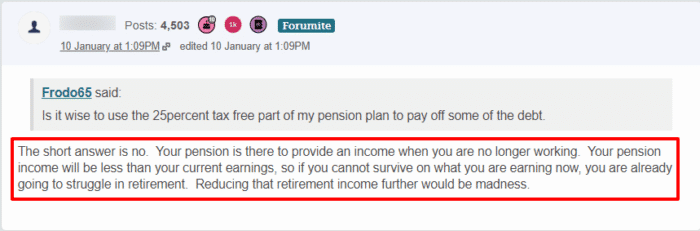
There is no universal answer. Withdrawing can be costly and may use money that is protected while still inside the pension. Consider other affordable ways to deal with the debts first.
If a withdrawal is being considered, obtain a written explanation of the amount you would receive after tax and charges and how your retirement benefits would change. Check the position with any insolvency practitioner or debt-plan provider involved.
Are there any other places I can get more information?
Free debt advice and pensions guidance serve different purposes. A personal recommendation about a pension withdrawal, transfer or investment may require a regulated financial adviser.
The former Pensions Advisory Service is now part of MoneyHelper. Pension Wise offers free guidance appointments for eligible people with defined contribution pensions. MoneyHelper can also help you find free debt advice.