ClearScore Credit Score Bands: What the Numbers Mean
By
Scott
Scott Nelson
Founder of MoneyNerd
Scott founded MoneyNerd after his own experience with debt. He runs the website and oversees its general information about debt and other money matters.
Scott does not provide personal debt advice or recommend debt solutions through MoneyNerd. If you make a debt enquiry, MoneyNerd may introduce you to The Debt Advice Service, which provides any personal debt advice.
Janine previously contributed articles and videos to MoneyNerd about everyday money, household costs, debt topics and parking matters. She has a background in broadcasting, including work with BBC Radio 5 Live and Bauer radio stations. Her published work provides general information, not personal debt advice.
Welcome! If you’re worried about your credit score and want to know what the ClearScore bands mean, you’re in the right place.
Each month, over 170,000 people visit our website for guidance on topics just like this one. You’re not alone.
We understand your concerns and are here to help you. In this easy-to-read guide, we’ll explain:
The five ClearScore bands and their meaning
The difference between ClearScore and Equifax
Ways to improve your ClearScore band
How to manage if your ClearScore rating goes down
What is considered a good ClearScore in the UK
We know that credit scores can be confusing, especially when they change. Don’t worry; we’re here to help make sense of it all for you.
By the end of this article, you’ll have a better understanding of what your ClearScore means and how to improve it. Let’s get started!
What is the difference between Clearscore and Equifax?
Equifax is one of the three main credit reference agencies in the UK. ClearScore is not a credit reference agency.
Rather, ClearScore provides users with access to the data that Equifax holds on them, free of charge.
ClearScore’s score scale
Before April 2021, Equifax had a credit score scale out of 700. Additionally, Equifax used five rating bands, which helped you to understand how good or bad your credit score was.
These bands were as follows:
Very Poor
Poor
Fair
Good
Excellent
A change in a scoring scale or band label does not itself show that your financial position has improved or worsened. Lenders make their own assessments using more than the consumer score.
As of April 2021, Equifax UK credit scores are no longer measured according to the scale above.
ClearScore’s published guide lists the bands below. Check the scale and label shown in your own account, because providers can update their models and presentation.
Each band has a different value assigned to it out of the 0-1000 scale. They are a way of describing your credit score in simple terms.
Knowing the Clearscore band your credit score falls into is a great starting point when trying to improve your credit rating.
What are the Values on the 0 – 1000 Scale?
Let’s go through each new Clearscore band and where they fall in the 0-1000 scale.
A stronger credit history can help with access to credit, but a Good band does not guarantee approval or a particular interest rate.
A lower score does not always prevent borrowing, but available products may be limited or more expensive. Check affordability and avoid applying merely to raise the displayed score.
What is a good credit score out of 1000?
What is considered to be a good credit score in the UK depends on the credit reference agency used.
ClearScore’s published Equifax bands place 531–670 in Good. Experian now uses a different scale out of 1,250, so its former 999-point ranges should not be used as current thresholds.
There is no universal UK score above which every lender treats you as low risk. A lender can weigh its own credit model, income, expenditure and existing commitments.
So, comparing credit scores across agencies can be a little confusing since the changes were implemented.
Why is my Clearscore rating So Low
The reasons for low Clearscore ratings have left many people confused.
If a provider changes its model, both your number and label may change even where your behaviour has not. A genuine update to the underlying credit data can also change the result.
For example, comparing 420 on an old 700-point scale with 420 on a 1,000-point scale does not establish that the same credit standing moved from Good to Poor.
This can come as quite a shock, especially for those who have actively worked on improving their score.
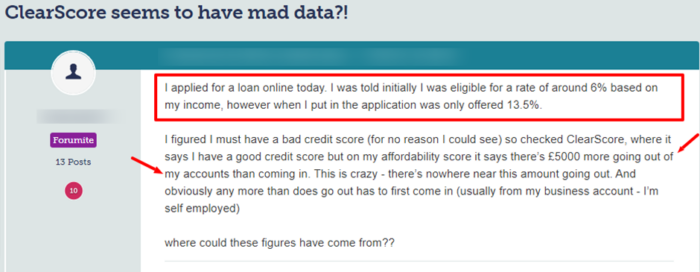
Check the explanation supplied by ClearScore and the account information in your report before drawing a conclusion.
You cannot guarantee that a lender will view the application exactly as before. It uses its own assessment and may receive newer or different data.
Check out this message a concerned person posted on an online forum.
Your Clearscore credit rating may have dropped for several reasons. In short, there are some factors affecting Clearscore ratings which I’ve listed below:
Late or missed payments reported by a lender.
Changes in balances or the proportion of available credit used.
Changes to credit limits or account closures.
Hard searches connected with credit applications.
New or corrected information, or a change in the scoring model.
How Can I Improve It?
I’ve listed some tips for improving Clearscore ratings here but, the most important factor in your credit rating is your credit history.
This is what is used to come up with your score.
Improving your credit history does take time, but following the tips I share below is a great place to start:
Pay agreed amounts on time where affordable; contact creditors promptly if you are struggling.
Dispute inaccurate report entries with supporting evidence.
Ask about disassociation from an ex-partner only when the relevant financial connection has ended.
Avoid unnecessary hard credit applications close together.
Keep electoral-register details accurate if eligible to register.
Keep borrowing affordable and avoid using more available credit simply to chase a score.
Work with debt advisors, especially when struggling with debts. They can help you to work out agreements with lenders and potentially avoid CCJs or bankruptcy, which can seriously affect your credit rating for many years.
I have some useful articles on how to deal with debt and the threat of CCJs, have a read if this is a present concern.
What is the Highest Clearscore Score?
The highest Clearscore score is 1000. A score between 811 and 1000 places you in the Excellent Clearscore band.
Even the highest displayed score does not guarantee approval, the lowest rate or affordable borrowing. Compare the actual offer and your budget.
What the Score Bands Mean to You
Knowing your Clearscore score band is a great way of helping you to understand the health of your credit rating.
In short, the personal implications of Clearscore bands can impact many aspects of your financial standing.
ClearScore uses Equifax credit information.
Its score runs from 0 to 1,000.
The score is a guide to the report, not a complete assessment of financial health or a lender’s decision.
Did you like this article?
Show your support ❤️
We're glad you liked the article! As a small team, your support means everything to us. If you could rate us on Google, it would be amazing. Thank you!
Scott founded MoneyNerd after his own experience with debt. He runs the website and oversees its general information about debt and other money matters.
Scott does not provide personal debt advice or recommend debt solutions through MoneyNerd. If you make a debt enquiry, MoneyNerd may introduce you to The Debt Advice Service, which provides any personal debt advice.
Janine previously contributed articles and videos to MoneyNerd about everyday money, household costs, debt topics and parking matters. She has a background in broadcasting, including work with BBC Radio 5 Live and Bauer radio stations. Her published work provides general information, not personal debt advice.