







Debt Calculator: Balances, Repayments and Interest








MoneyNerd introduces enquiries to The Debt Advice Service and may receive a referral fee. For free, independent guidance and help finding a debt adviser, visit MoneyHelper.
This information and enquiry service is not a full financial assessment or a guarantee of suitability or debt write-off. Debt solutions are not suitable for everyone. Fees may apply, and your credit record and assets may be affected. Get advice on your circumstances before choosing a solution.

MoneyNerd introduces enquiries to The Debt Advice Service and may receive a referral fee. For free, independent guidance and help finding a debt adviser, visit MoneyHelper.
This information and enquiry service is not a full financial assessment or a guarantee of suitability or debt write-off. Debt solutions are not suitable for everyone. Fees may apply, and your credit record and assets may be affected. Get advice on your circumstances before choosing a solution.
Are you eager to find out how much debt you owe? No need to worry; you’ve come to the right place.
A debt calculator can provide an illustration using the figures you enter. Check current balances and terms first; a calculator cannot confirm your legal liability or select a suitable debt solution for you.
In this helpful piece, we’re going to talk about:
- How to use a Debt Calculator to find out how much you owe
- The steps to take if you find your debt is too big
- Ways to work out how long it will take to pay off your debt
- Understanding interest and extra costs
- How to choose which debt should be paid off first
Start with statements, account details and a realistic household budget. Free debt advice is available if payments are becoming difficult. See related guidance.
So, let’s get started.
How do I Calculate My Debt?
Add the current balances from each creditor’s statement to find your total debt. A calculator can help estimate repayment costs, but its result depends on accurate inputs and assumptions.
Common calculator types include:
- Mortgage calculators: For calculating mortgage loan repayments
- Simple debt calculators: Determine monthly loan repayments for personal loans, car finance, etc
- Credit card loan calculator: Calculate the length of time and total interest paid if only making minimum repayments
- Debt snowball and avalanche calculators: Used to pay off multiple debts
- Debt-to-income calculator: compares regular debt repayments with income; it does not give a complete affordability assessment.
- Debt consolidation calculator: For determining potential savings by consolidating various debts into a single loan
A debt consolidation calculator compares an existing repayment schedule with a proposed new loan. It cannot establish that consolidation is affordable or that a lender will accept you.
Check whether the calculator includes interest changes, fees, minimum-payment rules and any early-repayment charges. Missing costs can make an illustration misleading.
To calculate the total of debts, you will need to add up the amounts you owe.
For example, £1,000 + £2,000 + £1,200 + £300 = £4,500.
You can separately compare the total debt with available savings, but having savings does not reduce what the creditors are owed until a payment is made.
Illustrative net position = total debt minus genuinely available cash or liquid assets.
Using the example above, £4,500 of debt minus £500 of available cash gives a net position of £4,000. The debt balance itself remains £4,500 until payment. Keep money needed for essential bills and emergencies in your budget rather than assuming every saving should immediately go to creditors.
A calculator can speed up arithmetic, but statements and a complete budget are still needed.
Which Should Be Paid Off First?
Budget for essential living costs and priority debts first, such as rent or mortgage arrears, council tax and energy arrears. Only then consider using spare money for higher-interest non-priority debts while keeping required payments on other accounts. The highest interest rate does not always identify the most urgent debt.
For debts on which interest continues, paying extra may reduce future interest. The way interest accrues and whether it is compounded depends on the agreement; do not assume every debt works like a credit card.
Make a repayment budget that protects essential costs and priority bills before choosing an avalanche or snowball strategy for non-priority borrowing.
» TAKE ACTION NOW: Fill out the short debt form
Just What is Too Much?
There is no single debt-to-income percentage that establishes whether debt is manageable. Check what remains after essential spending, priority bills and all required payments.
The debt to income formula calculates how much of your income goes towards paying your debts. To calculate the DTI, you need to follow these steps:
- Calculate the total amount of your monthly payments of debts, e.g., credit card dues, loans, and other amounts. (Make sure you list all the amounts and details of the debts correctly)
- Use a consistent income figure. For a household budget, take-home income is useful; lender definitions of debt-to-income may differ.
- Divide the total regular monthly debt repayments, not the total outstanding balance, by the monthly income figure.
- Multiply it by 100
Debt-to-income ratio = (total monthly debt repayments ÷ monthly income) × 100.
Use the same monthly period throughout and state whether the income is gross or take-home.
Now, let’s understand what this formula means.
The answer to this calculation represents the percentage amount of your income that is going towards paying the debt.
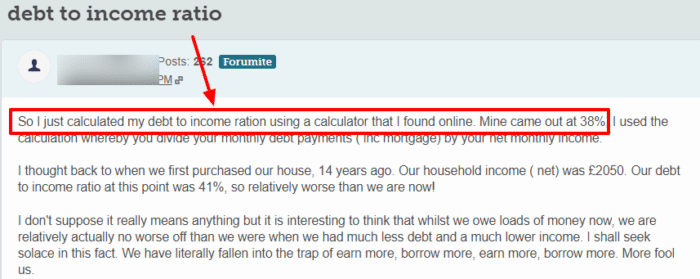
A higher percentage means that a higher amount of your income is going towards paying the debts, leaving you with less money to spend.
A higher proportion committed to debt leaves less flexibility, but there is no universal UK rule that the ratio must never exceed 25%. Housing costs, household needs and income stability also matter.
The claimed 5–15% “healthy” range is not a universal affordability standard. If payments mean you cannot cover essentials, get advice regardless of your ratio. See related guidance.
Understand your debt options
MoneyNerd can introduce you to The Debt Advice Service for free debt advice. MoneyNerd does not provide debt advice or recommend debt solutions.
The Debt Advice Service can explain your options, including their benefits, costs and risks. Options available depend on your circumstances. There’s no obligation to take a debt solution.
MoneyNerd does not provide debt advice or recommend debt solutions. The Debt Advice Service is a trading style of Pacific Financial Solutions Limited. If you request an introduction, we’ll share your details with their team so they can contact you.
Some debt solutions have fees and may negatively affect your credit rating. MoneyNerd is a commercial introducer and may receive a fee if you go ahead with a debt solution through The Debt Advice Service.
For free, impartial money guidance and help finding free debt advice, visit MoneyHelper.
Understanding Interest & Additional Charges
The interest rate is a very important factor in debt calculation and its repayment.
With higher interest rate debts, it will be hard for you to achieve a life free of debt. The interest rate or the annual percentage rate (rate APR) can cause heavy damage if it is not managed properly.
To simply understand why high-interest rate debt is dangerous, you need to understand the concept of compound interest.
Some agreements charge interest on a balance that can include earlier interest. Others work differently. Use the actual interest method, repayment dates and fees in the agreement when estimating the cost.
To keep a handle on the situation, you can use my free interest calculator. Use this tool to make sure you understand how interest affects your monthly bills and overall financial health.
This is a guidance tool only and not an assessment. For accurate interest calculations, contact the company issuing the credit. Do not rely solely on this calculator’s results.
How Can I Pay It Off?
Options depend on your debts, income, assets and location. A calculator result is not a recommendation or a promise that debts can be cancelled.
Let’s discuss a few options below.
Pay Back in Instalments – Debt Management Plan
A Debt Management Plan is an informal arrangement for suitable unsecured debts. It does not automatically freeze interest, prevent court action or cover priority debts, and reduced payments can harm your credit record. Free providers are available; affordability and suitability should be checked before starting.
Make a budget statement for your debts and divide up a part of your income from which you have to pay back the due amount. In this way, you’ll have fewer chances of overspending while paying your debt off gradually.
Individual Voluntary Arrangement
An IVA is a formal insolvency arrangement with creditors. It can include agreed payments or other contributions and binds creditors covered by the arrangement once approved. Fees, effects on assets and credit, and the risk of failure need to be considered with an authorised insolvency practitioner. An IVA can write off the unpaid balance of included debts on successful completion, subject to its terms. Excluded debts remain payable, and failure can leave you liable for remaining debt and further action.
Debt Consolidation Loan
A consolidation loan is not guaranteed to offer a lower rate or save money. Compare fees, early-repayment charges, the term and total repayable. A longer term can increase total interest despite a lower monthly payment. Securing previously unsecured debts on your home puts it at risk if payments are missed.
Take the first step towards tackling your debt
Every day, our partner, The Debt Advice Service, helps people understand their options for dealing with debt. Their debt advice is free, with no obligation to proceed.
MoneyNerd introduces you to The Debt Advice Service. We do not provide debt advice or recommend debt solutions.

Natasha
Very helpful and informative thank you
If you submit the enquiry form, MoneyNerd will share your details with The Debt Advice Service so they can contact you.
Some debt solutions have fees and may negatively affect your credit rating. MoneyNerd may receive a fee if you go ahead with a debt solution through The Debt Advice Service.
The Debt Advice Service is a trading style of Pacific Financial Solutions Limited.
For free, impartial help and access to not-for-profit debt advice, visit MoneyHelper.
How Long Will It Take to Clear?
It really depends upon the amount and type of debt that you have to repay. So, for every person, the answer to this question is different.
Use a repayment calculator with the correct rate, fees and payment schedule. Dividing the balance by a monthly payment only gives a reliable period if no interest or charges accrue and the payment is unchanged.
- Check all starting balances and any settlement charges.
- Enter interest rates, fees and an affordable monthly payment.
- Allow for priority payments, essentials and foreseeable changes in income or costs.
- Review the estimated term and total repayable, and compare them with your statements.