







How to Get a CCJ Removed From Your Credit File








For free and impartial money advice you can visit MoneyHelper.
For free and impartial money advice you can visit MoneyHelper.
A County Court Judgment (CCJ) can affect your ability to get credit. In England and Wales, the main routes to removing its entry are paying in full within one calendar month, successfully applying to set the judgment aside, or waiting for the six-year reporting period to end. These routes have different legal effects.
This guide explains how a CCJ is recorded and the available routes to challenge or update its entry.
- What a credit file is and why it is important.
- How a CCJ can affect your credit score.
- Why you get a CCJ and how to stop it from happening.
- Understanding the laws about debts.
- Ways to write off some of your debt.
We have a lot of experience with these issues. We know the cost of removing a CCJ, and we want to share our knowledge with you.
Dealing with a CCJ can be hard. But remember, there is always a way out. So, let’s start working on this together.
Will a CCJ affect my credit score?
Yes, a CCJ can affect your credit score.
A debt sale can change the company named on a credit account. If both seller and purchaser entries remain, they should show that they concern the same debt rather than two separate balances.
Selling the account does not restart the original default date.
A default normally remains for six years from its original date. A CCJ is a separate entry, normally recorded for six years from the judgment date unless removed earlier under the rules below.
Lenders assess the information on your credit report alongside their own criteria. A CCJ can make borrowing harder, but it may also have been entered by default and is not proof that you knowingly refused to pay.
Understandably, companies are going to be reluctant to give you credit!
After 6 years, it is no longer visible on your credit report and you should find it easier to get credit again.
Credit reporting differs between formal insolvency and informal repayment arrangements. Do not assume that every debt solution disappears exactly six years after it starts. Check the rules for the particular solution and challenge inaccurate records. Related guidance: visible on your credit file.
» TAKE ACTION NOW: Fill out the short debt form
Can You Stop a County Court Judgment From Being Given?
When you receive notice that a CCJ is being sought against you, you will be sent a county court claim form pack. Inside this pack are several forms. One of which is the counterclaim and defence form. You can fill out this form and return it to the court, providing any evidence you have of why you don’t owe the debt. The court will then take this evidence into consideration when deciding whether to issue the CCJ or not.
In some cases, the court might decide that a hearing is warranted, to get more information from both you and your creditor. In this case, you can appear in court and present your case, and also provide any documented proof of why you do not owe all or part of the debt.
Does the Statute of Limitations apply to debts?
Limitation rules can provide a defence to some debt claims, but they do not automatically cancel an existing CCJ. The usual six-year limit for many simple-contract debts in England and Wales depends on when the cause of action arose, payments, written acknowledgement and whether court action began in time. Scotland has different prescription rules.
The date a debt became due, any written acknowledgement or payment, the debt type and the court history all matter. A six-year age alone does not prove that a claim is statute-barred.
A statute-barred defence must be raised if a court claim is issued. Do not ignore court documents because you think the debt is old. Ask a debt adviser to check the debt type, dates and court history before paying or acknowledging it.
An unpaid CCJ does not expire simply because six years pass. Some enforcement methods need the court’s permission after that point. Removing the entry from your credit file does not write off the judgment debt.
Tax and benefit overpayment debts have specific rules. Do not assume all HMRC debts share the same limitation period; obtain advice about the particular debt.
A creditor does not need a new CCJ just because the original judgment disappears from your credit file after six years.
Getting a County Court Judgment Removed From Your Credit Report
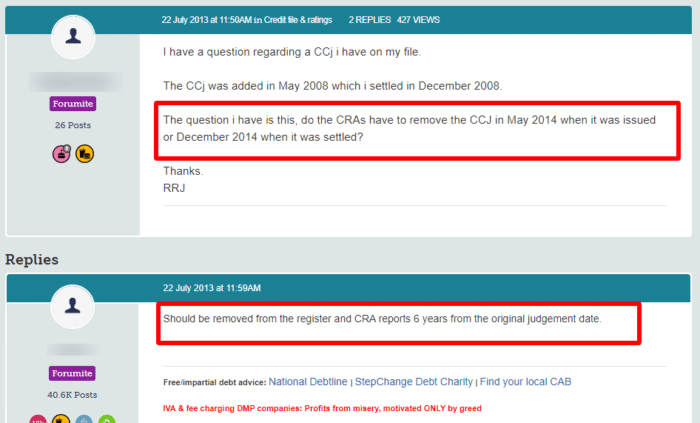
A CCJ entry normally drops off your credit file six years after the judgment date, whether paid or unpaid. This is separate from paying the debt or challenging the judgment. If you pay in full within one calendar month of the judgment, send proof to the court and ask for the register entry to be cancelled.
An application to set aside a CCJ is usually made on form N244. You must explain the legal grounds and may need to attend a hearing. Applying does not itself guarantee removal or automatically stop enforcement. The standard on-notice application fee is currently £321. Other fees may apply in some circumstances and you may qualify for Help with Fees; check with the court.
Paying in full after the first calendar month normally changes the entry to “satisfied”; it does not remove it early. The entry remains for six years from the judgment date.
What is a ‘satisfied’ and an ‘unsatisfied’ status?
An entry on the Register of Judgments, Orders and Fines can show whether the judgment debt has been paid in full. Some judgments are cancelled or exempt from registration, so an absent entry does not by itself settle liability.
Satisfied means that you have paid in full. Unsatisfied means that you have not paid in full.
Once a CCJ is paid in full, send the court evidence and request the appropriate update. You do not have to wait a month after payment to do this. Payment within one calendar month of judgment can allow cancellation; later payment normally marks the entry satisfied.
A judgment paid after the first month normally stays on the register until six years after the judgment date, rather than six years after payment.