Selling Home to Pay for Care – What You Should Know








MoneyNerd introduces enquiries to Age Partnership and may receive a referral fee. MoneyNerd does not provide equity release advice. Equity release reduces the value of your estate and can affect means-tested benefits. With a lifetime mortgage, unpaid interest compounds and increases the amount owed. Fees and early repayment charges may apply.
Ask a regulated adviser to explain suitability, costs and alternatives. For free, impartial guidance, visit MoneyHelper.

MoneyNerd introduces enquiries to Age Partnership and may receive a referral fee. MoneyNerd does not provide equity release advice. Equity release reduces the value of your estate and can affect means-tested benefits. With a lifetime mortgage, unpaid interest compounds and increases the amount owed. Fees and early repayment charges may apply.
Ask a regulated adviser to explain suitability, costs and alternatives. For free, impartial guidance, visit MoneyHelper.
Thinking about selling your home to pay for care? This is a big decision, and you may have many questions. From average care home costs to who pays for care homes in the UK, we’ll cover it all here.
We know that understanding the ins and outs of equity release can be tricky. You're not alone!
In this article, we’ll go over:
- The process of selling a house to pay for care.
- How to get a realistic quote for your home.
- What a Deferred Payment Agreement is and how it works.
- The benefits and drawbacks of a Deferred Payment Agreement.
- How to protect your home from needing to be sold to pay for care.
We have lots of helpful advice to guide you through the process. We’re here to help you understand and make the best choice for your situation.
Who pays for care homes in the UK?
Care funding differs across the UK. In England, NHS Continuing Healthcare may cover eligible assessed needs; otherwise the council assesses care needs and finances. A diagnosis alone does not establish NHS funding eligibility.
What are the average costs?
Care fees vary by location, provider, room and level of care. Obtain current written quotes; the historic £600-per-week figure should not be used for current planning. See related guidance.
Nursing care, specialist support and additional services can change the price substantially. Compare what each quote includes and how annual increases are set.
Consider the costs and risks of equity release
Equity release is a long-term financial decision. A lifetime mortgage is a loan secured against your home. If interest is added to the loan, the debt can grow substantially and reduce the inheritance you leave.
Consider the fees, effect on means-tested benefits, early repayment charges and future care needs. Alternatives may include downsizing, using other assets or a retirement interest-only mortgage where affordable.
Use the button below to start an enquiry with Age Partnership. An estimate does not confirm eligibility or suitability. Get specialist financial and independent legal advice before proceeding.
In partnership with Age Partnership, which advises on lifetime mortgages. MoneyNerd introduces enquiries and may receive a referral fee. Equity release can reduce your estate and affect means-tested benefits and future care funding. Fees may apply and interest added to a lifetime mortgage increases the amount owed. Specialist financial and independent legal advice are required before proceeding.
Can I sell my mum’s house to pay for it?
Your mother can decide to sell if she has capacity. Acting for her requires valid legal authority, such as an appropriate registered power of attorney or court appointment; being a child alone does not authorise a sale. Ask about funding alternatives before selling. See related guidance.
Read on for more!
Are you considering selling to cover fees?
If you are required to pay all or some of your care home fees, or if you are reading this on behalf of a loved one, the first thing to note is that there are viable options to explore. We discuss one of the most common methods of paying for care home fees using a Deferred Payment Agreement, as well as list some other options.
An Age Partnership customer’s experience
Individual experiences vary. Equity release is a long-term decision, and specialist advice is needed to assess whether it is suitable for you. Compare the costs, risks and alternatives before proceeding.

Mrs Wareham
“I am more than pleased to have taken out Equity Release with Age Partnership.”
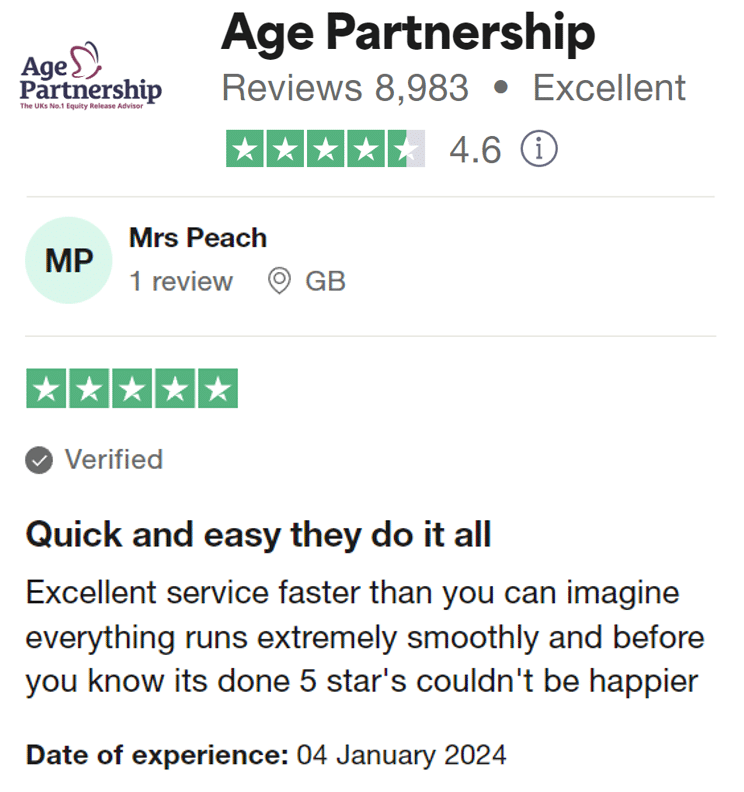
Reviews shown are for Age Partnership. Search powered by Age Partnership.
What is a Deferred Payment Agreement (DPA)?
A deferred payment agreement can let an eligible person defer some care charges using property as security. It is a debt, not a grant. The detailed rules below concern England; other UK nations differ.
The council assesses eligible care costs, income, capital, security and the amount that can be deferred. Contributions, an equity limit and ongoing conditions apply.
The deferred amount, interest and relevant fees build up as a secured debt. Repayment triggers and timing follow the agreement, commonly a property sale or death; the arrangement does not continue without limit.
The debt is usually repaid from the sale of your property. For example, you might move into care and need help paying your care home fees until you have sold your property, which may take many months or even years in some cases. Once the property has been sold, some of the sale proceeds will be used to pay back the amount owed to the local council. You do not need to sell your home if you can repay with other means.
If you pass away before repaying your Deferred Payment Agreement (DPA), the money will need to be repaid from your estate.
» TAKE ACTION NOW: Find out how much equity you could release
What is the equity limit?
A Deferred Payment Agreement (DPA) equity limit is the amount of money the council is willing to use to pay towards your care home costs. It is based on the cost of your care, how much money you are contributing and your property value.
Does the local authority charge interest on it?
In England, councils may charge interest up to the nationally specified maximum and reasonable administration costs. Check the council’s actual rate, compounding and fees; it is not an interest rate set directly by the OBR for your individual loan.
Who qualifies?
In England, eligibility generally involves assessed care needs, sufficient security and the applicable financial conditions. Ask the council to assess your circumstances, including:
- You have been assessed by an adult social care worker and told you would benefit from moving into a care home.
- The applicable non-housing capital test; the upper capital limit in England is £23,250 for 2026–27.
- Whether sufficient acceptable security can be provided. Sole ownership is not a universal requirement; joint owners may need to consent to the legal charge.
- You have the capacity to agree to a Deferred Payment Agreement while fully understanding the process and costs. Or you have a legally appointed person who can agree on your behalf.
Can I do it to pay for my husband’s care?
It is a common story that one person who lives at the property needs to go into a care home while the other person – often a spouse – does not require care home living. For example, one partner may have been diagnosed with Alzheimer’s and their spouse cannot provide the round-the-clock care they need.
If your partner requires a care home then the property will not need to be sold to pay for their care. The individual requiring care will have their own finances assessed to determine if they need to pay for care themselves or qualify for a Deferred Payment Agreement. You will continue living in the property and the value of the home will not be taken into consideration during the assessment.
Can it be done on a jointly owned house?
In England, mandatory property disregards can apply when specified relatives occupy the home, including some relatives aged 60 or over. Mere co-ownership without qualifying occupation is not enough.
A qualifying incapacitated relative’s occupation can be relevant to a property disregard. Ask the council to apply the statutory conditions to the actual household.
What if I own my home with another person?
Where the property is not disregarded, the value of the person’s beneficial interest must be assessed. It is not automatically half the vacant-possession market value merely because there are two owners.
Can I rent my property while on a DPA?
You are allowed to rent out your property while in a care home and receive a Deferred Payment Agreement. The rental income will be added into a new financial assessment of your circumstances and could result in you paying more towards your care and your deferred payments becoming less. You will be responsible for landlord insurance etc, and you must report your rental income to HM Revenue and Customs.
What is the 12-week property disregard?
Some homeowners may need to move into a care home and have sufficient wealth to pay their own care home costs, however, this wealth is tied up in the value of their property. Thus, they have not got the actual finances to pay for their care from the outset until their property is sold or rented out.
In England, an eligible 12-week property disregard means the home is temporarily excluded from the financial assessment. It is distinct from a deferred payment agreement, which is a repayable debt with separate conditions; one does not automatically require the other.
What are the benefits of a Deferred Payment Agreement?
The benefits of one of these agreements with your local authority are:
- You get financial support to pay for your care
- You are not required to make monthly repayments
- The financial support is means-tested by your local authority, which should make it fair for everybody
- The funding support remains in place for as long as you need it, within your equity limit
What are the disadvantages?
Interest and administration fees can increase the debt. Councils need not charge the maximum in every case; compare the written DPA terms with other suitable funding options.
How can I protect my home?
Care-funding options need a needs and financial assessment, current quotes and specialist advice. None automatically protects a home from assessment or guarantees it will never need to be sold.
- Take out a care annuity
- Rent (some) of your home (as discussed earlier)
- Consider equity release to fund at-home care services if adequate
- Trusts or transfers are not a reliable way to avoid care charges. Deliberate deprivation of assets may result in assessment as if the assets were still owned, and transfers can have tax and legal consequences.
What is equity release and how does it work?
Most standard lifetime mortgages start at age 55, but some payment-term lifetime mortgages are available from 50 and require interest payments for an agreed period. Home-reversion minimum ages and all other eligibility rules depend on the provider. Check the youngest applicant’s age and the actual product criteria. A lifetime mortgage is a loan secured on your home; you retain ownership. Interest that is not paid is added to the balance. The loan is usually settled when the last borrower dies or moves permanently into care, subject to the contract. Required or optional repayments vary by product.
Released funds may pay for care at home, but cannot guarantee that residential care will be avoidable or that the funding will last.
On a joint lifetime mortgage, the final borrower’s permanent move into care normally triggers repayment under the terms. If one borrower remains, check the agreement, benefits and funding implications before using further funds.
A lifetime mortgage is a loan secured on your home; you retain ownership. Interest that is not paid is added to the balance. The loan is usually settled when the last borrower dies or moves permanently into care, subject to the contract. Required or optional repayments vary by product. A home reversion plan is a sale of part or all of your home, usually below open-market value, in return for money and the right to remain under the plan’s occupancy terms. It is not a loan. The provider receives its agreed share when the home is sold. See related guidance.