






MoneyNerd introduces enquiries to Age Partnership and may receive a referral fee. MoneyNerd does not provide equity release advice. Equity release reduces the value of your estate and can affect means-tested benefits. With a lifetime mortgage, unpaid interest compounds and increases the amount owed. Fees and early repayment charges may apply.
Ask a regulated adviser to explain suitability, costs and alternatives. For free, impartial guidance, visit MoneyHelper.



Equity release lets eligible homeowners access some of the value in their home through a lifetime mortgage or home reversion plan. The two arrangements work differently, and neither is suitable for everyone.
Equity release can reduce the value of your estate and affect entitlement to means-tested benefits and funding for future care. A lifetime mortgage is secured on your home. Interest added to the loan increases the amount owed, and fees or early-repayment charges may apply. Get specialist financial advice and independent legal advice before proceeding.
Equity release and other ways to access equity
Equity is the property’s current value less borrowing secured against it. For example, a home worth £200,000 with an outstanding mortgage of £80,000 has £120,000 of equity. That is not the amount a lender will necessarily let you borrow.
“Releasing equity” can also mean downsizing, remortgaging, a further advance or a second-charge mortgage. Those are different from the later-life equity release plans explained here. A US-style home equity line of credit is not interchangeable with a UK lifetime mortgage.
How does a lifetime mortgage work?
A lifetime mortgage is a loan secured on your home while you retain ownership. Money may be provided as a lump sum or through a drawdown facility, subject to the agreement. Existing mortgages and other secured borrowing usually need to be repaid at completion, potentially using part of the release proceeds.
With an interest roll-up plan, unpaid interest is added to the balance and interest is then charged on that larger balance. Some products allow voluntary payments; others require payments for an agreed period. Check the actual contract rather than assuming every lifetime mortgage has no monthly repayments.
Repayment is usually due when the last borrower dies or moves permanently into long-term care. A sale often repays the loan, but the estate may use other funds if the lender’s terms allow it. Selling without transferring the loan, or breaching relevant conditions, can also trigger repayment.
How does home reversion work?
With a home reversion plan you sell all or part of the property to a provider, usually for less than the open-market value of that share. You receive money and rights to remain under an occupancy agreement. It is a sale, not a loan with rolled-up interest.
When the property is sold, the provider receives its agreed share of the proceeds. Selling a share also gives up that share of future value growth. Ask your solicitor about occupancy, maintenance, insurance, other residents and the consequences of moving or ending the plan.
Who can apply?
Most standard lifetime mortgages start at age 55. Some payment-term products are available from age 50 and require interest payments for a specified period, with affordability checks. Home-reversion ages and other criteria depend on the provider. Joint applicants must meet the relevant rules.
Property value, type, condition, lease length, location and existing borrowing can affect eligibility. There is no universal minimum valuation or maximum percentage of equity available across all products. A calculator or enquiry form gives an indication, not an approval or suitability assessment.
Consider the costs and risks of equity release
Equity release is a long-term financial decision. A lifetime mortgage is a loan secured against your home. If interest is added to the loan, the debt can grow substantially and reduce the inheritance you leave.
Consider the fees, effect on means-tested benefits, early repayment charges and future care needs. Alternatives may include downsizing, using other assets or a retirement interest-only mortgage where affordable.
Use the button below to start an enquiry with Age Partnership. An estimate does not confirm eligibility or suitability. Get specialist financial and independent legal advice before proceeding.
In partnership with Age Partnership, which advises on lifetime mortgages. MoneyNerd introduces enquiries and may receive a referral fee. Equity release can reduce your estate and affect means-tested benefits and future care funding. Fees may apply and interest added to a lifetime mortgage increases the amount owed. Specialist financial and independent legal advice are required before proceeding.
How does the cost build up?
The cost depends on the advance, interest rate, how interest is applied, fees, later withdrawals and any repayments. For a simple illustration only, £50,000 at 6% interest compounded annually, with no repayments, further borrowing or fees, becomes about £89,542 after ten years and £160,357 after twenty years. This is not a quoted product rate or offer.
Request a personalised illustration showing the projected balance over time. Advice, legal work, valuation and arrangement fees can add to the cost. If fees are added to a lifetime mortgage, interest may also be charged on them. Compare total projected costs rather than focusing only on the initial cash received.
What protections apply?
The FCA regulates lifetime mortgages and home reversion plans. Check the firm and its relevant permissions. The Equity Release Council is an industry body, not the regulator. Its product standards provide additional safeguards for qualifying plans.
A no-negative-equity guarantee limits liability to the net property sale proceeds when its conditions are met. It does not stop interest growing or guarantee an inheritance. The right to remain in the property depends on meeting the contract’s conditions. Products with mandatory payments can expose your home to repossession if those payments are not kept up.
Read the Council’s current standards and ask your adviser which safeguards the particular product meets.
An Age Partnership customer’s experience
Individual experiences vary. Equity release is a long-term decision, and specialist advice is needed to assess whether it is suitable for you. Compare the costs, risks and alternatives before proceeding.

Mrs Wareham
“I am more than pleased to have taken out Equity Release with Age Partnership.”
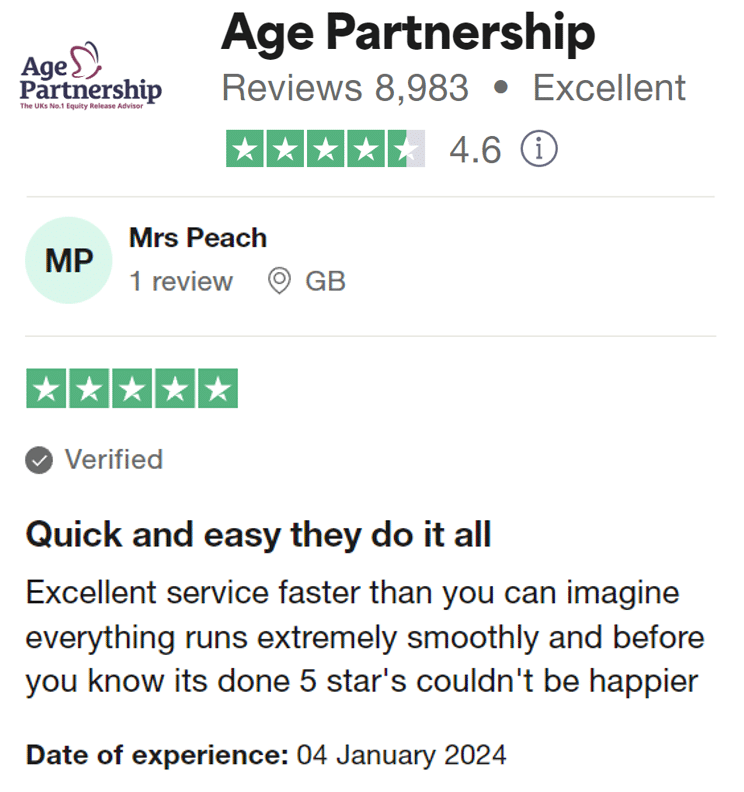
Reviews shown are for Age Partnership. Search powered by Age Partnership.
Can I move, repay early or let the property?
Moving with a lifetime mortgage normally requires the new property to meet the lender’s criteria. A cheaper property may require partial repayment. Valuation, legal costs or early-repayment charges can apply. Council standards do not mean every move is accepted without costs.
Voluntary repayment allowances, full redemption charges and downsizing protections vary. Obtain a written redemption figure before changing a plan. Letting the property, taking in a lodger or making substantial alterations may need permission. A residential plan should not be assumed to cover a buy-to-let or holiday property.
What about benefits, gifts and future care?
Keeping released money as savings can change entitlement to means-tested support. Drawdown does not guarantee that benefits will be protected. Giving away money can have tax consequences and may be considered under deprivation-of-assets rules for benefits or care funding. Obtain advice on your proposed use before committing.
The cash advanced under a lifetime mortgage is generally not taxable income, but interest earned or investments bought with it may be taxable. Do not treat “tax-free cash” as a promise that every later transaction is tax-free. Consider the effect on anyone living with you and on money available for later-life needs.
What alternatives should I compare?
Discuss using savings or other assets, benefits or grants, downsizing and other affordable mortgages or borrowing with an adviser. A retirement interest-only mortgage has different payment and affordability requirements. If debt is the reason for considering equity release, obtain free debt advice before securing or extending borrowing against your home.
How to get advice
Ask a specialist adviser which products and providers they cover, how they are paid and what fees you would owe. Read the recommendation and personalised illustration, and use your own solicitor to explain the legal terms. No adviser can guarantee a risk-free product or the best possible outcome.
MoneyNerd introduces enquiries to Age Partnership and may receive a referral fee. The introduction is not a recommendation that equity release is right for you. See MoneyHelper’s independent equity release overview and our lifetime mortgage guide.