






Shared Ownership Equity Release – Overview & More








MoneyNerd introduces enquiries to Age Partnership and may receive a referral fee. MoneyNerd does not provide equity release advice. Equity release reduces the value of your estate and can affect means-tested benefits. With a lifetime mortgage, unpaid interest compounds and increases the amount owed. Fees and early repayment charges may apply.
Ask a regulated adviser to explain suitability, costs and alternatives. For free, impartial guidance, visit MoneyHelper.

MoneyNerd introduces enquiries to Age Partnership and may receive a referral fee. MoneyNerd does not provide equity release advice. Equity release reduces the value of your estate and can affect means-tested benefits. With a lifetime mortgage, unpaid interest compounds and increases the amount owed. Fees and early repayment charges may apply.
Ask a regulated adviser to explain suitability, costs and alternatives. For free, impartial guidance, visit MoneyHelper.
Are you keen to learn about equity release and shared ownership? You're at the right place. In this article, we'll talk about:
- What shared ownership is.
- Risks of your home’s equity.
- How equity works with shared ownership.
- The way to get a good quote.
- Facts about equity release.
The Centre for Ageing Better’s study reveals that a million homes in the UK need changes to be better fit for living comfortably, and a third of these homes have someone over 551. This highlights the importance of making informed decisions about your home, particularly when considering equity release and shared ownership.
We know this could be confusing, but don’t worry; we’re here to help you. Our tips and advice will guide you through the process.
Let’s get started.
What is shared ownership?
Shared ownership is when you buy a percentage of a property with another party owning the remaining percentage of the property.
In a shared-ownership scheme, you usually pay rent to the housing provider on the share you do not own, plus applicable service charges. The lease sets the rent; it is not necessarily the same percentage of market rent.
How does equity work in this situation?
If you have shared ownership of a property, your home equity is calculated by working out the value of your percentage of the property and then subtracting any debts attached to the property in your name.
For example, you may own 50% of a property currently worth £200,000. But you might have taken out a £50,000 mortgage to help buy your 50% stake in the property. Therefore, the amount for equity you have in the property at the start is £50,000. This is calculated by working out 50% of £200,000 and then subtracting the £50,000 mortgage debt.
The amount of home equity you have should increase as the mortgage gets paid off, providing that the value of the property does not decrease.
Do’s and Dont’s
As we delve into the details of how equity works with shared ownership, it’s essential to navigate the process with clarity. To help you, I’ve put together this table outlining the do’s and dont’s of equity release. If you want to learn more about equity release, be sure to read our complete guide.
| Equity Release – DO… | Equity Release – DON’T… |
| DO Discuss your purpose, affordability, alternatives and future needs with a qualified equity-release adviser. Borrowing to repay debts or give money away can reduce your financial security. | DON’T proceed under pressure or without understanding estate, benefit, care-funding, interest and fee consequences. |
| DO Seek professional advice from professionals who specialize in equity release. | DON’T Rush into a decision. Take your time, you are in control on this. |
| DO Understand the difference between lifetime mortgages and home reversion plans – and which is best for you. | DON’T Use equity release without fully understanding the terms. |
| DO Check for flexibility – look for plans that let you be flexible, like making partial repayments. | DON’T Forget to look at alternative options for raising funds. |
Remember, always take your time to investigate how equity release works. This way, you’ll ensure you’re making the right choice for your needs.
Consider the costs and risks of equity release
Equity release is a long-term financial decision. A lifetime mortgage is a loan secured against your home. If interest is added to the loan, the debt can grow substantially and reduce the inheritance you leave.
Consider the fees, effect on means-tested benefits, early repayment charges and future care needs. Alternatives may include downsizing, using other assets or a retirement interest-only mortgage where affordable.
Use the button below to start an enquiry with Age Partnership. An estimate does not confirm eligibility or suitability. Get specialist financial and independent legal advice before proceeding.
In partnership with Age Partnership, which advises on lifetime mortgages. MoneyNerd introduces enquiries and may receive a referral fee. Equity release can reduce your estate and affect means-tested benefits and future care funding. Fees may apply and interest added to a lifetime mortgage increases the amount owed. Specialist financial and independent legal advice are required before proceeding.
Can you use it on jointly owned properties?
Equity release can be used on jointly owned properties, such as a married couple who own their home together deciding to use an equity release plan.
Most standard lifetime mortgages start at age 55, but some payment-term lifetime mortgages are available from 50 and require interest payments for an agreed period. Home-reversion minimum ages and all other eligibility rules depend on the provider. Check the youngest applicant’s age and the actual product criteria.
Some people may consider this as “shared ownership equity release” because both individuals have shared ownership of the property. But this is not exactly the correct terminology, because as we explained earlier, shared ownership means something slightly different.
» TAKE ACTION NOW: Fill out the short debt form
How about for a shared ownership property?
Many lifetime-mortgage providers require full ownership. Some may consider a shared-ownership property if you staircase to 100% at completion, subject to funding and housing-provider, lender and legal approval.
Two individuals jointly owning a home is different from a housing-provider shared-ownership scheme. Joint applicants must satisfy the product’s ownership and eligibility rules.
Why is it not available?
The provider must accept the property title and security. An existing mortgage may be cleared at completion; it does not universally have to be paid off before applying.
The lender needs enforceable security and acceptable sale and occupancy arrangements. Shared-ownership restrictions may prevent acceptance unless the ownership position changes in an approved way.
In a nutshell, equity release on a shared ownership property could get very messy.
An Age Partnership customer’s experience
Individual experiences vary. Equity release is a long-term decision, and specialist advice is needed to assess whether it is suitable for you. Compare the costs, risks and alternatives before proceeding.

Mrs Wareham
“I am more than pleased to have taken out Equity Release with Age Partnership.”
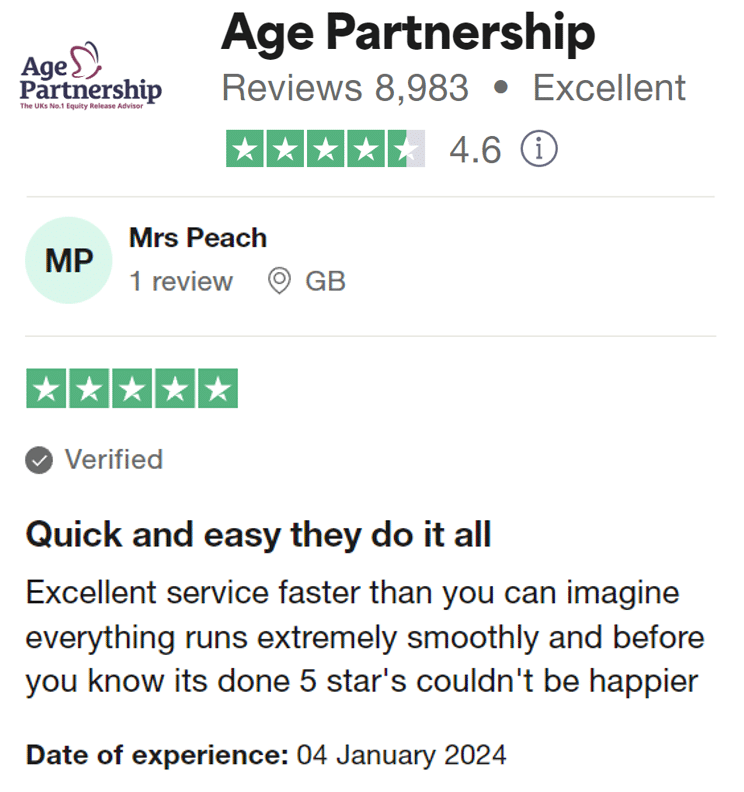
Reviews shown are for Age Partnership. Search powered by Age Partnership.
Can you use it on leasehold properties?
A leasehold property is a property where the owner owns the property but does not own the land that the property is built on. A prime example of a leasehold property could be a flat within a block of flats. The flat owner may own the flat but they do not own the land that it is built on, or any of the flats built below their flat.
These properties have a lease on the land, which is what heavily determines whether or not you can get equity release on your leasehold property.
Minimum remaining lease requirements vary by provider and can depend on borrower age. Check the particular criteria and any extension costs before proceeding.
References