





Speeding Fine Appeal Letter Sample for in the UK








Did you receive a speeding ticket and feel a bit lost about what to do? Don’t worry; this guide is here to clear things up. Every month, over 130,000 people visit our site seeking advice on fines and parking tickets.
In this article, we’ll go through:
- What a Fixed Penalty Notice (FPN) means
- If you must pay the FPN right away
- How to fight the FPN if you think it’s not correct
- Times when you might not need to pay
- What could happen if you choose not to pay
We know it’s hard when you get a fine. But you’re not alone; we’ll guide you through all the details so you can make the best choice for you.
Take a deep breath, and let’s dive in.
Paid legal information from JustAnswer
JustAnswer is a paid third-party question-and-answer service providing general information. Its standard service does not create a solicitor-client relationship. Membership can renew automatically with recurring charges until cancelled. Check the initial price, renewal price and cancellation terms before signing up. Buying this service does not guarantee a successful challenge. See JustAnswer’s membership and cancellation information.
You can use the official challenge process without buying a paid service. If you choose to use JustAnswer, visit JustAnswer to read its service and payment terms.
Commercial link to JustAnswer. MoneyNerd may receive a referral fee. No successful outcome is guaranteed.
What are the consequences of getting a speeding ticket?
You could face prosecution and receive a hefty fine depending on the severity of the offence. Furthermore, you could get a Fixed Penalty Notice (FPN) if caught over 20 mph in a 20 mph zone.
It’s deemed a serious speeding offence which merits a Band C fine and six penalty points on your licence. It can even end up with a disqualification. That said, Unlock says a Fixed Penalty Notice is not a conviction. It won’t affect your banking or housing, but the police will record it.1
Note: The fine can range from 125% to 175% of your earnings.
Also, if you end up with points on your driving record (you can only have a maximum of 12), you can almost certainly expect to see an increase in your insurance premiums.
If you’re unsure, you can use my free speeding fine calculator for a quick estimate on how much your speeding fine will be.
This is a guidance tool only and not an assessment. For accurate speeding fine figures, contact the issuing authority credit. Do not rely solely on this calculator’s results.
Should I appeal the speeding fine?
Appealing a speeding fine is a gamble because a court could rule against you. In short, a minor speeding penalty could suddenly become more expensive, so a risk assessment is crucial.
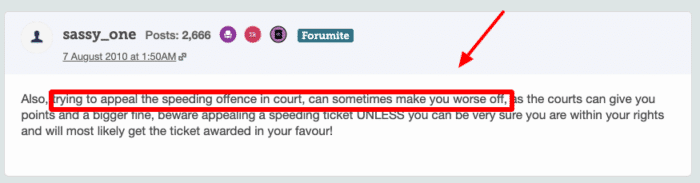
According to experts, fewer than 1% of speeding fines in the UK end up being contested. Plus, only half of the ones that go to appeal are successful! You need to have a valid reason to appeal the parking ticket; otherwise, you’ll likely find yourself in an uncomfortable position. Here are some examples of valid reasons for an appeal.
| Issue to check | Possible evidence | Important limit |
|---|---|---|
| The alleged offence did not occur | Contemporaneous photographs, video or reliable records. | The relevant legal elements and evidence must be assessed. |
| Valid insurance or entitlement | Policy documents or DVLA records covering the exact time and use. | Holding a document now does not prove cover or entitlement at the time. |
| A recognised statutory exemption | Evidence establishing the exact exemption, such as an applicable medical exemption. | An emergency or misunderstanding does not automatically amount to a defence. |
| Identity or vehicle details | Evidence of a mismatch, mistaken identity or cloned vehicle. | Follow the notice’s response requirements; do not invent a driver or account. |
| Signage or equipment | Photographs and reliable evidence relevant to the alleged offence. | A malfunctioning speedometer is not a general defence to speeding. Seek legal advice before contesting. |
FPNs do not use the same appeal procedure as council PCNs. Follow the notice; contesting the allegation may require a court hearing. Paper tax discs have not been required since 1 October 2014.
Note: An unsuccessful appeal against a speeding fine could set you back as much as £2,500 when you won’t or can’t identify who was driving when a ticket was issued. Plus, you could get a driving ban!
Another option is to plead guilty with mitigating circumstances. This is commonly known as pleading ‘special reasons’. This means that you accept you are guilty of the offence but were only speeding due to extenuating circumstances.
For instance, you could have been fleeing from danger, or it might have been a medical emergency. If the court accepts that mitigating circumstances are a factor in your case, the magistrates will likely show leniency during sentencing.
Check the right challenge process
A Penalty Charge Notice and a Fixed Penalty Notice use different procedures. Identify your notice, check the issuing authority’s guidance and meet every deadline. A council PCN may allow formal representations and an independent tribunal appeal; disputing an FPN may mean asking for a court hearing, with possible higher penalties and costs if convicted.
General information. The procedure depends on the notice and jurisdiction. Check the issuer’s instructions.
What happens after I get a speeding ticket?
There’s no official procedure for appealing a Fixed Penalty Notice (FPN). You have two choices:
- Paying the speeding fine means you automatically accept you broke the law
- Going to court to dispute the fine and therefore not admitting guilt
If you decide to go to court, there’ll be court costs if you lose and other legal implications. Plus, it will take up a lot of your time.
My advice? Think carefully before deciding what to do about a speeding fine, and seek advice from an independent legal adviser if you’re unsure about challenging a ticket.
Should I pay for the speeding ticket instead of appealing it?
If you think you might lose a case if it goes to court, I strongly recommend paying the speeding fine.
You’ll need to provide the following information:
- Your details or the driver at the time details if you weren’t driving
- Fixed Penalty Notice reference number
- Date of the speeding offence
- Offence code
- Your email address and mobile number
Note: you can also pay the speeding fine with a credit or debit card by following the instructions on the Fixed Penalty Notice.
» TAKE ACTION NOW: Get legal support from JustAnswer
How do I write a speeding fine appeal letter?
You can contest a speeding fine, although I recommend seeking independent legal advice beforehand.
First, you should contest the fine by replying to a Fixed Penalty Notice with a plea of ‘not guilty’. Next, write your letter of appeal against the FPN.
A speeding fine appeal letter should look something like this template:
Add the current date
Your name
Contact details which should include a postal address and phone number
Fixed Penalty Notice reference number
To whom it may concern,
The main body of the letter
On (date of the ticket), I was wrongly accused of going over the speed limit by (officer name and number)
Explain what happened in the main section of your appeal letter.
Please advise of the steps I should take to contest the speeding fine.
Yours sincerely,
Your signature
Legal information through JustAnswer
JustAnswer is a paid third-party question-and-answer service providing general information. Its standard service does not create a solicitor-client relationship. Membership can renew automatically with recurring charges until cancelled. Check the initial price, renewal price and cancellation terms before signing up. Buying this service does not guarantee a successful challenge. See JustAnswer’s membership and cancellation information.
Historical JustAnswer review image. The displayed rating and review total are not live. Reviews do not predict your case outcome. Membership fees and renewal terms apply.
What happens after I send the letter?
You’ll receive a court summons after sending your speeding fine appeal letter. You’ll have to attend a magistrates court hearing which allows you to present your argument.
My advice? Although you can represent yourself, you should get a solicitor if you’re sure you have valid grounds to contest the speeding fine. But it could cost you lots of legal fees during the court proceedings if you choose to have representation.
Contesting a speeding fine is challenging at the best of times. Not only is the process time-consuming, but it’s pretty tedious too.
Moreover, if you lose the appeal, it could cost you double the original speeding fine!
On what grounds can you contest a speeding ticket?
There are common and sometimes acceptable grounds for contesting a speeding ticket. This includes that you weren’t the driver when the fine was issued.
Other valid reasons to write a speeding fine appeal letter include the following dispute criteria:
- The Notice of Impending Prosecution (NIP) was incorrect
- Road signage indicating the speed limit was wrong or missing
- The equipment for measuring speed was not calibrated or not used correctly.
How long does it take for a speeding fine to arrive?
A Notice of Intended Prosecution (NIP) must be sent by post within 14 days of the alleged speeding offence to the registered keeper. Then, the registered keeper has 28 days to reply to the NIP as part of te process timeline.
If you are the registered keeper and the driver at the time, you must provide all the information requested in the NIP. But, of course, this applies to whether you intend to file an appeal or not!
What about foreign drivers?
It is far more difficult for the Court to issue penalties for driving offences committed by persons with international driving permits. The Court cannot endorse foreign driving licences. Therefore, alternative sanctions may be issued.
Foreign drivers are normally summoned directly to the court. The DVLA keeps records of any penalty points that should have been issued to a driver. The points may be applied retroactively if that driver subsequently applies for a UK driver’s licence.
Before using a paid legal information service
JustAnswer is a paid third-party question-and-answer service providing general information. Its standard service does not create a solicitor-client relationship. Membership can renew automatically with recurring charges until cancelled. Check the initial price, renewal price and cancellation terms before signing up. Buying this service does not guarantee a successful challenge. See JustAnswer’s membership and cancellation information.
A paid service is optional. Gather your notice and evidence, check the deadline and decide whether you need professional advice about your circumstances.
Commercial link to JustAnswer. MoneyNerd may receive a referral fee. Check all charges and cancellation terms before signing up.
References