











This guide explains how to make a rough estimate of an adult court speeding fine in England and Wales. It is not a prediction of a sentence and should not be confused with a fixed penalty.
The following sections explain the process, court guideline bands and a worked estimate.
- How much speeding fines in England and Wales might cost.
- How the speeding fine process works.
- Why enforcement tolerances do not change the legal speed limit.
- How you might be able to challenge your speeding fine.
- How to use the court guideline table and relevant weekly income to estimate a starting point.
We understand how you feel; some of us have been in the same boat. With our experience, we’ll help you navigate through your speeding fine.
Let’s dive in!
The speeding ticket process explained
When you are caught speeding, you aren’t simply sent the speeding ticket. There is a more rigid process that must be followed. This includes:
#1: Notice of Intended Prosecution (NIP)
A first Notice of Intended Prosecution normally must be served on the registered keeper within 14 days, but statutory exceptions apply. A later notice to a nominated driver does not have the same 14-day deadline. A roadside warning can also satisfy the notice requirement.
Late receipt is not automatically a defence. Check service on the first recipient, any roadside warning and statutory exceptions; bank holidays or postal problems do not by themselves settle the legal position.
#2: Section 172 Notice
A section 172 request for driver details normally requires a response within 28 days, even if you dispute the allegation or NIP timing. Give accurate information and seek advice promptly if you genuinely cannot identify the driver.
#3: Fixed Penalty Notice
If eligible, the driver may receive a fixed-penalty offer. Complying with every condition normally disposes of that offence without a court conviction, although a licence endorsement has record and rehabilitation consequences.
Speed, existing points and other circumstances may lead to prosecution instead. There is no universal eight-point threshold. Ordinary speeding proceedings in England and Wales generally must begin within six months; that is not a deadline for the driver to receive a summons.
Having or allowing the matter to go to court can be more expensive. Just look at this example:
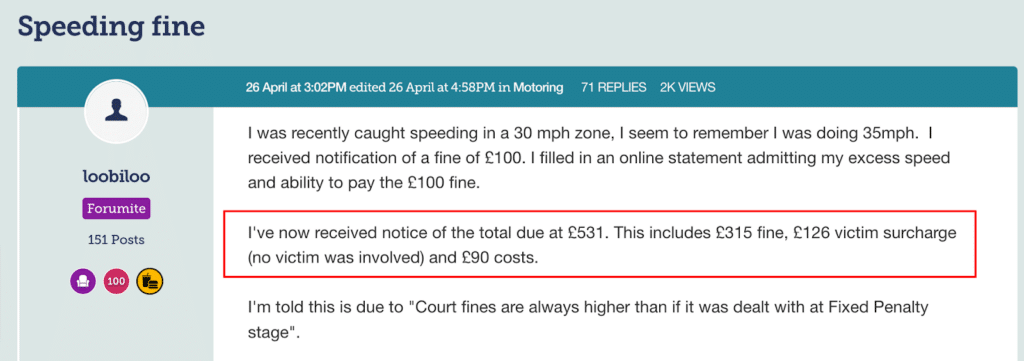
Source: https://forums.moneysavingexpert.com/discussion/6442553/speeding-fine
How much is a UK speeding fine?
The standard speeding fixed penalty is generally £100 and three points. A court fine in England and Wales is a separate process based on the guideline, relevant weekly income and circumstances.
What is the most you can be fined for speeding?
The most you can be fined for a speeding offence is £1,000 on a normal road and £2,500 for speeding on a motorway. Most speeding fines are much less than these amounts.
How is a speeding fine calculated?
For an adult court fine in England and Wales, relevant factors include:
- How much you exceeded the speed limit
- Any other factors that need to be considered, such as speeding near a school or weather conditions
- Relevant weekly income, normally income after tax and National Insurance, with special guidance for low or variable income.
The speeding offence guideline uses Bands A, B and C. Bands D, E and F in the wider fine framework are not additional speeding categories.
The recorded speed and limit set the guideline category. The court then considers the relevant circumstances and any adjustments; the final sentence is not produced by a simple salary multiplier alone.
Band A starts at 50% of relevant weekly income, Band B at 100% and Band C at 150%, subject to guideline ranges, adjustments and statutory maxima.
Simple speeding fine calculator table
The table below covers the three court speeding bands. These are starting categories for sentencing, not a guarantee of a fixed penalty, a course or any particular court outcome.
| Speed limit (mph) | Band A recorded speed | Band B recorded speed | Band C recorded speed |
|---|---|---|---|
| 20 | 21–30 | 31–40 | 41+ |
| 30 | 31–40 | 41–50 | 51+ |
| 40 | 41–55 | 56–65 | 66+ |
| 50 | 51–65 | 66–75 | 76+ |
| 60 | 61–80 | 81–90 | 91+ |
| 70 | 71–90 | 91–100 | 101+ |
| Fine starting point | 50% of relevant weekly income | 100% | 150% |
| Fine range | 25–75% | 75–125% | 125–175% |
| Points or guideline disqualification | 3 points | 4–6 points or 7–28 days | 6 points or 7–56 days |
What is a speeding fine calculator (UK)?
An online calculator can only estimate a court fine from the assumptions and rules it uses. Check the jurisdiction, guideline date, net-income basis and whether costs, surcharge or guilty-plea reductions are included.
A calculator cannot assess every fact, defence, disqualification issue or sentencing adjustment. Do not treat its output as a quote or court decision.
Worked court-fine estimate
For a simple illustration, net pay of £2,600 per month is £600 per week when multiplied by 12 and divided by 52.
At a Band A starting point of 50%, £600 relevant weekly income gives £300 before adjustments. The guideline range would be £150–£450. A guilty plea, circumstances, statutory maximum, costs and surcharge can change the total; a £100 fixed-penalty offer is a different procedure.
Speeding fine appeals, are they worth doing?
It can be challenging to get a speeding ticket overturned, especially considering the police only have to prove you were speeding for just a moment by any amount.
A lawful challenge must reflect the actual facts and legal requirements. No list of excuses guarantees cancellation. For broader procedure information, see our appealing tickets guide, and obtain advice about any specific defence.