







Debt Limitation Periods in the UK: What the Time Limits Mean








MoneyNerd introduces enquiries to The Debt Advice Service and may receive a referral fee. For free, independent guidance and help finding a debt adviser, visit MoneyHelper.
This information and enquiry service is not a full financial assessment or a guarantee of suitability or debt write-off. Debt solutions are not suitable for everyone. Fees may apply, and your credit record and assets may be affected. Get advice on your circumstances before choosing a solution.

MoneyNerd introduces enquiries to The Debt Advice Service and may receive a referral fee. For free, independent guidance and help finding a debt adviser, visit MoneyHelper.
This information and enquiry service is not a full financial assessment or a guarantee of suitability or debt write-off. Debt solutions are not suitable for everyone. Fees may apply, and your credit record and assets may be affected. Get advice on your circumstances before choosing a solution.
This guidance focuses on England and Wales. Scotland has different prescription rules: many ordinary debts can be extinguished after five years if the conditions are met. Northern Ireland has its own limitation legislation. Obtain advice for the correct jurisdiction and debt type.
In this article, we’ll explore:
- How limitation applies to ordinary debts in England and Wales.
- Why the relevant start date, payments and court proceedings matter.
- Debt types with different rules.
- Collection rights, complaints and credit reporting.
A study by Citizens Advice found evidence of poor practices by debt collectors in the UK, including the collection of very old debt.1 So, we understand your concerns.
Don’t worry! We’re here to guide you, helping you make smart choices about your money.
What Does the Limitation Act 1980 Say About Unsecured Debts?
Section 5 of the Limitation Act 1980 generally gives six years for an action founded on a simple contract in England and Wales.
The key question is when the legal cause of action arose, rather than simply how old the account is.
The statutory period runs from the date the creditor became entitled to bring the relevant claim.
For many simple-contract debts in England and Wales, the limitation period is six years from the relevant cause of action: when the creditor became entitled to sue. The date depends on the agreement and legal requirements, including any required default notice. It is not automatically the date on the credit report.
A notice may be relevant, but the date it was sent is not a universal starting point for every agreement.
Check the agreement, any notice and the repayment history with a debt adviser if the dates are uncertain.
Conditions for Limitation Period to be Valid
- Identify the relevant cause of action and the correct period.
- Check for payments and qualifying written acknowledgments before expiry; joint debts need particular care.
- Check whether the creditor started a claim within time or already obtained a judgment.
» TAKE ACTION NOW: Fill out the short debt form
Those checks must be considered together. A six-year gap since a notice or a missing credit-report entry does not, by itself, prove the claim is barred.
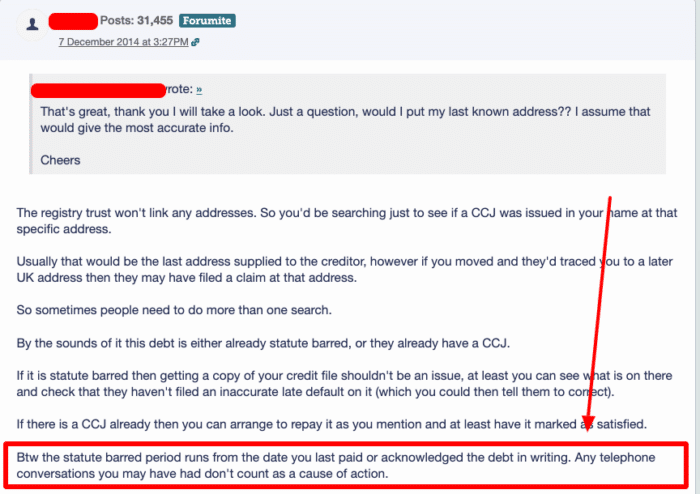
A payment or a qualifying written, signed acknowledgment before the limitation period expires can restart it. A creditor’s reminder does not itself restart the period. Once a claim is already statute-barred under the Limitation Act, a later acknowledgment or payment does not revive it.
Limitation can provide a defence to a late claim. If court papers arrive, respond in time and explain the defence rather than ignoring them.
Understand your debt options
MoneyNerd can introduce you to The Debt Advice Service for free debt advice. MoneyNerd does not provide debt advice or recommend debt solutions.
The Debt Advice Service can explain your options, including their benefits, costs and risks. Options available depend on your circumstances. There’s no obligation to take a debt solution.
MoneyNerd does not provide debt advice or recommend debt solutions. The Debt Advice Service is a trading style of Pacific Financial Solutions Limited. If you request an introduction, we’ll share your details with their team so they can contact you.
Some debt solutions have fees and may negatively affect your credit rating. MoneyNerd is a commercial introducer and may receive a fee if you go ahead with a debt solution through The Debt Advice Service.
For free, impartial money guidance and help finding free debt advice, visit MoneyHelper.
Can I be Chased for Debt After 10 Years?
Whether you’ll be being chased for your debts after ten years depends entirely on what type of debt it is and the circumstances surrounding it.
Let’s take a brief look at the debt types and limitation periods.
The Limitation Act 1980 governs England and Wales; other UK jurisdictions have their own rules.
Six years is common for simple-contract claims, but it is not a universal deadline for every debt or recovery method.
Loans, credit cards and some household bills can fall within that rule. Benefit overpayments and council tax have additional or different recovery rules and should not be treated as identical consumer-credit claims.
That being said, there are definitely some exceptions that the Act outlines thoroughly as well. Some of these exceptions to the Limitations Act are as follows:
Mortgage Shortfalls
Mortgage shortfalls have a limitation period of 12 years for the amount of money (the “capital”) you borrowed.
Keep in mind that the limitation period for the interest on your mortgage is still six years.
Claims that are not ordinary credit debts
Personal-injury claims, for example, have their own limitation rules and exceptions. Their time limits should not be used to assess an ordinary loan or credit-card debt.
Other Types of Debts
Some HMRC tax debts, including income tax and VAT, do not have the ordinary limitation period. Tax-credit overpayments are a different category.
Obtain advice on the particular tax or benefit debt and any statutory recovery powers rather than assuming a six-year rule applies.
County Court Judgment (CCJ)
A CCJ changes the position: the original limitation defence cannot simply be used to ignore the judgment. A judgment does not automatically expire after six years, although some enforcement methods then require the court’s permission and other restrictions can apply.
Criminal Fines
Criminal Fines have no limitation period, i.e., you could be pursued for any debts you may have regarding your criminal fines even after many years.
According to the Statute of Limitations, What can a Creditor do once a Debt is Statute-Barred?
For an ordinary statute-barred claim, a creditor cannot defeat a properly raised limitation defence simply by continuing to demand payment.
This does not mean you can ignore court papers. A claim may still be issued, and failing to respond can result in judgment.
FCA consumer-credit collection rules add protections where they apply.
For collection covered by FCA CONC 7.15, a firm must not keep demanding payment once you state that you will not pay because the debt is statute-barred. A separate rule bars recovery attempts where the lender or owner had not contacted you during the limitation period. This is not a blanket ban on every communication about any old debt.
Complain to the lender or collector first. If the complaint is eligible and remains unresolved, you can refer it to the Financial Ombudsman Service within the applicable time limit. The FCA can receive reports about misconduct but does not decide individual compensation disputes.
If those FCA rules do not cover the debt, obtain advice on the applicable law and complaint route.
You do not have to assume payment is the only way to resolve an unsupported or disputed demand.
If you cannot pay your debt, I suggest contacting an independent debt charity for advice, such as StepChange to help you with dealing with statute-barred debt collection attempts.
Take the first step towards tackling your debt
Every day, our partner, The Debt Advice Service, helps people understand their options for dealing with debt. Their debt advice is free, with no obligation to proceed.
MoneyNerd introduces you to The Debt Advice Service. We do not provide debt advice or recommend debt solutions.

Natasha
Very helpful and informative thank you

If you submit the enquiry form, MoneyNerd will share your details with The Debt Advice Service so they can contact you.
Some debt solutions have fees and may negatively affect your credit rating. MoneyNerd may receive a fee if you go ahead with a debt solution through The Debt Advice Service.
The Debt Advice Service is a trading style of Pacific Financial Solutions Limited.
For free, impartial help and access to not-for-profit debt advice, visit MoneyHelper.
What are Some Things I Should be Aware of for Statute-Barred Debt?
The most important thing you must remember is that you should not depend on these laws to get out of your debt.
Waiting for a debt to become barred is not a reliable debt-management plan. Court action and adverse credit reporting may happen before the period expires.
Prioritise rent, mortgage, council tax and other debts with serious consequences, and seek advice if you cannot afford them.
Ignoring your debts in hopes that they will become statute-barred may land you in more trouble than you were initially in.
Respond to legal notices and claims promptly; do not rely on the creditor forgetting the debt.
Another thing to always be wary of is to identify your debt type and ensure you know the correct limitation period.
You may incorrectly think your limitation period is six years, whereas it could be 12 years. This is one of the many misconceptions about statute-barred debts.
Some recovery can take place without an ordinary civil claim.
For example, DWP may recover qualifying benefit overpayments through benefit deductions or wages. That is a separate question from whether court proceedings are time-barred.
Debunking Common Myths around the Statute of Limitations
In the UK, there are several common myths surrounding statute-barred debts. It’s important to understand these myths to understand the law clearly. Here are a few of them:
- Myth 1: Statute-barred debts are automatically written off after a certain period.
In England and Wales, ordinary limitation usually prevents a court remedy if the defence is raised; it does not automatically cancel the underlying debt. Scotland’s prescription rules can extinguish a debt when their requirements are satisfied.
- Myth 2: Making a small payment or acknowledging the debt restarts the statute-barred clock.
A payment or a qualifying written, signed acknowledgment before the limitation period expires can restart it. A creditor’s reminder does not itself restart the period. Once a claim is already statute-barred under the Limitation Act, a later acknowledgment or payment does not revive it.
- Myth 3: The creditor must inform the debtor when the debt becomes statute barred.
Do not rely on receiving a notice that limitation has expired. Ask for advice and preserve the records needed to establish the dates.
It’s up to the debtor to be aware of their rights and raise the statute-barred defence if necessary.
- Myth 4: The debt collector can continue to pursue payment even if the debt is statute-barred.
Collection restrictions depend on the jurisdiction, type of debt and applicable FCA rules. They are not identical for every creditor.
If you are relying on limitation, state your position clearly without admitting liability, and ask for evidence if the collector disagrees.
- Myth 5: Statute-barred debts are removed from credit reports.
Credit reporting has separate time limits. A defaulted account is normally removed six years after the recorded default date; an account closed without a default normally remains for six years after closure. Becoming statute-barred does not start a new six-year reporting period.
There is no general requirement for a credit report to label an account “statute-barred”, and limitation does not guarantee future credit. Challenge inaccurate reporting through the lender and credit-reference agency.
What are the differences between statute-barred debts and written-off debts?
Many people confuse statute-barred debts with written-off debts. It is important to know the difference.
Statute-Barred Debts:
- Limitation generally restricts a court remedy after the applicable period and conditions are met.
- The period starts from the relevant cause of action, subject to rules about later payments and acknowledgment.
- An existing judgment and some public-debt recovery powers require separate consideration.
- A payment after a claim has already become barred under the Limitation Act does not revive it.
Written-off debts
- An accounting write-off does not necessarily release the borrower; the creditor may still collect or sell the debt.
- An express agreement to forgive a debt or a formal insolvency discharge can have different legal effects. Obtain the terms in writing.
- Credit-report treatment depends on the account history and applicable reporting rules, not simply the use of the words “written off”.
References