






Zinc Group Debt Collection: Checking a Demand and Your Options








MoneyNerd introduces enquiries to The Debt Advice Service and may receive a referral fee. For free, independent guidance and help finding a debt adviser, visit MoneyHelper.
This information and enquiry service is not a full financial assessment or a guarantee of suitability or debt write-off. Debt solutions are not suitable for everyone. Fees may apply, and your credit record and assets may be affected. Get advice on your circumstances before choosing a solution.
MoneyNerd introduces enquiries to The Debt Advice Service and may receive a referral fee. For free, independent guidance and help finding a debt adviser, visit MoneyHelper.
This information and enquiry service is not a full financial assessment or a guarantee of suitability or debt write-off. Debt solutions are not suitable for everyone. Fees may apply, and your credit record and assets may be affected. Get advice on your circumstances before choosing a solution.
This guide explains how to check a Zinc Group demand, respond to a dispute and seek help with repayment.
In this article, we’ll:
- Guide you on what to do if you’ve received a letter from Zinc Group.
- Explore if you really need to pay and what might happen if you don’t.
- Discuss ways to manage your debt.
- Show you where to get free advice about your debt.
Collection contact can be stressful. Keep records and identify any deadline that needs an immediate response.
Don’t worry. We’re here to share our knowledge and help you understand your debt.
Been Hit with a Zinc Debt Collection Letter?
Acting for a creditor is different from purchasing a debt. Ask who owns the account and what role Zinc has.
Debt purchase prices vary and do not establish your liability or require a creditor to accept a particular discount.
We go through handling both of these scenarios below.
Can You Ask Them To Prove Your Debt?
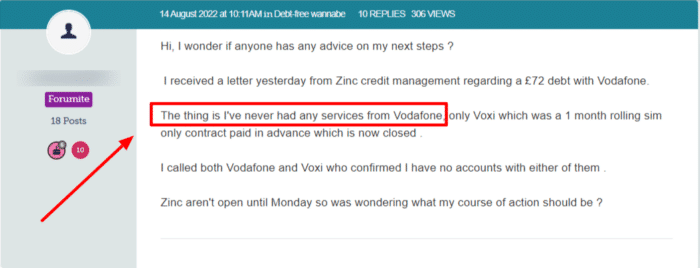
A forum example does not establish whether Zinc has evidence for your account. Explain your own dispute and request the relevant records.
For many simple-contract debts in England and Wales, the limitation period is six years from the relevant cause of action, subject to payment, written acknowledgement and court-proceeding rules. Many Scottish obligations prescribe after five years under different rules. Debt type and history matter; age alone does not establish that recovery is barred.
In England and Wales, limitation generally restricts the court remedy rather than cancelling a simple-contract debt. Scottish prescription can extinguish the obligation.
If the valid balance is affordable after essentials and priority debts, use a verified payment route. Otherwise, seek advice about an affordable response.
A plan may be agreed. Written confirmation helps establish its terms but cannot guarantee that no later dispute will arise. See related guidance.
If you don’t think that you can afford even a repayment plan with Zinc, you may need to consider a debt solution.
Understand your debt options
MoneyNerd can introduce you to The Debt Advice Service for free debt advice. MoneyNerd does not provide debt advice or recommend debt solutions.
The Debt Advice Service can explain your options, including their benefits, costs and risks. Options available depend on your circumstances. There’s no obligation to take a debt solution.
MoneyNerd does not provide debt advice or recommend debt solutions. The Debt Advice Service is a trading style of Pacific Financial Solutions Limited. If you request an introduction, we’ll share your details with their team so they can contact you.
Some debt solutions have fees and may negatively affect your credit rating. MoneyNerd is a commercial introducer and may receive a fee if you go ahead with a debt solution through The Debt Advice Service.
For free, impartial money guidance and help finding free debt advice, visit MoneyHelper.
When You Don’t Have to Pay the Debt
Don’t Ignore Zinc Collection Letters
What Debt Solution Can You Get?
There are a few different debt solutions available to you, depending on your circumstances and financial situation.
Keep in mind that, with so many options available,we recommend that you speak to a specialist who will be able to help you work out which one will be best for you.
Debt Management Plan (DMP)
A DMP is an informal debt solution between you and your creditors. You pay a set monthly sum that is shared among your non-priority debts.
A DMP is voluntary and normally aims to repay included unsecured debts in full. It does not guarantee frozen interest or protection from court action.
Individual Voluntary Arrangement (IVA)
An IVA is formal insolvency administered by an insolvency practitioner. Suitability depends on debts, affordable contributions or assets, fees and creditor approval, without a universal minimum debt or multiple-creditor rule.
Many IVAs involve five or six years of payments, but terms vary. Qualifying unpaid debt is normally released on successful completion, and fees, credit effects and asset risks apply. Necessary correspondence can still be sent.
Trust Deed
IVAs are not available in Scotland. An approved money adviser can compare protected trust deeds, DAS, sequestration and informal arrangements. See related guidance.
A protected trust deed usually involves at least four years of contributions. Discharge depends on successful completion; fees apply and assets may be at risk. It is not identical to an IVA or compulsory for Scottish debtors.
Debt Relief Order (DRO)
In England and Wales, DRO eligibility includes a £50,000 qualifying-debt limit and detailed income, asset, vehicle and residence conditions. An approved adviser checks eligibility.
During a DRO, included qualifying debts are protected from most recovery action under the moratorium rules. This is not a ban on every necessary communication, and excluded debts and ongoing bills still need attention.
A DRO normally lasts 12 months and discharges included qualifying debts if it remains in force. Report relevant changes and continue paying ongoing bills and excluded debts.
Bankruptcy
If you owe substantial debts but have no real possibility of paying them back, you may need to declare bankruptcy.
Bankruptcy has a negative image, but it is often your only way of clearing debts and getting a fresh financial start. That said, it is a serious financial situation that should not be taken lightly.
Sequestration
Sequestration is the Scottish version of bankruptcy.
An approved Scottish money adviser can assess eligibility for the Minimal Asset Process (MAP), a form of sequestration, and compare other suitable options. Eligibility and consequences must be checked; it is not automatically the best choice for everyone with a low income. See related guidance.
Thousands have already tackled their debt
Every day, our partner, The Debt Advice Service, helps people understand their options for dealing with debt. Their debt advice is free, with no obligation to proceed.
MoneyNerd introduces you to The Debt Advice Service. We do not provide debt advice or recommend debt solutions.

Natasha
Very helpful and informative thank you
If you submit the enquiry form, MoneyNerd will share your details with The Debt Advice Service so they can contact you.
Some debt solutions have fees and may negatively affect your credit rating. MoneyNerd may receive a fee if you go ahead with a debt solution through The Debt Advice Service.
The Debt Advice Service is a trading style of Pacific Financial Solutions Limited.
For free, impartial help and access to not-for-profit debt advice, visit MoneyHelper.
Can Zinc Take Your Valuable Items?
Debt Collectors vs Bailiffs
We recently spoke to the Mirror about debt collectors and bailiffs. While a bailiff may be permitted to take your possessions, a debt collector never can.
All they are allowed to do is ask for a payment. To learn more about this, please take a quick look at the table below.
| Issue | Debt collector | Bailiff or enforcement agent |
|---|---|---|
| Role | Requests payment for a creditor or debt purchaser. | Acts under a legally valid enforcement power and must follow its limits. |
| Entry | No power to force entry; you can refuse entry and ask them to leave. | Usually cannot force first entry to a home for council tax or an ordinary civil debt. Limited exceptions and re-entry rules apply. |
| Goods | Cannot seize your goods. | May take non-exempt goods belonging to the debtor where the legal conditions are met; essential items and some work equipment are protected. |
| Bank accounts | A judgment alone gives no access. | Taking money from an account normally requires a separate third-party debt order obtained by the creditor, not a doorstep bailiff power. |
| Contact | Must avoid harassment; regulated firms must contact at reasonable times. | Visits are normally between 6 am and 9 pm, subject to legal exceptions. |
| Vulnerability | Tell the firm what support or communication adjustments you need. | Tell the agent and creditor about vulnerability and seek advice about additional safeguards. |
| Disputes | Ask for evidence of the debt and complain about improper conduct. | Check identification, the enforcement authority and fees; get urgent advice about an invalid notice or proposed entry. |
Stopping Nuisance Calls
» TAKE ACTION NOW: Fill out the short debt form
How to complain
First, make a complaint directly to Zinc so they have the opportunity to sort out the issue themselves.
Complain to the business first. If the activity falls within the Financial Ombudsman Service’s remit, you can normally escalate after a final response or eight weeks without one, usually within six months of the final response. The Ombudsman can require redress, such as compensation or correcting records; it does not fine firms or remove their authorisation.
Zinc Group Credit Contact Information
References