Debt Info
Bailiffs

Can Bailiffs Take My Property for My Son’s Debt?

Scott Nelson MoneyNerd Janine Marsh MoneyNerd
By
Scott
Scott Nelson MoneyNerd

Scott Nelson

Debt Expert

Scott founded MoneyNerd after his own experience with debt. He runs the website and oversees its general information about debt and other money matters. Scott does not provide personal debt advice or recommend debt solutions through MoneyNerd. If you make a debt enquiry, MoneyNerd may introduce you to The Debt Advice Service, which provides any personal debt advice.

Learn more about Scott
&
Janine
Janine Marsh MoneyNerd

Janine Marsh

Financial Expert

Janine contributed articles and videos to MoneyNerd about everyday money, household costs, debt topics and parking matters. She has a background in broadcasting, including work with BBC Radio 5 Live and Bauer radio stations.

Learn more about Janine
· Oct 4th, 2026
Get debt advice from The Debt Advice Service

Total amount of debt?

MoneyNerd does not provide debt advice or recommend debt solutions. We can introduce you to The Debt Advice Service, a trading style of Pacific Financial Solutions Limited. Their debt advice is free, and there is no obligation to proceed.

If you request an introduction, we’ll share your details with The Debt Advice Service so they can contact you.

Some debt solutions have fees and may negatively affect your credit rating. MoneyNerd is a commercial introducer and may receive a fee if you go ahead with a debt solution through The Debt Advice Service.

For free, impartial money guidance and help finding free debt advice, visit MoneyHelper.

MoneyNerd introduces enquiries to The Debt Advice Service and may receive a referral fee. For free, independent guidance and help finding a debt adviser, visit MoneyHelper.

This information and enquiry service is not a full financial assessment or a guarantee of suitability or debt write-off. Debt solutions are not suitable for everyone. Fees may apply, and your credit record and assets may be affected. Get advice on your circumstances before choosing a solution.

Take My Property For Son's Debt

MoneyNerd introduces enquiries to The Debt Advice Service and may receive a referral fee. For free, independent guidance and help finding a debt adviser, visit MoneyHelper.

This information and enquiry service is not a full financial assessment or a guarantee of suitability or debt write-off. Debt solutions are not suitable for everyone. Fees may apply, and your credit record and assets may be affected. Get advice on your circumstances before choosing a solution.

It can be very concerning when a bailiff company says they might take your things. This is even scarier when it’s for your son’s debt, not yours.

This guide explains goods ownership and bailiff enforcement in England and Wales when a debt belongs to an adult child.

This article is here to help you understand:

  • Whether bailiffs can take goods at your home for your son’s debt.
  •  What to do if a bailiff comes to your door because of your son’s debt.
  •  What things bailiffs can’t take.

You are not liable for a debt merely because you are the debtor’s parent. Joint liability or a guarantee may change the position.

Check the notice, the debtor’s address and ownership of the goods, and get prompt advice if enforcement is threatened.

Could you legally write off some debt?

MoneyNerd can introduce you to The Debt Advice Service for free debt advice. MoneyNerd does not provide debt advice or recommend debt solutions.

Answer a few questions to start your enquiry. Options available depend on your circumstances.

How much debt do you have?

MoneyNerd does not provide debt advice or recommend debt solutions. We can introduce you to The Debt Advice Service, a trading style of Pacific Financial Solutions Limited. Their debt advice is free, and there is no obligation to proceed.

If you request an introduction, we’ll share your details with The Debt Advice Service so they can contact you.

Some debt solutions have fees and may negatively affect your credit rating. MoneyNerd is a commercial introducer and may receive a fee if you go ahead with a debt solution through The Debt Advice Service.

For free, impartial money guidance and help finding free debt advice, visit MoneyHelper.

Dealing with a Notice of Enforcement from Bailiffs Regarding Your Son’s Debt

A notice of enforcement should be addressed to the debtor. If a notice for your son arrives at your address, contact the enforcement company and explain whether he lives there.

For enforcement action under the rules in force from 1 May 2026, the usual minimum notice before taking control of goods is 14 clear days. A qualifying debt advice provider can request an extension to at least 28 clear days before the original deadline, except for excluded business debt. A court can shorten notice in specified circumstances; earlier enforcement action is protected by transitional rules.

You can use this time to contact them and inform them that the debt is your son’s and not yours.

A debt being your son’s does not itself prevent enforcement against his goods where he lives. Explain if he does not live at your address and provide relevant evidence; do not pay simply because you are his parent. See related guidance.

If the address or debtor’s identity is wrong, ask the company to correct its records and confirm a hold while it checks. Keep copies and contact the creditor too.

An enforcement agent must not misrepresent their powers. The rules on taking control of goods and the Ministry of Justice’s national standards are relevant; FCA debt collection rules are not the general source of bailiff powers.

What Should You Do if a Bailiff Shows Up at Your Doorstep Regarding Your Son’s Debt? 

Dealing with a bailiff visit for another person’s debt is stressful – even when the other person is your son!

An agent may have lawful authority to attend premises where they reasonably believe your son usually lives or trades, even if you own the property. Your own goods remain protected unless you are also liable. Forced entry depends on the debt and specific legal authority.

For ordinary civil debts, including council tax, an enforcement agent cannot force initial entry into a home. They may enter through a normal unlocked door where they have lawful authority, but cannot climb through a window or push past you. You can communicate through a closed door.

If a bailiff shows up at your door, you can deal with them through a closed door.

Firstly, ask them to prove they are who they say they are. Enforcement agents are required to carry a form of ID with them.

Ask them to show you this, it will give you their name as well as what kind of a bailiff they are. 

Once you know their name and what kind of bailiff they are, you can look them up to ensure they’re a real bailiff. 

I shared with The Mirror how important it is to know your rights when faced with bailiffs at your front door.

» TAKE ACTION NOW: Fill out the short debt form

Ask for evidence of the enforcement power, the debtor named and the amount claimed. The document may properly name your son rather than you.

A County Court warrant and a High Court writ are different documents. Other debts, such as council tax, have different legal authority; ask the agent to identify the basis of enforcement.

If the debt is owed by your son, these documents will have his name on them and not yours. Inform the bailiff of this fact. 

If the bailiff does not believe you, you can prove yourself to them by showing them any form of ID such as a driving licence. 

If your son does not live or trade at your home, provide relevant evidence and ask the firm to update its records. A court can authorise entry to other specified premises in limited cases, so obtain advice if the agent claims a separate warrant.

If your son lives with you, his non-exempt goods may be at risk. Goods owned solely by you cannot be taken for his debt; jointly owned goods need separate consideration.

Understand your debt options

MoneyNerd can introduce you to The Debt Advice Service for free debt advice. MoneyNerd does not provide debt advice or recommend debt solutions.

The Debt Advice Service can explain your options, including their benefits, costs and risks. Options available depend on your circumstances. There’s no obligation to take a debt solution.

Get Started

MoneyNerd does not provide debt advice or recommend debt solutions. The Debt Advice Service is a trading style of Pacific Financial Solutions Limited. If you request an introduction, we’ll share your details with their team so they can contact you.

Some debt solutions have fees and may negatively affect your credit rating. MoneyNerd is a commercial introducer and may receive a fee if you go ahead with a debt solution through The Debt Advice Service.

For free, impartial money guidance and help finding free debt advice, visit MoneyHelper.

What Should You Do if a Bailiff is Trying to Take Something That Belongs to You? 

The agent may seek to take control of the debtor’s non-exempt goods. That does not make all goods at the address the debtor’s property. See related guidance.

Goods can sometimes be removed on the first lawful enforcement visit; there is no rule requiring the agent to offer a controlled goods agreement first.

If an inventory or controlled goods agreement is proposed, check both ownership and exemptions before agreeing to it.

If they attempt to put an item into the inventory that belongs to you and not your son, you should intervene and inform them that they don’t have the right to do that.

Provide ownership evidence and request correction of the inventory. If the agent disputes your claim, obtain prompt advice on the formal third-party claim process.

Goods owned solely by someone else cannot be taken for your debt. Jointly owned goods can be affected, with protection for the other owner’s share; provide evidence and obtain prompt advice if ownership is disputed.

Taking goods owned solely by a third party is contrary to the statutory limits on taking control of goods. Explain any joint ownership separately. See related guidance.

If a bailiff tries to do this, assure them that the possession belongs to you and not to your son. You could prove this by showing them a bill or a credit card receipt for the possession.

A V 5 C identifies the registered keeper, not necessarily the vehicle’s owner. Use purchase receipts, bank statements, finance documents or other evidence of ownership.

Take the first step towards tackling your debt

Every day, our partner, The Debt Advice Service, helps people understand their options for dealing with debt. Their debt advice is free, with no obligation to proceed.

MoneyNerd introduces you to The Debt Advice Service. We do not provide debt advice or recommend debt solutions.

Natasha

Very helpful and informative thank you

Get started

If you submit the enquiry form, MoneyNerd will share your details with The Debt Advice Service so they can contact you.

Some debt solutions have fees and may negatively affect your credit rating. MoneyNerd may receive a fee if you go ahead with a debt solution through The Debt Advice Service.

The Debt Advice Service is a trading style of Pacific Financial Solutions Limited.

For free, impartial help and access to not-for-profit debt advice, visit MoneyHelper.

What Should You Do if Bailiffs Take Something That Belonged to You? 

Immediately notify the enforcement agent and creditor in writing that the goods belong to you and seek urgent advice on a third-party claim under Civil Procedure Rule 85.4.

A notice of claim should be given as soon as practicable and normally within seven days of removal, identifying you, the goods and the grounds of ownership. Do not wait for a routine complaint response before checking the court procedure and deadlines.

It is a good idea to only communicate from this point through letter or email so that you can keep copies and have a detailed record of your dealings with the bailiffs.

Bailiffs are not allowed to take someone else’s goods if they don’t owe the debt.

When you complain to them, state that they have taken someone else’s property and not the property of the person who owes the debt. You can include proof of ownership by including a bill or a receipt of the purchase of the item. 

If the bailiffs take your belongings and then refuse to give them back even after you’ve provided proof, you could contact the original creditor.

This is the person or company for whom they are working for. 

The Financial Ombudsman Service is not a general appeal body for bailiff enforcement and does not fine bailiffs. The correct escalation route depends on the agent and creditor: it may involve an eligible enforcement complaints scheme, a council ombudsman complaint or an application to court. Obtain advice on the route and any deadline. See related guidance.

A complaint and a formal claim to goods are different procedures. Ask an adviser which action is needed to protect your goods before any sale.

Check the firm’s applicable independent complaints scheme or trade association process, but do not let this delay a time-sensitive claim to the goods. See related guidance.

If goods have been sold, obtain legal advice promptly about possible remedies, evidence and costs. Do not assume a routine complaint alone will recover their value.

What are Some Things They Cannot Take? 

This guide concerns England and Wales; Scotland and Northern Ireland have different enforcement systems.

Goods owned solely by someone else cannot be taken for your debt. Jointly owned goods can be affected, with protection for the other owner’s share; provide evidence and obtain prompt advice if ownership is disputed.

Your solely owned goods cannot be taken just because your child owes a debt. If you are jointly liable or have guaranteed the debt, get advice on your own position.

The vice versa is true as well: a bailiff can’t take anything belonging to your children if you’re the one who owes the debt. 

Pets and assistance animals are protected. Items personally needed for work, business, study or education are protected up to an aggregate value of £1,350; the exemption is not unlimited.

Goods on hire purchase or conditional sale generally belong to the finance company until the contract conditions are met. Provide the agreement and seek advice if an agent disputes the ownership or your son’s interest in the goods. See related guidance.

Bailiffs also cannot take any appliances or equipment that you need to fulfill your basic domestic needs. Prohibited items for bailiffs include things like:

  • tables
  • chairs
  • beds
  • a cooker
  • microwave
  • fridge
  • mobile phone.

Do Bailiffs Have a Right of Entry?

Rights of entry depend on the enforcement power. These situations must be distinguished:

  • Ordinary civil debts: no forced initial entry into a home, although lawful peaceful entry through an unlocked door may be possible.
  • Certain criminal fines: specific statutory powers can allow reasonable force.
  • Tax enforcement: forced entry requires the applicable legal authority and conditions.
  • Lawful eviction under a possession warrant or writ: different powers from taking goods for a debt.

Council tax enforcement does not permit forced initial entry merely because a liability order exists.

An earlier visit alone does not authorise forced re-entry. Reasonable force may be available to recover goods already controlled after a repayment agreement is breached, but only if the statutory conditions and required notice are satisfied. Get urgent advice if forced re-entry is threatened.

Being aware of your rights can make the situation less stressful. Take this example:
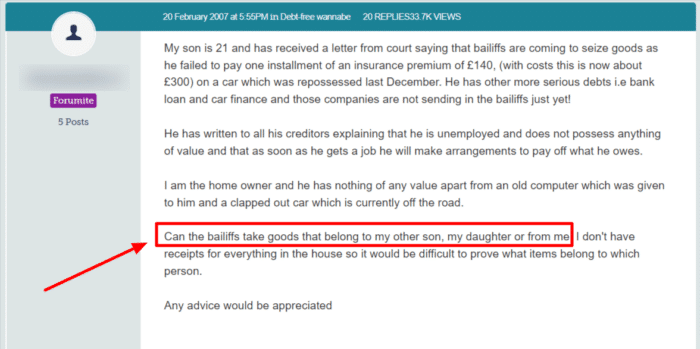
A parent is not automatically liable for a child’s debt. An ordinary civil debt does not permit forced initial entry into a home, but the agent may still be able to take the debtor’s non-exempt goods outside.

Your Rights With Bailiffs

Here’s a table delving deeper into bailiffs’ rights.

Bailiffs may Important limits
Visit under a valid enforcement power Normally at least 14 clear days’ notice is required before taking control of goods; courts can shorten notice. An eligible debt-advice request can extend it to 28 clear days.
Take non-exempt goods belonging to the debtor They cannot take ordinary essential household items or someone else’s property. Some jointly owned goods may be affected.
Take a vehicle where legally permitted Ownership, finance, disability and other exemptions must be checked. ANPR does not remove those limits.
Enter through a door when lawful For ordinary civil debts they usually cannot force first entry to a home. A CCJ by itself is not a power to break in.
Enter into a controlled goods agreement Ask for a clear inventory and terms; breaking an agreement can have serious consequences.
Sell goods under the enforcement rules Notice and sale requirements apply. Get advice if you dispute ownership, exemption, entry or fees.

England and Wales only. Tools and equipment needed personally for work, study or education have a combined exemption limit of £1,350. The rules differ elsewhere in the UK.

Could you legally write off some debt?

MoneyNerd can introduce you to The Debt Advice Service for free debt advice. MoneyNerd does not provide debt advice or recommend debt solutions.

Answer a few questions to start your enquiry. Options available depend on your circumstances.

How much debt do you have?

MoneyNerd does not provide debt advice or recommend debt solutions. We can introduce you to The Debt Advice Service, a trading style of Pacific Financial Solutions Limited. Their debt advice is free, and there is no obligation to proceed.

If you request an introduction, we’ll share your details with The Debt Advice Service so they can contact you.

Some debt solutions have fees and may negatively affect your credit rating. MoneyNerd is a commercial introducer and may receive a fee if you go ahead with a debt solution through The Debt Advice Service.

For free, impartial money guidance and help finding free debt advice, visit MoneyHelper.

References

  1. Citizens Advice – Debt Statistics and Bailiff Issues
  2. FCA Handbook – CONC 7

Schedule 12, Tribunals, Courts and Enforcements Act, 2007

Part 1, Regulation 10, Certification of enforcement agents, 2014.

Gov.uk, CPR – Rules and Directions, 2018.

Did you like this article?
Show your support ❤️
We're glad you liked the article! As a small team, your support means everything to us. If you could rate us on Google, it would be amazing. Thank you!
We are so sorry...

Is there something missing? We’re all ears and eager to improve. Send us a message and let us know how we can make our article more useful for you.

You can email us directly at [email protected] to share your feedback.

The authors
Scott Nelson MoneyNerd
Author
Scott founded MoneyNerd after his own experience with debt. He runs the website and oversees its general information about debt and other money matters. Scott does not provide personal debt advice or recommend debt solutions through MoneyNerd. If you make a debt enquiry, MoneyNerd may introduce you to The Debt Advice Service, which provides any personal debt advice.
Janine Marsh MoneyNerd
Debt Expert
Janine contributed articles and videos to MoneyNerd about everyday money, household costs, debt topics and parking matters. She has a background in broadcasting, including work with BBC Radio 5 Live and Bauer radio stations.