Rundles Bailiffs: Your Rights, Fees and Payment Options








MoneyNerd introduces enquiries to The Debt Advice Service and may receive a referral fee. For free, independent guidance and help finding a debt adviser, visit MoneyHelper.
This information and enquiry service is not a full financial assessment or a guarantee of suitability or debt write-off. Debt solutions are not suitable for everyone. Fees may apply, and your credit record and assets may be affected. Get advice on your circumstances before choosing a solution.
MoneyNerd introduces enquiries to The Debt Advice Service and may receive a referral fee. For free, independent guidance and help finding a debt adviser, visit MoneyHelper.
This information and enquiry service is not a full financial assessment or a guarantee of suitability or debt write-off. Debt solutions are not suitable for everyone. Fees may apply, and your credit record and assets may be affected. Get advice on your circumstances before choosing a solution.
If Rundles Enforcement Agents have contacted you, check the debt, authority and deadline in the notice promptly. This guide explains the main enforcement rules in England and Wales and where to get free debt advice.
In this article, we will explain:
- How to find out if the debt Rundles are asking about is really yours.
- Who Rundles Bailiffs are and why they want to talk to you.
- Options if you dispute the debt or cannot afford payment.
- How to deal with a visit from Rundles Bailiffs.
- Steps to take if Rundles take your things.
Enforcement can be stressful. Understanding the notice and getting independent advice can help you decide what to do next.
Let’s dive in to explore your options and find the best course of action.
Why Do They Want to Speak to You?
If you are being contacted by Rundles & Co bailiffs, you might be wondering why they want to speak to you.
Rundles provides enforcement services. Its website lists the following areas of work; check the particular creditor and debt on your notice:
Rundles can be instructed to act for the organisation owed the money under the relevant enforcement authority. Its instruction does not mean it has bought your debt.
Before paying, verify the notice with Rundles or the instructing creditor. Useful checks include:
Being instructed to enforce a debt is different from an agreement to purchase the debt. Do not assume Rundles has bought it: check the creditor and authority on the notice. Use independently verified contact details if you doubt a message is genuine.
Do not assume a discount is available because an enforcement company is involved. If you cannot afford payment, provide a budget and ask about an affordable arrangement.
So, Rundles Enforcement is a legitimate company. If you hear from them, you might need to check your finances for any outstanding balances.
How to Deal with Contact
If you are contacted by Rundles Bailiffs and you are not sure what to do, these are some things to bear in mind:
Speak to them
The figures below are the non-High Court stage fees under the rules effective from 1 May 2026. Earlier enforcement action has transitional protection; High Court enforcement and court-employed County Court bailiffs have different fee arrangements. Ask for an itemised calculation.
Respond promptly, including if you believe the debt is not yours. Ask for a written hold while an error or vulnerability is considered; speaking to the company alone does not guarantee that a visit or further fee is avoided.
Our financial expert, Janine Marsh, advises on letting a bailiff into your home: ‘It’s crucial you check who they are before you open your door. Ask for their certificate through the letterbox or a window.’
There are lots of examples of debts having fees added online, including debts being chased by Rundles Enforcement.
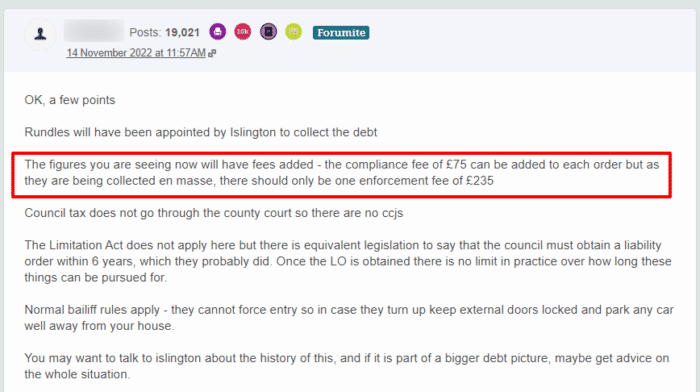
The forum example below is anecdotal and may show fees under older rules. Use the current statutory figures above and obtain an itemised calculation for your case. A free debt adviser can help check disputed charges.
Is it your debt?
The first step, if you are sent a letter which states that you owe the money, is to make sure it is correct. Debt verification is a step that too many people skip.
If you don’t recognise it, it could belong to someone who lived at your address prior to you moving in, or there could be an error with the name. Alternatively, you may have already cleared the debt.
A prove it letter can help request information, but does not itself stop enforcement. Ask for the creditor, debt type, relevant dates, authority to enforce and an itemised balance. If liability is disputed, contact the creditor as well as the enforcement company and obtain urgent advice on the proper challenge. A request for evidence does not itself suspend enforcement or extend a deadline. See prove it letter template.
Council tax and statutory penalty debts do not depend on a signed consumer credit agreement. Failure to produce such an agreement does not cancel a liability order or warrant. Check the actual legal basis of the debt and the available review or court procedure.
Is it enforceable?
Older debts require a check of the applicable limitation or prescription rules and any existing court action.
Some unsecured contractual debts in England and Wales have a six-year time limit for starting court proceedings, normally measured from when the creditor could sue. A payment or qualifying signed written acknowledgment before expiry can restart the period. A conversation alone does not restart it, and court proceedings begun in time can change the position.
Scotland has different prescription rules: certain debts are extinguished after five years without a relevant claim or acknowledgment, subject to the applicable rules. This is not the same as the England and Wales limitation defence. Ask an adviser to check the debt type, dates and any court action.
Keep in mind that not all debts become statute-barred!
A debt with an existing judgment, council tax liability order or enforcement warrant cannot be assessed using a simple six-years-since-last-payment rule. Tax debts also have special rules. A judgment does not disappear when its six-year credit-file entry ends, although later enforcement may require court permission.
Seek advice before using a statute-barred letter, making a payment or acknowledging an old debt. Ask the adviser to check the relevant dates, debt type and any court action; do not ignore an enforcement notice while waiting. See statute-barred debt letter template.
Pay it back
If the liability and charges are valid, discuss payment or an affordable arrangement promptly. If you cannot afford payment in full, provide an income-and-expenditure budget and propose affordable instalments. The company does not have to accept every offer. Ask for written confirmation of any agreement and whether enforcement is paused; merely making an offer does not stop action or fees. Keep receipts and check that the payment is allocated to the correct account.
Whatever you do, it is always best to speak to Rundles Bailiffs and be honest about your financial situation. If you set up a repayment plan, and for any reason, you are unable to make a payment, you should give them plenty of notice to let them know.
Understand your debt options
MoneyNerd can introduce you to The Debt Advice Service for free debt advice. MoneyNerd does not provide debt advice or recommend debt solutions.
The Debt Advice Service can explain your options, including their benefits, costs and risks. Options available depend on your circumstances. There’s no obligation to take a debt solution.
MoneyNerd does not provide debt advice or recommend debt solutions. The Debt Advice Service is a trading style of Pacific Financial Solutions Limited. If you request an introduction, we’ll share your details with their team so they can contact you.
Some debt solutions have fees and may negatively affect your credit rating. MoneyNerd is a commercial introducer and may receive a fee if you go ahead with a debt solution through The Debt Advice Service.
For free, impartial money guidance and help finding free debt advice, visit MoneyHelper.
How to Deal with a Visit
For ordinary civil debts, including council tax, an enforcement agent cannot force initial entry into a home. They may enter through a normal unlocked door where they have lawful authority, but cannot climb through a window or push past you. You can communicate through a closed door.
Forced entry depends on specific legal powers, not simply whether a debt is described as serious. Limited exceptions can apply to certain criminal fines, authorised business-premises enforcement or recovery of goods already controlled after breach of an agreement. Ask for the precise authority and seek urgent advice; a locksmith or warrant alone does not establish a general right to force entry.
Ask the agent for evidence of identity and authority to enforce. An identity card alone does not prove a right to force entry. Useful information includes:
If you are worried about answering the door to get this information, you can just ask them to pass it through the letterbox or under the door. You should inspect them closely, including ensuring they are not out of date, and that all the information is accurate.
Vulnerability depends on the person’s circumstances and how enforcement affects them. Tell the enforcement company and creditor about your needs, provide relevant evidence if available, and ask for suitable adjustments. A diagnosis or membership of a particular group does not automatically cancel the debt, stop all visits or remove all fees.
» TAKE ACTION NOW: Fill out the short debt form
If the debt is not yours or the agent cannot explain their authority, tell Rundles and the creditor immediately and obtain advice. You can communicate through a closed door. Refusing entry to a home does not itself cancel lawful enforcement against non-exempt goods outside.
Ignoring a valid notice can lead to further enforcement and recoverable fees. Seek advice early about a dispute, vulnerability or unaffordable payment demand.
If you are unsure of the rights and responsibilities that Rundles Enforcement have, you should contact a debt charity for some free and specific professional advice.
Do They Have Any Powers?
As they are an authorised enforcement agent, Rundles Bailiffs do have legal powers with regards to your debt. You have certain rights as well, it’s not all about them, and you should know what they can and can’t do.
For ordinary civil debts, including council tax, an enforcement agent cannot force initial entry into a home. They may enter through a normal unlocked door where they have lawful authority, but cannot climb through a window or push past you. You can communicate through a closed door. A debtor-owned vehicle outside the home may be controlled without entry to the house, but ownership and exemptions matter. Goods necessary personally for work, study or education are normally protected up to £1,350 in aggregate, subject to statutory exceptions for certain debts. A vehicle displaying a valid Blue Badge because it is used to transport a disabled person is exempt. A work commute alone does not automatically protect a car, and financed or third-party vehicles require careful ownership checks.
Agents may take control only of goods the law allows them to take, under valid authority. Essential household items, qualifying work or study equipment and certain disability-related goods are protected. Check the goods guidance and the entry restrictions below. See related guidance.
Please check out the following table to learn more about what bailiffs can and can’t do.
| Bailiffs may | Important limits |
|---|---|
| Visit under a valid enforcement power | Normally at least 14 clear days’ notice is required before taking control of goods; courts can shorten notice. An eligible debt-advice request can extend it to 28 clear days. |
| Take non-exempt goods belonging to the debtor | They cannot take ordinary essential household items or someone else’s property. Some jointly owned goods may be affected. |
| Take a vehicle where legally permitted | Ownership, finance, disability and other exemptions must be checked. ANPR does not remove those limits. |
| Enter through a door when lawful | For ordinary civil debts they usually cannot force first entry to a home. A CCJ by itself is not a power to break in. |
| Enter into a controlled goods agreement | Ask for a clear inventory and terms; breaking an agreement can have serious consequences. |
| Sell goods under the enforcement rules | Notice and sale requirements apply. Get advice if you dispute ownership, exemption, entry or fees. |
England and Wales only. Tools and equipment needed personally for work, study or education have a combined exemption limit of £1,350. The rules differ elsewhere in the UK.
If you have any queries or concerns about Rundles and your own circumstances, you can contact a debt charity for some free debt and legal advice. The following organisations offer these services for free:
How to Cope if They Take Your Belongings
Act promptly if your goods have been removed, especially if a sale date has been set. The available options depend on ownership, exemptions, the validity of enforcement and whether the debt and recoverable costs can be resolved.
If goods have been removed, obtain urgent advice before the sale. Paying the full enforceable debt and recoverable costs in time can stop the sale; a repayment offer alone does not guarantee return. Buying goods at auction does not necessarily clear any remaining debt and fees.
If exempt goods or someone else’s property have been taken, contact the agent immediately with evidence and seek advice on the appropriate court procedure and deadline. An error does not automatically cancel the debt or guarantee that goods will be returned without costs. See related guidance.
Take the first step towards tackling your debt
Every day, our partner, The Debt Advice Service, helps people understand their options for dealing with debt. Their debt advice is free, with no obligation to proceed.
MoneyNerd introduces you to The Debt Advice Service. We do not provide debt advice or recommend debt solutions.

Natasha
Very helpful and informative thank you

If you submit the enquiry form, MoneyNerd will share your details with The Debt Advice Service so they can contact you.
Some debt solutions have fees and may negatively affect your credit rating. MoneyNerd may receive a fee if you go ahead with a debt solution through The Debt Advice Service.
The Debt Advice Service is a trading style of Pacific Financial Solutions Limited.
For free, impartial help and access to not-for-profit debt advice, visit MoneyHelper.
Is There Any Way of Stopping Them?
Rundles may send notices, contact you and make authorised enforcement visits. The company must act within the applicable law and standards.
Do not ignore the notice. Contact Rundles and the creditor promptly if there is a mistake or you need help, and ask a free debt adviser about the available options. See related guidance.
For enforcement action under the rules in force from 1 May 2026, the usual minimum notice before taking control of goods is 14 clear days. A qualifying debt advice provider can request an extension to at least 28 clear days before the original deadline, except for excluded business debt. A court can shorten notice in specified circumstances; earlier enforcement action is protected by transitional rules.
There are things that Rundles & Co bailiffs can’t do, and these include:
If you wish to contact Rundles, you can check the letters they have sent or take a look at the company’s website to get the details you require.
Early contact can help resolve a problem, but does not itself freeze fees or prevent a visit. Obtain written confirmation of any accepted arrangement or pause in enforcement.
Ask for the creditor, debt type, relevant dates, authority to enforce and an itemised balance. If liability is disputed, contact the creditor as well as the enforcement company and obtain urgent advice on the proper challenge. A request for evidence does not itself suspend enforcement or extend a deadline. The Financial Conduct Authority’s guidelines apply to activities within their consumer-credit scope, not universally to all statutory bailiff enforcement.
How do I Complain?
If you believe an agent acted improperly, keep the notices, payment records and details of the incident. Online reviews cannot determine whether a specific enforcement action was lawful. See Rundles customer reviews.
Complain to the enforcement company and the creditor, identifying the conduct or charge you dispute. For a County Court bailiff employed by HMCTS, complain to the court. A complaint does not itself suspend enforcement or extend a court deadline. FCA consumer-credit rules are not a universal complaints framework for council tax or penalty enforcement. See FCA handbook information.
Follow Rundles’ current complaints procedure and raise the issue with the instructing creditor where appropriate. A complaint does not itself suspend enforcement or a court deadline.
The Financial Ombudsman Service is not a general appeal body for bailiff enforcement and does not fine bailiffs. The correct escalation route depends on the agent and creditor: it may involve an eligible enforcement complaints scheme, a council ombudsman complaint or an application to court. Obtain advice on the route and any deadline. See Financial Ombudsman eligibility and complaints information.
CIVEA means the Civil Enforcement Association. Check the current complaints arrangements for the firm and any applicable independent scheme; membership and eligibility matter. Court complaints about certification are a separate process and can carry costs risks. See CIVEA complaints information, CIVEA code of practice.
Rundles Bailiffs Contact Number
References
- Citizens Advice – Debt Statistics and Bailiff Issues
- StepChange – Creditor and Debt Collector Conduct
Schedule 12, Tribunals, Courts and Enforcements Act, 2007
Part 1, Regulation 10, Certification of enforcement agents, 2014.