I Can’t Afford to Pay my Fixed Penalty Notice – Things You Can Do


Are you worried because you can’t afford to pay your Fixed Penalty Notice? This article is here to help. We will give you clear, simple advice on what you can do. Every month, over 130,000 people use our website to understand fines and penalty notices better.
In this article, we will explain:
- What a Fixed Penalty Notice (FPN) is.
- Whether or not you need to pay your FPN.
- Ways to challenge an FPN.
- Situations where you might not need to pay.
- What could happen if you ignore the FPN.
We understand that getting a Fixed Penalty Notice can be a big worry, and not only for you. A group of MPs and Peers are also worried about Fixed Penalty Notices. They say FPNs, which can cost up to £10,000, are hard to understand and might be unfair.1
But you’re not alone – in fact, many people face this problem. We are here to help you understand your options and guide you through what you can do next.
Let’s dive in.
Paid legal information from JustAnswer
Paid general legal information from JustAnswer.
You can use the official challenge process without buying a paid service.
Advertisement. MoneyNerd may receive a referral fee.
Memberships renew automatically until cancelled. Check the initial price, renewal price, billing interval and cancellation terms.
The standard service does not create a solicitor-client relationship. No successful outcome is guaranteed. JustAnswer’s membership and cancellation information.
How much is a Fixed Penalty Notice?
Can I appeal?
Check the right challenge process
Paid general legal information from JustAnswer.
A Fixed Penalty Notice does not normally use the council parking tribunal process. The notice explains how to dispute the allegation, which may require a court hearing. If convicted, the penalty and costs can be higher than the fixed penalty. Check the process and deadlines before deciding what to do.
Procedures vary by notice and jurisdiction.
Advertisement. MoneyNerd may receive a referral fee.
Memberships renew automatically until cancelled. Check the initial price, renewal price, billing interval and cancellation terms.
The standard service does not create a solicitor-client relationship.
What if I ignore it?
Paid legal question service: Continue to JustAnswer
Advertisement. Paid general legal information from JustAnswer. Memberships renew automatically until cancelled. Check the initial price, renewal price, billing interval and cancellation terms. The standard service does not create a solicitor-client relationship. No successful outcome is guaranteed. MoneyNerd may receive a referral fee.
I can’t afford to pay, what can I do?
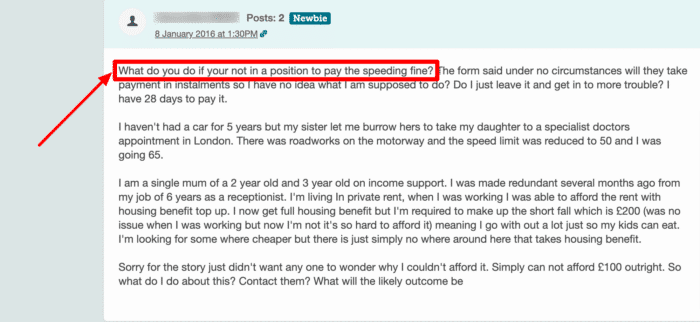
We can see here that this forum user on MoneySavingExpert cannot afford to pay her FPN, so she is looking for advice on what happens if you can’t pay a fine.
Showing your budget
Paid legal information from JustAnswer
Paid general legal information from JustAnswer.
Advertisement. MoneyNerd may receive a referral fee.
Memberships renew automatically until cancelled. Check the initial price, renewal price, billing interval and cancellation terms.
The standard service does not create a solicitor-client relationship. No successful outcome is guaranteed. JustAnswer’s membership and cancellation information.
I have ignored my Fixed Penalty Notice and have to go to court; what can I do?
Glossary of terms
FPN – Fixed Penalty Notice. An FPN or Fixed Penalty Notice is an offer to pay a fee to avoid being prosecuted in the Magistrates’ Court. They are issued to people for different types of offences, including motoring offences, environmental crimes and other minor offences in public.
NIP – Notice of Intended Prosecution. A NIP or Notice of Intended Prosecution informs a potential defendant that they may face prosecution for an offence while the incident remains fresh in their memory. The incident could be for speeding or other types of traffic violations.
PCN – Penalty Charge Notice. A PCN or Penalty Charge Notice is a type of fine from a local council or Transport for London (TfL). They are issued to motorists for different reasons, such as parking contraventions on public land or using a bus lane when not permitted.
Enforcement Officer – An Enforcement Officer or Bailiff is a person who may visit your home for debt collection if you do not pay your debts. This can happen if you ignore letters saying that bailiffs will be used. In England and Wales, the usual minimum initial notice under the rules in force from 1 May 2026 is 14 clear days, subject to the exceptions and earlier-action qualification explained above.
Before using a paid legal information service
Paid general legal information from JustAnswer.
A paid service is optional. Gather your notice and evidence, check the deadline and decide whether you need professional advice about your circumstances.
Advertisement. MoneyNerd may receive a referral fee.
Memberships renew automatically until cancelled. Check the initial price, renewal price, billing interval and cancellation terms.
The standard service does not create a solicitor-client relationship. No successful outcome is guaranteed. JustAnswer’s membership and cancellation information.
References