







Can You Move from an IVA to a DRO?








MoneyNerd introduces enquiries to The Debt Advice Service and may receive a referral fee. For free, independent guidance and help finding a debt adviser, visit MoneyHelper.
This information and enquiry service is not a full financial assessment or a guarantee of suitability or debt write-off. Debt solutions are not suitable for everyone. Fees may apply, and your credit record and assets may be affected. Get advice on your circumstances before choosing a solution.
MoneyNerd introduces enquiries to The Debt Advice Service and may receive a referral fee. For free, independent guidance and help finding a debt adviser, visit MoneyHelper.
This information and enquiry service is not a full financial assessment or a guarantee of suitability or debt write-off. Debt solutions are not suitable for everyone. Fees may apply, and your credit record and assets may be affected. Get advice on your circumstances before choosing a solution.
You cannot obtain a Debt Relief Order (DRO) while an IVA is still in force. It may be possible to apply after the IVA has formally ended, but stopping payments does not itself end the IVA or guarantee DRO eligibility. Get independent debt advice before taking that step. This guide uses the DRO rules for England and Wales.
In this easy-to-understand guide, we’ll explain:
- What an IVA is and how it works.
- What a DRO is and how it helps with debt.
- If you can change from an IVA to a DRO.
- The good and bad points of changing to a DRO.
- How to deal with debt that is too much to handle.
We understand that dealing with debt can be hard. But don’t worry, we’re here to help you.
By understanding your debt and knowing how to manage it, you will be taking steps towards a better financial future.
Eligibility comparison
Below, I’ve added an IVA and DRO comparison table.
| DRO in England and Wales | IVA |
|---|---|
| No more than £50,000 in debts counted for DRO eligibility. | No universal statutory £6,000 minimum; the proposal must be viable and acceptable to creditors. |
| Counted assets within the £2,000 limit, with a separate £4,000 vehicle limit and other exclusions. You cannot own your home. | The proposal sets out payments and treatment of assets, home equity and other contributions. |
| No more than £75 monthly spare income after reasonable household expenses. | Contributions must be affordable and may involve income, a lump sum or both. |
| Required England and Wales connection, such as living or working there within the last three years. | Available in England, Wales and Northern Ireland, with jurisdiction and terms checked by the practitioner. |
| No current bankruptcy, IVA or interim order; no DRO within the previous six years. | Requires a licensed insolvency practitioner and the necessary creditor approval. |
| Free application through an approved intermediary. | Fees apply under the approved proposal. |
Can I switch from one to the other?
There is no direct transfer. An adviser should first check whether the IVA can be made workable and whether you would meet all DRO conditions if it ends. Do not deliberately let an IVA fail without understanding the consequences.
A new DRO would normally be recorded on your credit file for six years from approval. The existing IVA history does not disappear simply because you obtain a different solution.
Ask both an independent debt adviser and your IVA supervisor about the options before deciding. If the IVA is terminated, creditors can generally resume recovery, subject to the law and any later protection you obtain.
The wrong debt solution could make your financial situation worse.
It’s a question many people ask, just take a look at this message and response posted on an online forum.
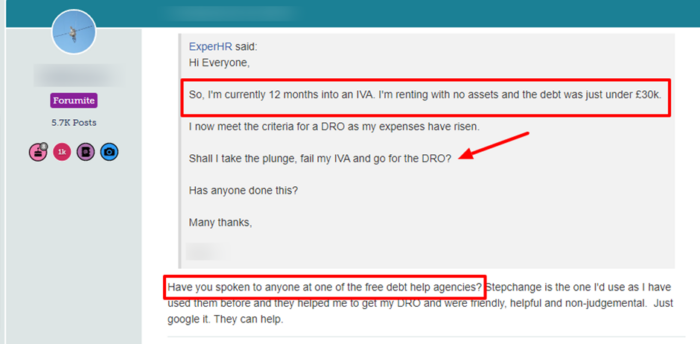
Source: Moneysavingexpert
Is switching a good idea?
Timing matters, but it is not the deciding factor on its own. Consider the current balance, fees already paid, future affordability, assets, likely changes and the terms on which the IVA could finish.
As such, when researching IVA vs DRO for debt management, you should seek professional advice first.
» TAKE ACTION NOW: Fill out the short debt form
Changing early in your agreement
If payments become unaffordable early in the IVA, request a review promptly. A payment break, reduction or formal variation may be possible under the agreement.
Do not assume a DRO is better simply because the IVA has several years left. An approved intermediary needs to check actual DRO eligibility, and the IVA must have formally ended before a DRO can be made.
IVA failure can leave you owing substantial balances because contributions may have covered fees as well as creditor payments. Ask for an up-to-date statement and explanation of termination before making a decision.
A DRO would deal only with qualifying debts under its rules. Ongoing bills and excluded liabilities remain payable, and income or asset changes must be reported during the DRO period.
Changing in the second half
Later in an IVA, ask whether it can be completed or varied based on the payments already made and your changed circumstances. There is no automatic right to stop making contributions because most of the term has passed.
Compare that possibility with the consequences of termination and a new DRO application, including a new six-year credit-file entry if a DRO is approved.
Some of your options before looking into a DRO are:
1. Reducing your payment
The supervisor’s power to reduce payments depends on your agreed terms. The 2025 IVA Protocol allows certain reductions of up to 25% without a creditor variation, subject to its conditions; some older terms use 15%. A larger or different change may require creditors’ approval. Ask which rules apply to your arrangement.
2. Finishing on a “funds paid to date” basis
Your supervisor may be able to propose successful completion based on the funds already paid, particularly where circumstances have changed and further contributions are not realistic.
This requires the necessary approval and confirmation of successful completion. It is not the same as cancelling or failing the IVA, and you should not stop payments on the assumption that it has been agreed.
Creditors assess the proposal and supporting evidence. There is no guaranteed approval rate based on how close you are to the scheduled end.
What are the downsides of a Debt Relief Order?
I’ve listed the DRO disadvantages below:
· The DRO will show on your credit history for six years, making it difficult to get credit.
You must report changes in income or assets. The DRO may be revoked if you no longer meet its conditions, which can leave the debts payable again.
· You can’t set up, promote, manage, or a limited company except with court permission during the DRO.
· You can’t act as a director for a company without court permission while the order is in place
· There are tight asset and debt restrictions on who can apply for a DRO.
What are the benefits of going with it?
A DRO may be appropriate if you qualify and cannot repay your debts. Its principal features include:
Recovery of the qualifying debts listed in the DRO is restricted during its period. This does not remove every legal risk, including possession action for rent arrears.
· It does not require court approval to proceed
You are normally released from qualifying debts at the end of the usual 12-month period, provided the order has not been revoked. Some liabilities can survive.
Payments towards listed qualifying debts are suspended. Ongoing bills and excluded debts must still be paid, and creditors may send statements and general correspondence.
How do I qualify?
There are strict DRO requirements which I’ve listed here:
· not have had a DRO in the last six years.
· be unable to pay your debts.
The debts counted for DRO eligibility must total no more than £50,000.
Counted assets must be within the £2,000 limit, subject to the applicable exclusions; you cannot own your home.
· have £75 or less spare income after your household expenses.
A separate £4,000 vehicle limit applies, with specific valuation and disability-related rules checked by the intermediary.
You must have the required connection with England or Wales, such as having lived or worked there within the previous three years. You cannot have a current IVA, bankruptcy or interim order. Northern Ireland has separate rules.
Tips for managing debt
First, work out your budget which allows you to see how much you have left every month after paying essential things. This is known as ‘available income’.
Keep a copy which you can refer to when needed. Plus, creditors will ask for a copy if you ask them to let you make lower payments.
Try to be as accurate about your budget as you can.
I suggest you deal with your most important debts first which are known as ‘priority debts’.
These are:
- Rent/mortgage
- Energy supply
- Council tax
- Court fines
These are important debts because failing to keep up with payments could have far-reaching consequences.
Next, deal with non-priority debts which include:
- Overdrafts
- Catalogue debts
- Credit card debts
- Store card debts
- Unsecured personal loans
- Payday loans
Contact your creditors to tell them you’re working on sorting out your debts. You can ask them to:
- Cease contacting you for payments until you sort things out
- Stop adding charges and interest to the debt
Consider alternatives to an IVA or DRO. For example, with the right debt management plan in place, you could see your situation improve. A debt advisor could tell you about your options.
Do you have to talk to your creditors?
An IVA supervisor or DRO intermediary can help deal with enquiries, but a debt solution does not mean all creditor contact stops. Statements and other permitted correspondence can continue. Pass demands concerning protected debts to the supervisor or adviser promptly.
Do not ignore court papers, letters about excluded debts or requests for information needed to administer the solution.
What is the impact on employment?
It depends. If your “contract of employment” states that you can’t have a DRO, then your job will be affected if you take a DRO.
DRO restrictions can affect company directorship and involvement in forming or managing a company without court permission. They are not a blanket ban on every job with “manager” or “CEO” in its title. Check the actual role and seek advice where company-management duties are involved.
What can’t you do?
During the DRO restrictions, you must disclose the DRO when obtaining credit of £500 or more, whether alone or jointly with another person. Additional restrictions apply to company involvement and trading under a different name.
Plus you can’t promote, manage or set up a limited company. You can’t be a company director either without first receiving permission from the court.
Does an advisor check your bank account?
An intermediary may request bank statements, payslips, benefit letters or other evidence to check income, expenditure and assets. The Insolvency Service can also request information. Do not assume it will never need to see statements.
What debts Cannot be included?
Certain debts can’t be written off by a Debt Relief Order. It means you’d have to keep paying them. It includes:
- Criminal fines
- Child Maintenance Service arrears or CSA
- Student loans
- Social Fund loans
- TV Licence arrears
- Court ordered damages for personal injury