





How to Get Out of a Speeding Ticket









Are you wondering how to get out of a speeding ticket? You’ve come to the right place. Each month, over 130,000 people visit our website for guidance on fines and parking tickets.
In this article, we’ll cover:
- How speeding tickets work in the UK.
- Whether you have to pay every speeding ticket.
- The legal framework around speeding fines.
- How a speeding ticket might affect your insurance.
- Ways to potentially get out of paying a speeding fine.
A group of MPs and Peers say FPNs, which can cost up to £10,000, are hard to understand and might be unfair.1 Our team has experienced these challenges as well, so we’re familiar with the concerns you may have.
With our experience, we’ll help you understand how to handle the situation.
Paid legal information from JustAnswer
JustAnswer is a paid third-party question-and-answer service providing general information. Its standard service does not create a solicitor-client relationship. Membership can renew automatically with recurring charges until cancelled. Check the initial price, renewal price and cancellation terms before signing up. Buying this service does not guarantee a successful challenge. See JustAnswer’s membership and cancellation information.
You can use the official challenge process without buying a paid service. If you choose to use JustAnswer, visit JustAnswer to read its service and payment terms.
Commercial link to JustAnswer. MoneyNerd may receive a referral fee. No successful outcome is guaranteed.
How can I avoid a fine?
To avoid paying a speeding fine, you have two options.
- Taking responsibility for the obligations and meeting them.
- If you weren’t driving at the time of the incident or weren’t speeding, you can contest the charges.
The following are examples of defences to a speeding ticket:
1. The 14-Day Exception
According to the law, the officer who pulled you over for speeding is required to post your NIP or FPN within the first 14 days after the incident occurred.
If you receive the notice with a date that is later than 14 days, the ticket may not be valid.
But it is still good if it gets there after 14 days, but it must be dated and sent on time.
Even if you had a change in vehicle ownership or were driving a company car, as long as the notice was delivered to the registered keeper within the first 14 days, the notice would be effective.
Check out the question this motorist asked when they got a Notice of Intended Prosecution late.
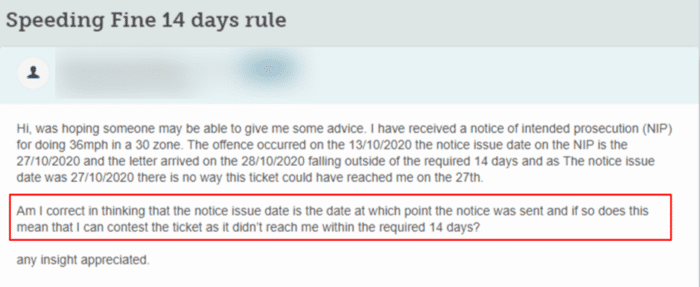
Source: Moneysavingexpert
2. You Were Not Going Over the Allowed Maximum Speed
A speeding ticket can be contested and the associated fines avoided if the driver maintains that they were driving at or below the posted speed limit.
But you have to show proof, like a speed limit sign that is hard to read or a video recording.
If you’ve been caught speeding but can prove that you were on your way to the hospital or otherwise responding to an emergency, the court may grant you leniency.
If you’re making such an argument, you’d better have proof to back it up.
» TAKE ACTION NOW: Get legal support from JustAnswer
3. You Weren’t Driving During the Incident
If your vehicle was stolen, rented, or the ownership changed, you could be exempt from the speeding fine.
All of this data is required when sending back the NIP.
If you admit guilt for someone else’s crime or refuse to reveal the identity of the driver, you could face criminal charges.
However, if you are caught speeding, you may be subject to the following penalties:
- A monetary fine between £100 and £2,500.
- A record of speeding on your record for 4–11 years.
- Increase in the cost of insurance.
- Revocation of your driver’s licence.
Disclaimer: Your punishment will be proportional to the seriousness of your offence.
Fixed Penalty Notice Appeal Reasons
I’ve put together this table to help you understand other reasons that can help you make an appeal.
If you want to learn more about the appeal process, be sure to read our specialized guide.
| Issue to check | Possible evidence | Important limit |
|---|---|---|
| The alleged offence did not occur | Contemporaneous photographs, video or reliable records. | The relevant legal elements and evidence must be assessed. |
| Valid insurance or entitlement | Policy documents or DVLA records covering the exact time and use. | Holding a document now does not prove cover or entitlement at the time. |
| A recognised statutory exemption | Evidence establishing the exact exemption, such as an applicable medical exemption. | An emergency or misunderstanding does not automatically amount to a defence. |
| Identity or vehicle details | Evidence of a mismatch, mistaken identity or cloned vehicle. | Follow the notice’s response requirements; do not invent a driver or account. |
| Signage or equipment | Photographs and reliable evidence relevant to the alleged offence. | A malfunctioning speedometer is not a general defence to speeding. Seek legal advice before contesting. |
FPNs do not use the same appeal procedure as council PCNs. Follow the notice; contesting the allegation may require a court hearing. Paper tax discs have not been required since 1 October 2014.
Check the right challenge process
A Fixed Penalty Notice does not normally use the council parking tribunal process. The notice explains how to dispute the allegation, which may require a court hearing. If convicted, the penalty and costs can be higher than the fixed penalty. Check the process and deadlines before deciding what to do.
General information. The procedure depends on the notice and jurisdiction. Check the issuer’s instructions.
Is it worth fighting?
Many drivers simply don’t know they have the option to challenge their speeding tickets.
The officer who gives you the ticket is supposed to tell you this, but many people don’t hear it because they are so shocked.
And they frequently do not ask for clarification until they have driven away.
Even those who are aware of their right to contest a speeding ticket may be uncertain as to whether or not it is worthwhile to do so.
Are there any upsides to going through with it? If you were previously hesitant to contest a speeding ticket, you can now do so without fear.
Should I Go to Court?
Should I fight my speeding ticket in court? How are you going to get the judge to dismiss your ticket?
Those are excellent questions that many people, including yourself, frequently ask. The correct response is that you could challenge a speeding ticket in court.
If I go to court and fight my speeding ticket and lose, what are the consequences?
The speeding ticket amount could increase and you’ll have to pay it. Plus you’ll have court costs to pay. On top of this, a judge might give you more penalty points than the original FPN carried.
Could I be offered a speed awareness course?
There is a chance the authorities may offer you a speed awareness course as an alternative to being fined and receiving penalty points.
However, this would not be an option if:
- You had already been on a course within three years
- The offence is deemed extremely serious
- You are a repeat offender
Legal information through JustAnswer
JustAnswer is a paid third-party question-and-answer service providing general information. Its standard service does not create a solicitor-client relationship. Membership can renew automatically with recurring charges until cancelled. Check the initial price, renewal price and cancellation terms before signing up. Buying this service does not guarantee a successful challenge. See JustAnswer’s membership and cancellation information.
Historical JustAnswer review image. The displayed rating and review total are not live. Reviews do not predict your case outcome. Membership fees and renewal terms apply.
How does it work?
If you are caught driving over the speed limit, you can be issued a ticket in one of two ways:
If a Speed Camera Catches You
If a speed camera catches you going over the speed limit, you will be issued a Notice of Intended Prosecution (NIP) and a Section 172 notice.
You will get the notices in the mail 14 days after the event.
You have a deadline of 28 days to return the section 172 notice, during which time you are required to provide information about the driver of the vehicle at the time of recording.
After sending back the section 172 notice, you will either receive a Fixed Penalty Notice (FPN) or a court summons letter.
If You Are Stopped by the Police
Depending on your speeding offence, a police officer may pull you over and issue the following.
- A verbal warning against speeding
- A Fixed Penalty Notice (FPN)
- A court order delivered by letter
You can choose to plead guilty or not guilty, and you can also submit a petition to ask the judge to throw out your speeding ticket.
The legal framework
Speeding is illegal in the UK and falls under the Road Traffic Regulation Act 1984.
Having speed limits in place helps reduce road traffic accidents and therefore, keeps people safer.
There are various speed limits in place depending on an area, road type and the sort of vehicle that uses public roads.
Will it affect my insurance?
Yes.
When you get penalty points on your licence, your insurance premium will likely go up. That said, you must inform an insurer if they ask you and when you renew a policy.
Plus the points will remain on your licence for several years which means telling a new provider about them if you change insurers.
Before using a paid legal information service
JustAnswer is a paid third-party question-and-answer service providing general information. Its standard service does not create a solicitor-client relationship. Membership can renew automatically with recurring charges until cancelled. Check the initial price, renewal price and cancellation terms before signing up. Buying this service does not guarantee a successful challenge. See JustAnswer’s membership and cancellation information.
A paid service is optional. Gather your notice and evidence, check the deadline and decide whether you need professional advice about your circumstances.
Commercial link to JustAnswer. MoneyNerd may receive a referral fee. Check all charges and cancellation terms before signing up.
References