







DWF Debt Recovery: Letters, Disputes and Court Claims








MoneyNerd introduces enquiries to The Debt Advice Service and may receive a referral fee. For free, independent guidance and help finding a debt adviser, visit MoneyHelper.
This information and enquiry service is not a full financial assessment or a guarantee of suitability or debt write-off. Debt solutions are not suitable for everyone. Fees may apply, and your credit record and assets may be affected. Get advice on your circumstances before choosing a solution.
MoneyNerd introduces enquiries to The Debt Advice Service and may receive a referral fee. For free, independent guidance and help finding a debt adviser, visit MoneyHelper.
This information and enquiry service is not a full financial assessment or a guarantee of suitability or debt write-off. Debt solutions are not suitable for everyone. Fees may apply, and your credit record and assets may be affected. Get advice on your circumstances before choosing a solution.
Getting a surprise letter from DWF Solicitors Debt Recovery can be a bit scary. You might wonder where the debt has come from or if you really have to pay it.
A debt letter can be worrying. Keep the correspondence, check the creditor and balance, and note any response deadline. Free independent debt advice is available.
In this article, we will talk about:
- How to figure out if the debt is really yours.
- What to do if DWF are not being fair.
- Ways to stop DWF from bothering you too much.
- How to set up a plan to pay back the debt.
- And even how you might not have to pay all of the debt.
If dealing with debt is affecting your wellbeing, seek support and tell the firm about any communication or accessibility needs. A debt adviser can help you decide what to do next.
Don’t worry; we’re here to help you understand how to deal with DWF Solicitors Debt Recovery.
What if you don’t believe you owe the money?
DWF is a law firm that provides debt-recovery services. If you dispute a demand, ask it to identify the creditor, explain the amount and provide the relevant evidence.
Statutory Consumer Credit Act information requests apply to particular regulated credit agreements, not every debt DWF handles. The correct request and its consequences depend on the agreement and legislation; get advice before relying on non-compliance. See related guidance.
Missing or insufficient evidence does not automatically settle or write off a debt. Raise the dispute, keep records and respond to any court claim. A finding of non-liability or an agreed release is different from a request that has not yet been answered.
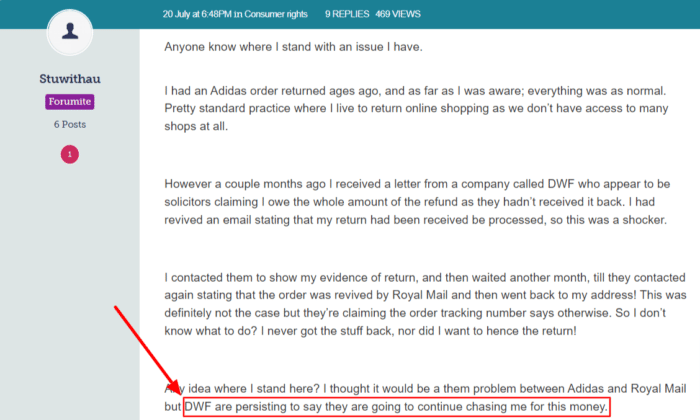
@Stuwithau on Money Saving Expert found himself being chased for money for a refund on an item he says he sent back.
This is where it pays to have as much evidence to support your claim as possible.
If you believe a debt isn’t yours, ask DWF to send you a letter proving the debt.
Debt solutions have eligibility rules, costs and consequences. Get free independent advice before deciding whether a solution that can write off included debt is suitable.
What happens if you ignore them?
We always recommend responding to debt collectors – even just to question the debt’s validity.
If you dispute the debt, explain why and ask for an itemised balance and evidence that you are liable. For recovery covered by FCA consumer-credit rules, a valid or potentially valid dispute must be investigated and recovery paused. A generic proof request does not cancel a debt, override an existing court order or extend a court deadline.
DWF may bring proceedings on a creditor’s instructions where there is a legal basis for a claim.
The creditor, or solicitors acting for it, may bring a court claim if entitled to do so. Only the court can issue a judgment. A claim form is not a CCJ: respond within its deadline, as judgment can be entered in default without a hearing. The court may award interest and recoverable costs; not every fee demanded is automatically payable.
Ask for time to obtain advice and for any appropriate interest or recovery pause, but obtain confirmation. If court papers arrive, seek advice promptly and follow the court deadline even if a request remains unanswered. See related guidance.
Typical Collection Process
Understanding the debt collection process is crucial to prevent any unwanted situations and manage your finances in the best possible way.
The table below explains the debt collector timeline and provides useful advice. If you’d like to learn more about each of the key stages, please read our specialized guide.
| Possible stage | What can happen | What to do |
|---|---|---|
| Missed payments | The creditor or collector may contact you, apply contractual charges or issue required notices. There is no single timetable for every debt. | Check the debt and contact the creditor early. Prioritise essential bills and seek free debt advice. |
| Collection activity | Letters, calls or a proposed visit may follow. A collection agent has no power to seize your belongings. | Ask for identification and evidence of the debt. You do not have to let a debt collector into your home. |
| Letter of claim | A creditor may send a formal pre-action letter before making a claim. | Follow the response deadline and get advice; do not ignore it. |
| Court claim | In England and Wales, a creditor may apply for a county court judgment. A judgment and later enforcement are separate stages. | Respond to the claim by the court deadline, whether admitting it, disputing it or asking for time to pay. Attend if the court requires a hearing. |
| Enforcement after judgment | Where legally permitted, a creditor may seek enforcement such as an attachment of earnings, charging order or warrant of control. | Get advice promptly about the specific notice, available objections and affordable payment options. |
Prepare a budget covering essential living costs and priority debts first. Propose only instalments you can afford, and obtain written acceptance and confirmation of any interest or action being paused. An offer alone does not guarantee agreement or stop a court claim.
Understand your debt options
MoneyNerd can introduce you to The Debt Advice Service for free debt advice. MoneyNerd does not provide debt advice or recommend debt solutions.
The Debt Advice Service can explain your options, including their benefits, costs and risks. Options available depend on your circumstances. There’s no obligation to take a debt solution.
MoneyNerd does not provide debt advice or recommend debt solutions. The Debt Advice Service is a trading style of Pacific Financial Solutions Limited. If you request an introduction, we’ll share your details with their team so they can contact you.
Some debt solutions have fees and may negatively affect your credit rating. MoneyNerd is a commercial introducer and may receive a fee if you go ahead with a debt solution through The Debt Advice Service.
For free, impartial money guidance and help finding free debt advice, visit MoneyHelper.
How long can they chase you?
Many ordinary unsecured debts have a six-year limitation period in England and Wales or a five-year prescription period in Scotland. The start date, debt type, relevant payments or acknowledgments and court action matter. Ask an adviser to check before paying or admitting liability, and respond to court papers on time.
The period runs under the applicable legal rules, not simply from the date a collector first writes.
For many unsecured contractual debts in England and Wales, the usual period for starting a court claim is six years from when the creditor could sue. A payment or qualifying signed written acknowledgment before expiry can restart it. A creditor’s letter alone does not restart it. Debt type, court action and jurisdiction matter; a limitation defence does not normally extinguish an England and Wales debt.
Scotland has different prescription rules: certain debts are extinguished after five years without a relevant claim or acknowledgment, subject to the applicable rules. This is not the same as the England and Wales limitation defence. Ask an adviser to check the debt type, dates and any court action. A debt with an existing judgment, council tax liability order or enforcement warrant cannot be assessed using a simple six-years-since-last-payment rule. Tax debts also have special rules. A judgment does not disappear when its six-year credit-file entry ends, although later enforcement may require court permission.
There’s a few options if you owe debt and don’t feel you have the finances to pay it back.
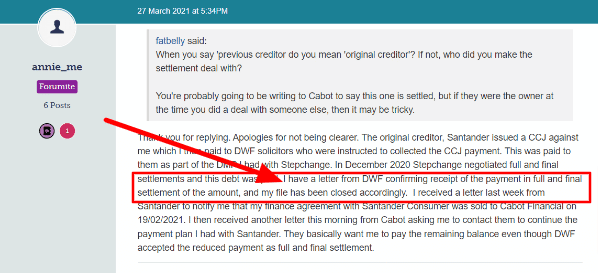
The historical forum example below describes an account involving Santander, DWF and Cabot. A solicitor handling recovery has not necessarily bought the debt; check assignment notices and the current creditor. See related guidance.
Only a court issues a CCJ. A forum poster’s description is not enough to establish that an account or judgment was settled. Obtain written settlement confirmation and check the court record if necessary. See related guidance.
Seeking help through Stepchange or MoneyHelper is a good idea. You should also keep all documentation to contest your debt.
Remember, if you are contacted by a debt collection agency, don’t ignore it.
Check if the debt is actually yours and how much you owe. Then consider which next steps work best for you and your finances. And do consider seeking help from from Step Change or Citizens advice.
» TAKE ACTION NOW: Fill out the short debt form
Is there a way to write off the debt?
If you can prove you’re experiencing financial difficulty and don’t have a viable way to repay, your creditor might agree to write off your debt.
A creditor may consider exceptional health or hardship circumstances, but age, vulnerability or a small balance does not guarantee a write-off. Provide relevant evidence and obtain any agreement in writing.
You can request a discretionary write-off with a budget and relevant supporting evidence. Continue to address deadlines while it is considered; making the request does not itself cancel liability.
Many ordinary unsecured debts have a six-year limitation period in England and Wales or a five-year prescription period in Scotland. The start date, debt type, relevant payments or acknowledgments and court action matter. Ask an adviser to check before paying or admitting liability, and respond to court papers on time.
A limitation defence must be raised if a claim is issued; do not ignore court papers. Existing judgments follow different rules and are not cancelled by the ordinary six-year summary.
Take the first step towards tackling your debt
Every day, our partner, The Debt Advice Service, helps people understand their options for dealing with debt. Their debt advice is free, with no obligation to proceed.
MoneyNerd introduces you to The Debt Advice Service. We do not provide debt advice or recommend debt solutions.

Natasha
Very helpful and informative thank you

If you submit the enquiry form, MoneyNerd will share your details with The Debt Advice Service so they can contact you.
Some debt solutions have fees and may negatively affect your credit rating. MoneyNerd may receive a fee if you go ahead with a debt solution through The Debt Advice Service.
The Debt Advice Service is a trading style of Pacific Financial Solutions Limited.
For free, impartial help and access to not-for-profit debt advice, visit MoneyHelper.
What about an IVA?
An IVA stands for an Individual Voluntary Arrangement (IVA). It’s a legally binding agreement between you and your creditors which states that you will pay back your debts to your creditors over a certain period of time to which they have agreed to.
An IVA is proposed and supervised by an insolvency practitioner and takes effect through the required creditor approval process. It does not require a new court order in every case. Fees, assets, exclusions, credit effects and the risk of failure must be considered.
Then, you’ll have to stick by the proposals presented in your arrangement throughout its entire period for it to be successful.
Only certain debts can be placed in an IVA, which is why you should always get specific advice to find out if an IVA is worth it for you.
References