







Walker Love Sheriff Officers: Your Rights in Scotland








MoneyNerd introduces enquiries to The Debt Advice Service and may receive a referral fee. For free, independent guidance and help finding a debt adviser, visit MoneyHelper.
This information and enquiry service is not a full financial assessment or a guarantee of suitability or debt write-off. Debt solutions are not suitable for everyone. Fees may apply, and your credit record and assets may be affected. Get advice on your circumstances before choosing a solution.

MoneyNerd introduces enquiries to The Debt Advice Service and may receive a referral fee. For free, independent guidance and help finding a debt adviser, visit MoneyHelper.
This information and enquiry service is not a full financial assessment or a guarantee of suitability or debt write-off. Debt solutions are not suitable for everyone. Fees may apply, and your credit record and assets may be affected. Get advice on your circumstances before choosing a solution.
Received a Walker Love letter? Walker Love provides Scottish sheriff-officer and debt-recovery services. Its powers depend on whether it is collecting informally or enforcing legal authority.
Check the creditor, balance and document, then seek Scottish debt advice if it is disputed or unaffordable.
In this article, we’ll explain:
- How to check if the debt is really yours. If it isn’t, you don’t have to pay!
- What Walker Love Debt Collectors can and can’t do.
- How to stop Walker Love from bothering you so much.
- Ways to set up a payment plan or even write off your debt.
- What happens if you can’t pay.
We understand your worries; some of us have had debt collectors chasing us too. It can be very scary, but we’ve found ways to deal with it. In this guide, we’ll share these with you.
Why are they Calling Me?
A letter or call may concern an alleged debt, but does not alone prove liability. It may also relate to existing court enforcement.
But there’s no reason to panic, as this procedure is quite normal for debt collection.
For example, if you are behind with your Business Rates payments, the local authority will apply for a summary warrant from the Sheriff’s Court.
It is, in effect, a court order detailing your outstanding debt and legally forces you to settle the debt.
Receiving these court orders can be stressful for consumers but it’s important to never simply ignore it.
A phone call is not a summary warrant. Read any formal notice and seek advice promptly about the available challenge or payment remedy.
Verifying their Request
Before doing anything, I suggest you find out more about the source of the debt.
Confirming legitimacy of Walker Love’s debt collection request should put your mind at ease.
Verify the sender independently with the creditor and official firm contact details. Matching information is useful, but does not automatically establish that the balance or enforcement is correct.
In short, always ask for proof and confirmation that the debt is yours and that the debt collection agency is not a scam but legitimate.
Is the Debt Too Old?
First, start by establishing what specifically the debt is for, and if you are in debt with the creditor.
Scotland has its own prescription rules. Many ordinary contractual debts can be extinguished after five years without a relevant claim or relevant acknowledgment, but the start date and exceptions matter. Council tax, tax debts and court decrees do not follow that ordinary five-year rule. A creditor’s letter alone does not restart the period. Get a Scottish debt adviser to check your dates and debt type before making a payment or admitting liability.
The relevant Scottish law is the Prescription and Limitation (Scotland) Act 1973, as amended. Credit-file reporting periods are separate from prescription and do not decide whether a debt is enforceable.
For an ordinary contractual debt, an adviser will need to check:
- When the obligation first became enforceable
- Whether there was a payment or legally relevant acknowledgment
- Whether a relevant court claim or decree affects the applicable period
England and Wales have different limitation rules, commonly six years for ordinary unsecured debts. Those rules should not be substituted for Scottish prescription.
Joint debts and guarantees need individual advice. Do not assume that the actions of one person have the same effect on every other person’s liability.
» TAKE ACTION NOW: Fill out the short debt form
What criteria makes a debt statute barred?
Do not use a simple five- or six-year checklist for every debt. The following factors require particular attention:
Prescription depends on the applicable law, the debt type and what happened during the relevant period.
- A relevant acknowledgment or payment can affect the ordinary five-year period before it expires.
- A decree or summary warrant requires separate enforcement and prescription checks.
- A demand letter from the creditor does not by itself interrupt prescription.
If a debt has prescribed in Scotland, the obligation is extinguished. If court or enforcement documents arrive, still respond promptly and obtain advice on raising the appropriate challenge.
Council Tax Collection
If you are behind with Council Tax bills, the council may send you a reminder to settle your overdue bill.
When you get a reminder, you will be given seven days to pay or make an arrangement to pay off the debt in instalments.
If you do not bring the instalments up to date within seven days of the reminder, the remaining annual council tax balance normally becomes due, with a further seven days to pay.
Contact the council promptly about an affordable arrangement and any discounts or reductions. Do not assume you will receive a further reminder before enforcement.
If the required council tax notices are not paid, the council can seek a summary warrant. Repeated missed instalments can lead to a final notice rather than another reminder.
If this warrant is then granted against you, the local council will submit your details to debt collectors like Walker Love.
Sheriff officers may serve the relevant documents after a summary warrant. A charge for payment will normally give 14 days before further diligence can proceed; ask an adviser to check the documents and any urgent remedy.
It’s important to note that besides the Council Tax that you need to pay, you will be liable for an additional 10% penalty as a charge for your summary warrant.
Understand your debt options
MoneyNerd can introduce you to The Debt Advice Service for free debt advice. MoneyNerd does not provide debt advice or recommend debt solutions.
The Debt Advice Service can explain your options, including their benefits, costs and risks. Options available depend on your circumstances. There’s no obligation to take a debt solution.
MoneyNerd does not provide debt advice or recommend debt solutions. The Debt Advice Service is a trading style of Pacific Financial Solutions Limited. If you request an introduction, we’ll share your details with their team so they can contact you.
Some debt solutions have fees and may negatively affect your credit rating. MoneyNerd is a commercial introducer and may receive a fee if you go ahead with a debt solution through The Debt Advice Service.
For free, impartial money guidance and help finding free debt advice, visit MoneyHelper.
Business Rates Collection
As with your unpaid Council Tax, your local authority can also apply for a summary warrant from the Sheriff’s Court for unpaid Business Rates.
Walker Love and Business Rates collection take over at this stage of the recovery process.
The enforcement options and payment remedies depend on the debt. Do not assume business-rates arrears qualify for exactly the same time-to-pay remedies as council tax.
A creditor can petition for bankruptcy in Scotland if at least £5,000 is owed and the other statutory conditions are met. Two or more creditors can combine qualifying debts to meet the threshold; bankruptcy is not automatic.
Payment Arrangements
You may be able to apply to the court for time to pay. Eligibility depends on the debt and previous applications; it is not available for every debt. A granted order protects against specified enforcement while its conditions are met. Ask a Scottish money adviser to check the correct form and any urgent deadline.
Negotiating debt repayment with Walker Love is advised and should be done as soon as possible.
You can request affordable instalments, but an informal proposal does not itself stop enforcement or guarantee acceptance.
If time to pay is granted, it restricts specified forms of enforcement while you comply. It is not an unconditional ban on every possible action.
Check with your adviser which arrestments or attachments the order prevents and whether it affects action already taken.
An inhibition concerning land or buildings has separate rules. Ask your adviser about any existing inhibition and the precise protection your order provides.
What Happens If I Am Unable To Pay?
The consequences of non-payment to Walker Love can be far-reaching and best avoided.
Where the legal requirements are met, available remedies can include the following. Some need a separate court application and are not powers arising merely because Walker Love asks for payment:
- Earnings arrestment
- Bank arrestment
- Application for an EAO
- Sequestration/bankruptcy
- Attachment of property outside your home
- Inhibition
Earning Deductions
This refers to when your employer will be instructed to deduct money from your salary to meet the repayment obligations for your debt.
An earnings arrestment requires the employer to make deductions under the statutory rules. It can end through repayment or a relevant legal remedy or debt solution.
Deductions are made by the employer from net earnings using statutory bands and a protected minimum, rather than Walker Love choosing any amount it wishes.
You will additionally be responsible for charges for fees, which will form part of these deductions.
Bank Arrestments
A bank arrestment freezes eligible funds held when it is served, subject to the protected minimum balance and other applicable restrictions.
Arrested funds are normally transferred to the creditor automatically after 14 weeks, unless a valid objection or other restriction applies. You can consent to earlier release. Regular payments may fail if insufficient accessible funds remain.
However, this means that you may fall behind on other debts during the time that the funds in your account are unavailable.
Only your available funds on the date that the bank arrestment was applied will be frozen.
For personal accounts, a protected minimum balance of £1,000 is normally left free from arrestment. This applies across accounts with the same bank, and does not apply to business accounts. Joint accounts and money from benefits need individual advice. You can ask the sheriff to release arrested funds where the legal grounds, such as undue hardship, apply.
For an earnings arrestment, the Debt Advice and Information Package must have been supplied no earlier than 12 weeks before service. This does not give you a 12-week waiting period before arrestment.
Read the package and seek advice about payment, dispute and formal protection options. Receiving it does not guarantee that an arrestment can be avoided.
One example is to apply for a time for pay order, and if it’s granted, it will prevent the earnings arrestment.
What are Attachment Orders?
An exceptional attachment order is a separate court authority concerning eligible non-essential goods inside a dwelling. Essential items and statutory protections remain.
The creditor must apply for this additional remedy; an ordinary decree or summary warrant does not automatically authorise taking household goods.
An exceptional attachment order is a separate court remedy with safeguards. It does not automatically follow a missed 14-day deadline.
The sheriff considers the required legal conditions and circumstances before granting exceptional attachment. It is not a routine consequence of missed instalments.
An exceptional attachment visit normally requires advance written notice, usually four calendar days. Restrictions apply where nobody is present or the only person present cannot properly understand what is happening.
Sequestration / Bankruptcy
For a creditor’s bankruptcy petition in Scotland, the current debt threshold is at least £5,000, and the statutory requirements for apparent insolvency and court procedure must also be met.
Sequestration changes how qualifying debts are dealt with and restricts creditor action, but excluded debts and existing rights require individual advice.
However, bankruptcy could have dire consequences for your personal credit history and may influence your employment and risk losing your assets.
The trustee administers the bankruptcy estate and any required contributions; this does not mean every aspect of your finances or every essential possession is taken.
A trustee deals with assets and contributions that fall within the bankruptcy. Essential items and other statutory exemptions apply; your home and other valuable assets may be at risk.
Attachment of My Property Not In My Home
Ordinary attachment can cover eligible movable goods outside the dwelling, subject to legal authority, procedure and exemptions.
Attached goods may later be removed and sold. Entry to outbuildings or business premises is subject to Scottish enforcement law; an ordinary collector has no such power.
However, they cannot get access to your house under these orders.
Ask to see the sheriff officer’s identification and authority. Attachment normally requires prior legal steps including an expired charge for payment and provision of debt information; obtain advice on the particular documents and any exemptions.
What’s an Inhibition?
An inhibition restricts certain dealings with land and buildings to protect the creditor’s position. It is not itself an eviction or an order to sell your home.
An inhibition restricts certain dealings with land and buildings. It is not a blanket restriction on selling every major asset; get legal advice before a property transaction.
Take the first step towards tackling your debt
Every day, our partner, The Debt Advice Service, helps people understand their options for dealing with debt. Their debt advice is free, with no obligation to proceed.
MoneyNerd introduces you to The Debt Advice Service. We do not provide debt advice or recommend debt solutions.

Natasha
Very helpful and informative thank you

If you submit the enquiry form, MoneyNerd will share your details with The Debt Advice Service so they can contact you.
Some debt solutions have fees and may negatively affect your credit rating. MoneyNerd may receive a fee if you go ahead with a debt solution through The Debt Advice Service.
The Debt Advice Service is a trading style of Pacific Financial Solutions Limited.
For free, impartial help and access to not-for-profit debt advice, visit MoneyHelper.
Consequences of Ignoring Them
It’s not a good idea to ignore Walker Love. The problem won’t go away.
The impact of not responding to Walker Love will make settling a debt much harder. Plus, the experience will get more stressful.
For Scottish debts, the relevant court judgment is generally a decree, not a County Court Judgment. A council tax summary warrant does not normally appear on your credit file, but it can still lead to enforcement and fees.
Plus, the debt may get harder to settle if there are additional court fees and charges to pay.
How Can I Lodge a Report or Complaint?
Filing a complaint against Walker Love is possible, and they can be contacted directly:
| Official website | walkerlove.com |
| Debt enquiries | 0141 212 6120; Monday–Friday 8.30am–5pm |
| Online contact | Current payment and contact options |
| Complaints address | Complaints Manager Walker Love 16 Royal Exchange Square Glasgow G1 3AB |
| Complaint procedure | Official complaint information |
Complain to the firm first and keep copies of the evidence. For sheriff-officer conduct, escalation can be to the Society of Messengers-at-Arms and Sheriff Officers or the relevant Sheriff Principal. The Financial Ombudsman Service is not the general complaints body for Scottish court enforcement. A complaint does not automatically stop enforcement.
Case study
See this message posted by a concerned Walker Love customer about payment refusals.
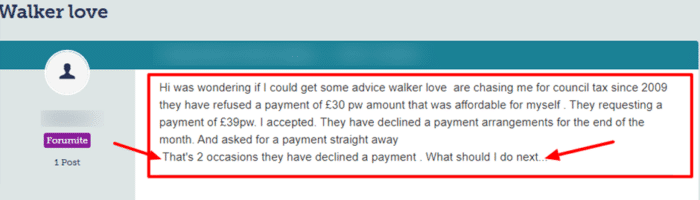
Source: Moneysavingexpert
How They Handle Vulnerable Debtors
According to Walker Love, all individuals should be treated as ‘individuals’. In short, ‘one size does not fit all’.
Tell Walker Love and the creditor about any vulnerability or support need. FCA consumer-credit rules do not automatically govern every Scottish sheriff-officer enforcement case.
- Explain how a health condition, disability or other circumstance affects your ability to understand documents, communicate or make payments.
- Ask for reasonable communication adjustments and time to obtain advice where appropriate.
- Keep a record of the request. A vulnerability or complaint does not automatically suspend lawful enforcement.
Other Debt Collectors
You should check for more outstanding debts that you may have with other companies or debt collectors. Here are four steps you could take:
- Check your credit report for other defaults
- Check your email and post for reminders or overdue notices
- Check the court records for CCJs against you
- Check your bank statements for the names of other debt collectors
There are hundreds of debt collectors in the UK and each works with different companies to collect debts.
Some debt collection businesses act for creditors; others purchase debts. Check the letter and ask who owns the debt and how the balance was calculated.
If you see a name on your bank statement that you don’t recognise then you can search MoneyNerd to see if they’re a debt collector.
References
Scottish Government: summary warrants and council tax arrears






