






Debt Info
Debt Collectors

Can Debt Collectors Contact You at Work?

Scott Nelson MoneyNerd Janine Marsh MoneyNerd
By
Scott
Scott Nelson MoneyNerd

Scott Nelson

Debt Expert

Scott founded MoneyNerd after his own experience with debt. He runs the website and oversees its general information about debt and other money matters. Scott does not provide personal debt advice or recommend debt solutions through MoneyNerd. If you make a debt enquiry, MoneyNerd may introduce you to The Debt Advice Service, which provides any personal debt advice.

Learn more about Scott
&
Janine
Janine Marsh MoneyNerd

Janine Marsh

Financial Expert

Janine contributed articles and videos to MoneyNerd about everyday money, household costs, debt topics and parking matters. She has a background in broadcasting, including work with BBC Radio 5 Live and Bauer radio stations.

Learn more about Janine
· Oct 4th, 2026
Get debt advice from The Debt Advice Service

Total amount of debt?

MoneyNerd does not provide debt advice or recommend debt solutions. We can introduce you to The Debt Advice Service, a trading style of Pacific Financial Solutions Limited. Their debt advice is free, and there is no obligation to proceed.

If you request an introduction, we’ll share your details with The Debt Advice Service so they can contact you.

Some debt solutions have fees and may negatively affect your credit rating. MoneyNerd is a commercial introducer and may receive a fee if you go ahead with a debt solution through The Debt Advice Service.

For free, impartial money guidance and help finding free debt advice, visit MoneyHelper.

MoneyNerd introduces enquiries to The Debt Advice Service and may receive a referral fee. For free, independent guidance and help finding a debt adviser, visit MoneyHelper.

This information and enquiry service is not a full financial assessment or a guarantee of suitability or debt write-off. Debt solutions are not suitable for everyone. Fees may apply, and your credit record and assets may be affected. Get advice on your circumstances before choosing a solution.

debt collectors call or come to your work

MoneyNerd introduces enquiries to The Debt Advice Service and may receive a referral fee. For free, independent guidance and help finding a debt adviser, visit MoneyHelper.

This information and enquiry service is not a full financial assessment or a guarantee of suitability or debt write-off. Debt solutions are not suitable for everyone. Fees may apply, and your credit record and assets may be affected. Get advice on your circumstances before choosing a solution.

Debt collectors must respect privacy and reasonable contact preferences. This guide explains workplace calls and visits, how to request a different contact method and what to do if the conduct is unreasonable.

In this guide, we will explain:

  • How to check if the debt is really yours.
  • The rules about debt collectors calling or visiting your work.
  • How to request reasonable contact arrangements.
  • Where to get advice about a disputed or unaffordable balance.
  • What to do if a debt collector is bothering you too much.

Keep records of calls, letters and any explanation of your working hours or vulnerability.

Could you legally write off some debt?

MoneyNerd can introduce you to The Debt Advice Service for free debt advice. MoneyNerd does not provide debt advice or recommend debt solutions.

Answer a few questions to start your enquiry. Options available depend on your circumstances.

How much debt do you have?

MoneyNerd does not provide debt advice or recommend debt solutions. We can introduce you to The Debt Advice Service, a trading style of Pacific Financial Solutions Limited. Their debt advice is free, and there is no obligation to proceed.

If you request an introduction, we’ll share your details with The Debt Advice Service so they can contact you.

Some debt solutions have fees and may negatively affect your credit rating. MoneyNerd is a commercial introducer and may receive a fee if you go ahead with a debt solution through The Debt Advice Service.

For free, impartial money guidance and help finding free debt advice, visit MoneyHelper.

Can Debt Collectors Come to Your Work?

For recovery covered by FCA consumer-credit rules, a firm must not visit you at work without prior agreement. It must also avoid inappropriate disclosure of the debt to others; authorised representatives and other lawful communications are different. See related guidance.

If an unagreed workplace visit or inappropriate disclosure occurs, record the details and complain through the firm’s procedure.

Can Debt Collectors Call You at Work?

But can debt collectors call you while you are at work to discuss the debt and any repayments? The answer to this is a little more complex. Debt collectors can call you on your mobile to discuss the debt, and if you happen to be at work when they call, this is not an offence. After all, they genuinely might not know you are at work.

A workplace call must be handled appropriately, including protecting your privacy. The firm should consider reasonable requests about when and how to contact you.

Explain if your employer prohibits personal calls, a shared line creates a privacy risk or contact at work causes difficulty. Give a reasonable alternative route.

» TAKE ACTION NOW: Fill out the short debt form

How to Stop Them From Calling?

Ask for a reasonable contact method and explain any vulnerability. The firm should consider your circumstances, but a preference or debt solution does not automatically prevent every necessary legal notice or communication. See related guidance.

Contact frequency must be reasonable. Repeated or excessive calls may amount to harassment or breach applicable rules, but there is no universal rule that any second call is unlawful.

Can They Call at Any Time?

UK FCA rules do not impose a universal 8am–9pm calling window. Contact should be at reasonable times, take account of your circumstances and respect reasonable requests about when, where and how it is made.

How About Old Debts?

Many ordinary unsecured debts may become statute-barred after six years in England and Wales, or prescribed after five years in Scotland. The start date, debt type, payments, legally relevant acknowledgments and any court claim all matter. A creditor’s letter alone does not restart the period. Ask a debt adviser to check the facts before paying or admitting liability, and respond to any court papers on time.

For ordinary simple-contract debts in England and Wales, limitation generally restricts the court remedy rather than cancelling the debt. Scottish prescription can extinguish the obligation.

Keep in mind that not all debts become statute-barred!

Tax debts and judgments have different rules. A CCJ does not automatically expire after six years, although some later enforcement steps need court permission.

If your debt is statute-barred, you can use my free letter template to write to your debt collectors and explain the situation.

If you are unsure about the status of your debt, you can contact a debt charity for some advice. Their advisors will be able to look at the debt in question, determine its status, and advise you on your next steps.

Understand your debt options

MoneyNerd can introduce you to The Debt Advice Service for free debt advice. MoneyNerd does not provide debt advice or recommend debt solutions.

The Debt Advice Service can explain your options, including their benefits, costs and risks. Options available depend on your circumstances. There’s no obligation to take a debt solution.

Get Started

MoneyNerd does not provide debt advice or recommend debt solutions. The Debt Advice Service is a trading style of Pacific Financial Solutions Limited. If you request an introduction, we’ll share your details with their team so they can contact you.

Some debt solutions have fees and may negatively affect your credit rating. MoneyNerd is a commercial introducer and may receive a fee if you go ahead with a debt solution through The Debt Advice Service.

For free, impartial money guidance and help finding free debt advice, visit MoneyHelper.

How Do I Verify Debt Collectors?

If you have received debt letters from a debt collector but aren’t sure if they’re legit, what do you do?

From my experience, the best thing to do is ask for proof that the debt is yours. I have a free ‘prove it’ letter template that you can use to help you write to the debt collector and request evidence that you are liable for the debt that they are chasing.

Explain a dispute and request an itemised balance and evidence of liability. A valid or potentially valid dispute within FCA consumer-credit rules must be investigated with recovery paused, but a generic evidence request does not cancel a debt, override a court order or extend a court deadline.
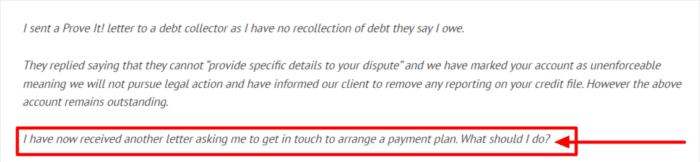
Do not infer from a forum example that later letters can be ignored. Keep evidence of any dispute and respond promptly to genuine court papers or enforcement notices.

Prompt engagement may help resolve a dispute or arrangement, but does not guarantee that charges or proceedings stop. Added charges require an applicable legal or contractual basis.

What to Do If a Debt Collector Is Harassing You

If you are being harassed at your place of work or over the phone by a debt collector, there is a three-step process to deal with it.

The first step is to collect as much evidence as possible that your debt collector is harassing you. There are many ways to collect evidence, including but not limited to:

  • Call logs
  • Photographs
  • Statements from colleagues or your boss
  • Your communications asking them to stop

Set out the conduct, dates and evidence in a complaint and explain the outcome you want. You do not need to wait until an arbitrary amount of evidence has accumulated.

The firm should handle the complaint under the applicable rules. There is no general requirement to give a final response within three business days or individually notify the FCA of every complaint; eligible Ombudsman escalation is normally available after a final response or eight weeks.

What If They Still Harass You?

If you think that your debt collector has been unreasonable or behaved inappropriately, you can make a complaint. You can also make a complaint if you feel that they have broken any of the Financial Conduct Authority’s (FCA) guidelines.

Make your first complaint to the debt collector’s company or agency so that they have the chance to sort out the issue themselves. If you feel that they have not taken your complaint seriously enough or have not addressed your issue properly, you can escalate matters.

Complain to the business first. If the activity falls within the Financial Ombudsman Service’s remit, you can normally escalate after a final response or eight weeks without one, usually within six months of the final response. The Ombudsman can require redress, such as compensation or correcting records; it does not fine firms or remove their authorisation.

The Difference Between Debt Agencies and Enforcement Agents

Distinguish an ordinary collection business from an enforcement agent acting under a warrant or writ. Police powers are a separate matter. See related guidance.

An ordinary collector may request payment and a voluntary visit, but has no power to force entry, seize goods or deduct wages itself.

FCA consumer-credit rules restrict workplace visits without prior agreement. A home visit is not automatically unlawful, but an ordinary collector must not misrepresent its powers or refuse a reasonable request to leave.

A bailiff needs separate lawful enforcement authority and must follow the applicable rules. A CCJ can be entered by default without a hearing, so do not assume you will always be invited to a court date before judgment.

Take the first step towards tackling your debt

Every day, our partner, The Debt Advice Service, helps people understand their options for dealing with debt. Their debt advice is free, with no obligation to proceed.

MoneyNerd introduces you to The Debt Advice Service. We do not provide debt advice or recommend debt solutions.

Natasha

Very helpful and informative thank you

Get started

If you submit the enquiry form, MoneyNerd will share your details with The Debt Advice Service so they can contact you.

Some debt solutions have fees and may negatively affect your credit rating. MoneyNerd may receive a fee if you go ahead with a debt solution through The Debt Advice Service.

The Debt Advice Service is a trading style of Pacific Financial Solutions Limited.

For free, impartial help and access to not-for-profit debt advice, visit MoneyHelper.

Staying On Top Of Your Debts

A letter may come from the original creditor, a debt purchaser or a separate collection agency. Check the business name and contact details against reliable records, and ask it to explain who owns the debt and its authority to collect. Keep earlier correspondence so you can trace any change of owner or representative.

  • Robinson Way will sometimes contact you under the name Hoist Finance. 
  • Cabot Financial Group recently bought Wescot Credit Services
  • Credit Style communicate as both Credit Style and CST Law. 
  • Lowell Financial also owns Overdales and collects debts under both names. 
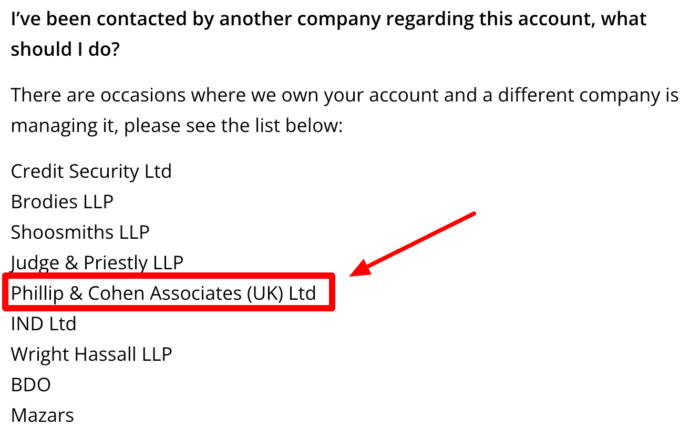
PRA Group

debt collector names

Know Your Rights When Dealing with Debt Collectors

If you are dealing with a debt collection company or just struggling to manage your money, I recommend speaking to a debt charity.

There are several charities and organisations in the UK that offer free debt counselling services and free financial advice. Their advisors will be able to walk you through your options and find the best solution for you.


Could you legally write off some debt?

MoneyNerd can introduce you to The Debt Advice Service for free debt advice. MoneyNerd does not provide debt advice or recommend debt solutions.

Answer a few questions to start your enquiry. Options available depend on your circumstances.

How much debt do you have?

MoneyNerd does not provide debt advice or recommend debt solutions. We can introduce you to The Debt Advice Service, a trading style of Pacific Financial Solutions Limited. Their debt advice is free, and there is no obligation to proceed.

If you request an introduction, we’ll share your details with The Debt Advice Service so they can contact you.

Some debt solutions have fees and may negatively affect your credit rating. MoneyNerd is a commercial introducer and may receive a fee if you go ahead with a debt solution through The Debt Advice Service.

For free, impartial money guidance and help finding free debt advice, visit MoneyHelper.

Did you like this article?
Show your support ❤️
We're glad you liked the article! As a small team, your support means everything to us. If you could rate us on Google, it would be amazing. Thank you!
We are so sorry...

Is there something missing? We’re all ears and eager to improve. Send us a message and let us know how we can make our article more useful for you.

You can email us directly at [email protected] to share your feedback.

The authors
Scott Nelson MoneyNerd
Author
Scott founded MoneyNerd after his own experience with debt. He runs the website and oversees its general information about debt and other money matters. Scott does not provide personal debt advice or recommend debt solutions through MoneyNerd. If you make a debt enquiry, MoneyNerd may introduce you to The Debt Advice Service, which provides any personal debt advice.
Janine Marsh MoneyNerd
Debt Expert
Janine contributed articles and videos to MoneyNerd about everyday money, household costs, debt topics and parking matters. She has a background in broadcasting, including work with BBC Radio 5 Live and Bauer radio stations.








