How Long Can a Parking Debt Be Pursued?


An old parking demand needs checking, but age alone does not establish that it is unenforceable. Identify the notice type, jurisdiction and whether a court or enforcement order already exists.
In this article, we will share easy-to-understand information on:
- If you must pay a parking ticket.
- The time limit to receive a parking ticket.
- The difference between a parking charge notice and a penalty charge notice.
- How to challenge a parking ticket.
- The difference between notice deadlines, limitation and enforcement.
In England and Wales, a simple contractual parking claim generally has a six-year limitation period from when the cause of action accrued. Acknowledgment, part-payment, proceedings or an existing judgment can affect the position. This is not a universal six-year write-off for every parking notice, and Scotland has different prescription rules.
Not sure what to write in your parking appeal?
You don’t need to start with a blank page.
We’ve created a free parking ticket appeal letter template that gives you a clear structure to follow.]
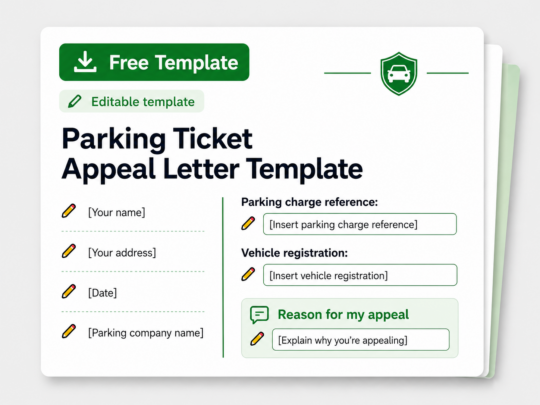
Free editable parking appeal letter template from MoneyNerd.
Is there a time limit to receive a parking ticket?
For keeper liability under Schedule 4 of the Protection of Freedoms Act 2012 in England and Wales, a notice without an earlier notice to driver normally must be delivered within 14 days after the parking period. If a compliant notice to driver was first given, the keeper notice normally must be delivered on days 29–56 after that notice. Other conditions also apply. Council postal PCNs and Notices to Owner have separate time limits and statutory exceptions. There is no universal six-month service rule for every private notice.
When you get a parking ticket through the post, please don’t ignore it. Even when you think it may be from a private company. In my experience, it is worth finding out if the ticket is yours and whether you should challenge it!
What is the difference between a parking charge notice and a penalty charge notice?
Private companies issue parking charge notices (PCNs). When you park on private land, say a supermarket car park, you effectively enter into a contract with the owner, and so there should be signs clearly stating the ‘rules‘ and that the land is private.
Check the applicable industry code and site terms. A departure grace period can apply after a permitted parking period, but there is no unconditional ten-minute right to park in breach of any restriction. Consideration time on arrival and departure grace are different.
Parking on private land and receiving a parking charge notice is not a criminal offence!
A penalty charge notice is given to motorists who have committed a traffic violation or a car park violation, and it is issued by local authorities. Most councils enforce PCNs under the Traffic Management Act 2004. Civil enforcement officers (traffic wardens) give PCNs to people who commit parking offences according to UK parking legislation.
Receiving a PCN, however, is not considered a criminal offence. You cannot go to prison for obtaining one.
Is a parking fine a fixed penalty notice?
A fixed penalty notice (FPN) can be issued by the police, a local council, or the Driver and Vehicle Standards Agency (DVSA). The major difference between the A PCN and an FPN is that a PCN is issued for civil offences while an FPN covers criminal offences. FPNs are missed as an alternative to prosecution in court.
FPNs can be issued on-the-spot or through the post. If you get an FPN, don’t ignore it!
How can a parking charge notice be enforced?
A valid private parking debt can be owed before a court judgment. Check the parking terms, evidence, amount and whether the person pursued is legally liable. The driver, keeper or owner rules differ by notice and jurisdiction; not owning the vehicle does not automatically answer every liability question.
Depending on the circumstances, you must decide whether you want to go through the appeal process or pay the PCN. If you choose to appeal, you must have solid grounds for doing so.
When you don’t pay in full and you don’t appeal against the notice, an operator could:
- Chase you for the payment
- Send your details to a debt collection agency
- Seek added charges, which must have a lawful and recoverable basis rather than merely being described as reasonable.
- Take you to County Court (civil action) where you could receive a County Court Judgement (CCJ)
You only have a limited time to respond when you receive a claims form. Therefore, I suggest you seek advice as soon as possible if things have gone this far.
A court claim requires a response using the court procedure. A warrant is a later enforcement step requiring the appropriate judgment and authority, not an automatic result of issuing a claim.
I recommend you do one of the following:
- Agree you owe the money and make a monthly repayment offer using the court forms
- Disagree and use the court forms to put in your defence. However, if you lose, be prepared to have extra costs added to the amount you owe!
In England and Wales, a judgment paid in full within one month can normally be removed from the register. Payment later can mark it satisfied, but it usually remains for six years from judgment. If unpaid as ordered, permitted enforcement may be requested.
What’s Included in the Free Appeal Template
A clear structure
The template gives you a simple framework for putting your parking appeal together, so you don’t have to work out what to write from scratch.
Free parking appeal letter template from MoneyNerd.
Can bailiffs contact me for an unpaid parking ticket?
For a council PCN, an Order for Recovery and the applicable response period normally precede a warrant. A private-parking judgment uses a different enforcement procedure; do not apply one sequence to both.
Under the amended England and Wales rules from 1 May 2026, the normal minimum enforcement notice is 14 clear days, or 28 in qualifying regulated debt-adviser cases, subject to exceptions and transitions. This is separate from the earlier PCN and court response deadlines.
A witness statement or statutory declaration is only available on specified truthful grounds. An out-of-time application requires the relevant extra form and reasons for lateness; check with TEC and the enforcement company whether enforcement is suspended in your actual case.
Eligible people in England and Wales can access statutory Breathing Space through an authorised debt adviser. Standard protection lasts up to 60 days for included qualifying debts; it is not obtained simply by asking a collector and does not cancel liability. Eligibility, exclusions and ongoing obligations apply.
Can you challenge a court order?
The available challenge depends on whether you have a council-PCN Order for Recovery, a private-parking judgment or another order. Use the appropriate grounds and procedure, not a generic parking appeal.
Some council-PCN schemes permit a witness statement or statutory declaration on specified grounds. Check the exact wording on the correct form, which may concern:
- Not receiving the Notice to Owner or other specified statutory notice, rather than merely losing the original ticket.
- Making formal representations in time but not receiving a response.
- Appealing to the adjudicator in time but not receiving the required response.
- You already paid the ticket
TE9 is used for a witness statement in certain schemes; other notices use a statutory declaration and different forms. A late filing may also need an out-of-time application. Do not tick a ground unless it is true, and do not use these forms as a general merits appeal.
» TAKE ACTION NOW: Get legal support from JustAnswer
How to challenge a parking fine
Use the stated challenge route and deadline. Payment normally closes an ordinary parking appeal, although specific statutory procedures, such as some removal cases, differ.
How to appeal a Penalty Charge Notice
An informal challenge to a windscreen PCN is normally possible before the Notice to Owner. Formal representations then follow the deadline on that notice, commonly 28 days from service. They are not universally restricted to days 29–56 after the original ticket.
When making an appeal, you need to give the reason why you think the ticket was wrongfully issued, and strong evidence to back your parking ticket appeal.
The 56-day response rule applies to certain formal parking representations, not every informal challenge, bus-lane or moving-traffic scheme. Keep proof and check the rule governing your specific notice. Use a template only after adapting it to that procedure.
Feel more confident before you send your appeal
Writing a parking appeal can be difficult when you’re not sure what to include or how to structure it.
Our free template gives you a clear starting point, helping you:
- Set out what happened clearly
- Explain why you’re disputing the charge
- Include the important details
- Avoid starting from a blank page
Simply adapt the template to your own circumstances before sending it.
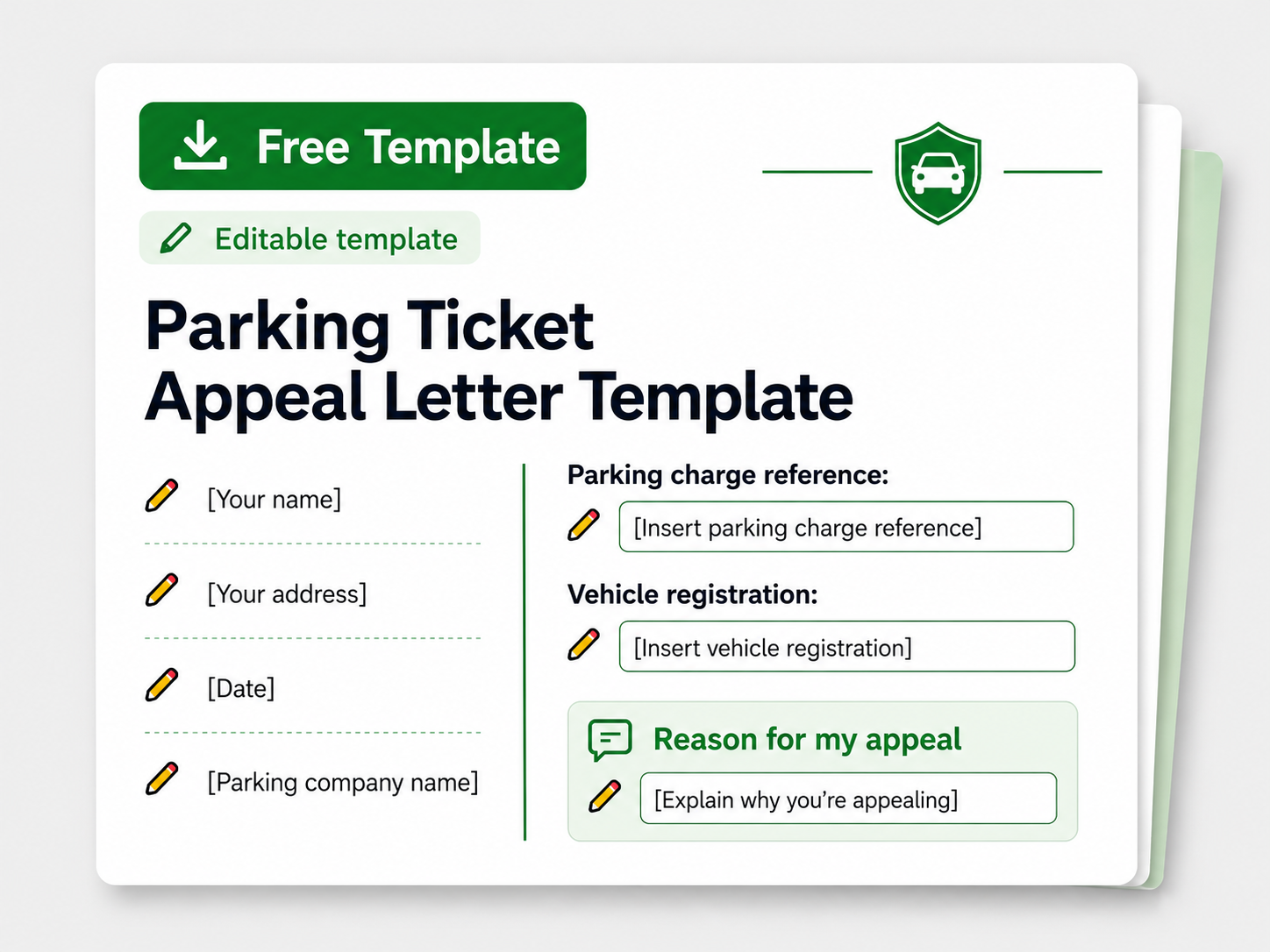
Free parking appeal letter template from MoneyNerd.
How to appeal a privately-issued ticket
The process for appealing private parking fines differ depending on the issuer. In general, you will need to write a letter stating the reason why you think the Parking Charge Notice should be cancelled, and you should have supporting evidence. The letter and your evidence for appeal should be submitted via post or uploaded to the online portal on the issuer’s website.
You usually have 28 days within receiving the ticket to make an appeal. To understand the appeal process better, please take a look at the following table.
| When | Action |
|---|---|
| On receiving a council PCN | Read the notice, keep it, gather evidence and note all payment and challenge deadlines. |
| Windscreen or handed-to-driver PCN | An informal challenge may be available before the Notice to Owner. Early challenge can preserve a discount under the authority’s policy; 14 days is not a universal final appeal deadline. |
| Postal PCN or Notice to Owner | Normally make formal representations within 28 days as stated on the notice. Do not assume there is an extra informal stage. |
| Representations rejected | The Notice of Rejection explains how to appeal to the appropriate independent tribunal, normally within 28 days. |
| Appeal unsuccessful | Pay by the deadline given in the decision or obtain advice on any available review. Further statutory charges can follow if you do neither. |
| Other ticket type | Private parking charges and FPNs use different procedures; follow the actual notice. |
Further guidance: Traffic Penalty Tribunal; Citizens Advice.

If your appeal is rejected, you should either pay the fine or you can then escalate the matter to an independent group. As you can see, this MoneySavingExpert forum user escalated their appeal to the IAS (Independent Appeals Service) and got their ticket dropped.
Private parking charge limits
The government’s 2022 code was withdrawn and did not establish a universal £50 statutory cap. Applicable trade-association rules commonly set a £100 ceiling, with conditions or exceptions. Check the current notice, code and legal basis rather than relying on a promised automatic reduction.
Ready to appeal your parking ticket?
Don’t start with a blank page.
Get our free parking ticket appeal letter template and use it as the starting point for your response.
Add the details of your parking charge, explain why you’re appealing and adapt the wording to your circumstances.
We’ll send the template straight to your email.
Free parking appeal letter template from MoneyNerd.
References