







Wescot Debt Letters: Check the Account and Your Options








MoneyNerd introduces enquiries to The Debt Advice Service and may receive a referral fee. For free, independent guidance and help finding a debt adviser, visit MoneyHelper.
This information and enquiry service is not a full financial assessment or a guarantee of suitability or debt write-off. Debt solutions are not suitable for everyone. Fees may apply, and your credit record and assets may be affected. Get advice on your circumstances before choosing a solution.
MoneyNerd introduces enquiries to The Debt Advice Service and may receive a referral fee. For free, independent guidance and help finding a debt adviser, visit MoneyHelper.
This information and enquiry service is not a full financial assessment or a guarantee of suitability or debt write-off. Debt solutions are not suitable for everyone. Fees may apply, and your credit record and assets may be affected. Get advice on your circumstances before choosing a solution.
Have you received a letter from Wescot Credit Services Debt Collectors? Are you feeling confused about the debt and wondering if you should pay it?
A debt letter can be worrying. Keep the correspondence, check the creditor and balance, and note any response deadline. Free independent debt advice is available.
In this article, we’ll help you understand:
- Who Wescot Credit Services are.
- How to check if the debt they claim is truly yours.
- The steps to deal with Wescot if you can’t afford to pay.
- Your rights when dealing with Wescot and other debt collectors.
- Options for paying the debt, including ways to possibly write off some of it.
If dealing with debt is affecting your wellbeing, seek support and tell the firm about any communication or accessibility needs. A debt adviser can help you decide what to do next.
Don’t worry! We’re here to help you navigate this issue and find the best solution for you.
Why Is Wescot Calling?
Keep in mind that Wescot will sometimes make mistakes! Take this comment from a financial advice forum:
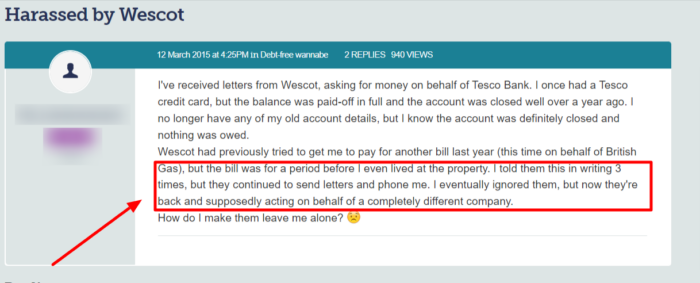
This forum account describes a disputed demand. It does not establish what happened or prove misconduct; check your own records and explain any discrepancy to the firm.
While this was probably just an error on their part, it is very important that you keep good records of your finances. Being able to quickly share evidence that they have the wrong person is the easiest way to get them off your back if they have made a mistake!
Typical Debt Collection Process
As mentioned above, Wescot will call or send letters if you’ve missed a payment. This is quite common, as it’s part of the debt collection process.
We’ve put together this table that will help you better understand the debt collector timeline. If you’d like to learn more about this process, be sure to check out our specialized guide.
| Possible stage | What can happen | What to do |
|---|---|---|
| Missed payments | The creditor or collector may contact you, apply contractual charges or issue required notices. There is no single timetable for every debt. | Check the debt and contact the creditor early. Prioritise essential bills and seek free debt advice. |
| Collection activity | Letters, calls or a proposed visit may follow. A collection agent has no power to seize your belongings. | Ask for identification and evidence of the debt. You do not have to let a debt collector into your home. |
| Letter of claim | A creditor may send a formal pre-action letter before making a claim. | Follow the response deadline and get advice; do not ignore it. |
| Court claim | In England and Wales, a creditor may apply for a county court judgment. A judgment and later enforcement are separate stages. | Respond to the claim by the court deadline, whether admitting it, disputing it or asking for time to pay. Attend if the court requires a hearing. |
| Enforcement after judgment | Where legally permitted, a creditor may seek enforcement such as an attachment of earnings, charging order or warrant of control. | Get advice promptly about the specific notice, available objections and affordable payment options. |
How to Dispute a Wescot Debt
Understand your debt options
MoneyNerd can introduce you to The Debt Advice Service for free debt advice. MoneyNerd does not provide debt advice or recommend debt solutions.
The Debt Advice Service can explain your options, including their benefits, costs and risks. Options available depend on your circumstances. There’s no obligation to take a debt solution.
MoneyNerd does not provide debt advice or recommend debt solutions. The Debt Advice Service is a trading style of Pacific Financial Solutions Limited. If you request an introduction, we’ll share your details with their team so they can contact you.
Some debt solutions have fees and may negatively affect your credit rating. MoneyNerd is a commercial introducer and may receive a fee if you go ahead with a debt solution through The Debt Advice Service.
For free, impartial money guidance and help finding free debt advice, visit MoneyHelper.
What Happens if You Ignore Wescot?
If you dispute the debt, explain why and ask for an itemised balance and evidence that you are liable. For recovery covered by FCA consumer-credit rules, a valid or potentially valid dispute must be investigated and recovery paused. A generic proof request does not cancel a debt, override an existing court order or extend a court deadline.
Keep a record of any conduct you consider misleading, threatening or excessive. A lawful warning of possible court action is different from pretending to have powers the firm does not possess. A complaint should identify the actual words, dates and evidence. See related guidance.
Can You Write Off the Debt?
For many unsecured contractual debts in England and Wales, the usual period for starting a court claim is six years from when the creditor could sue. A payment or qualifying signed written acknowledgment before expiry can restart it. A creditor’s letter alone does not restart it. Debt type, court action and jurisdiction matter; a limitation defence does not normally extinguish an England and Wales debt.
Scotland has different prescription rules: certain debts are extinguished after five years without a relevant claim or acknowledgment, subject to the applicable rules. This is not the same as the England and Wales limitation defence. Ask an adviser to check the debt type, dates and any court action.
Even if your debt is younger, you may be able to write off some of it. Keep in mind that this is not guaranteed and will depend on your personal circumstances.
You will need to do some research to make sure you find the best option for you!
Individual Voluntary Arrangement (IVA)
An IVA is a formal insolvency arrangement with creditors. It can include agreed payments or other contributions and binds creditors covered by the arrangement once approved. Fees, effects on assets and credit, and the risk of failure need to be considered with an authorised insolvency practitioner.
If you take out an IVA, you will have some obligations.
- You must make all of the payments that you have agreed to
- Follow the borrowing restrictions in your IVA terms and obtain your supervisor’s permission where required; not every form of new credit is absolutely prohibited.
- Report changes in income, assets and circumstances as required by the IVA terms and your supervisor.
Once approved, the IVA binds the creditors and debts covered by it. For those included debts:
- Recovery must follow the IVA terms; required notices and other permitted correspondence may still be sent.
- Interest and charges are dealt with under the approved arrangement. Excluded debts and ongoing bills remain payable.
There is no universal statutory requirement to owe several thousand pounds or have more than one creditor. Suitability depends on the debts, available income or assets, alternatives and the provider’s criteria.
Debt Settlement Offer
A creditor may consider a reduced full-and-final settlement, but does not have to accept it. Obtain written confirmation that the agreed payment settles the account and releases the remaining balance before paying. Do not use money needed for essential living costs or priority debts. See related guidance.
Budget for essential living costs and priority debts first, such as rent or mortgage arrears, council tax and energy arrears. Only then consider using spare money for higher-interest non-priority debts while keeping required payments on other accounts. The highest interest rate does not always identify the most urgent debt.
Explain the source and availability of any lump sum honestly. Do not describe funds as available only for a limited time unless that is true.
A settlement can be declined. Ask how an accepted partial settlement will be reported to credit reference agencies; it does not normally remove an existing default.
Debt Relief Order
In England and Wales, a Debt Relief Order may be available if qualifying debts are no more than £50,000, spare monthly income is no more than £75, assets are no more than £2,000 and any qualifying vehicle is worth no more than £4,000. Other conditions apply, including not owning your home. An approved adviser must assess eligibility. See Debt Relief Order guide.
During the usual 12-month DRO period, recovery of listed qualifying debts is restricted and you generally do not pay those debts. Ongoing bills and excluded debts still need attention. Creditors may send statements and other permitted correspondence.
Included debts are normally discharged at the end of the DRO period if the order remains in force. Changes in circumstances must be reported and can affect the order; excluded debts are not written off.
There is no application fee for a DRO in England and Wales. An approved debt adviser must check eligibility and submit the application.
DROs do not discharge every debt. Exclusions include child maintenance, criminal court fines and student loans; get advice about your full list of debts. See related guidance.
Bankruptcy
Bankruptcy is a formal insolvency option with eligibility rules and serious consequences for assets, housing, credit and sometimes employment. It does not cover every debt. Get independent advice on all available options before applying.
In England and Wales, discharge from bankruptcy is normally after 12 months, but asset administration and income payments can continue longer. Excluded debts remain payable.
Bankruptcy can affect a home, assets, credit and some jobs. Compare its costs and consequences with other options through independent advice. See related guidance.
Feeling overwhelmed?
Don’t hesitate to contact someone for help!
There are several charities and organisations that offer financial counselling, debt advice, and even tips to negotiate with your creditors.
The following organisations can help:
- TDAS enquiry service: check the commercial service and referral disclosures. Free independent debt advice is also available from the organisations listed below.
- StepChange
- National Debtline
- Citizens Advice
» TAKE ACTION NOW: Fill out the short debt form
Has Wescot Debt Collectors Behaved Like This?
Aggressive Callers
Frequent Calling
Wearing You Down
Breaking Privacy Laws
Pretending to Be More than Debt Collectors
How Can You Contact Wescot Debt Collection?
Thousands have already tackled their debt
Every day, our partner, The Debt Advice Service, helps people understand their options for dealing with debt. Their debt advice is free, with no obligation to proceed.
MoneyNerd introduces you to The Debt Advice Service. We do not provide debt advice or recommend debt solutions.

Natasha
Very helpful and informative thank you

If you submit the enquiry form, MoneyNerd will share your details with The Debt Advice Service so they can contact you.
Some debt solutions have fees and may negatively affect your credit rating. MoneyNerd may receive a fee if you go ahead with a debt solution through The Debt Advice Service.
The Debt Advice Service is a trading style of Pacific Financial Solutions Limited.
For free, impartial help and access to not-for-profit debt advice, visit MoneyHelper.
Checking for Other Debt Collectors
There are a lot of ways to get into debt. In fact, it’s not uncommon to owe money to several companies at once.
Perhaps you have a mortgage, a car loan, a couple credit cards and an item or two you bought on buy-now-pay-later schemes. It’s easy to lose track.
That’s why it’s important to regularly check your credit report and bank statements to make sure you haven’t missed anything.
A sold debt may appear under a new creditor name on your credit report, but not every debt or collector is reported to every credit reference agency.
Some of the debt collectors you’re most likely to come across are PRA Group, Lowell and Cabot Financial.
References






